







Question: Examining Force and Acceleration Objective Examine and confirm Newton's 2: Law of Motion Examine the force of friction for a frictionless system Equipment Computer with
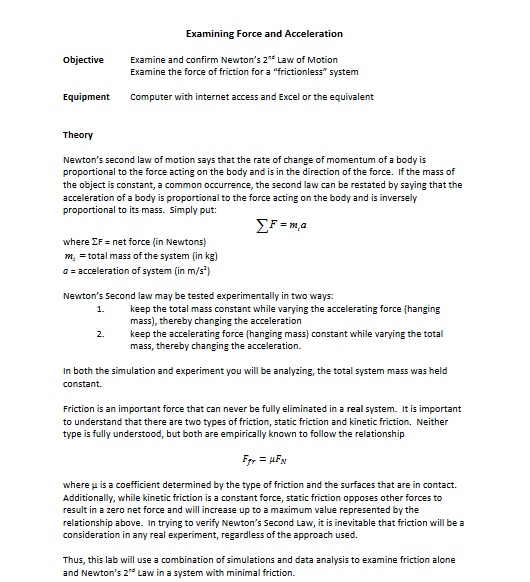
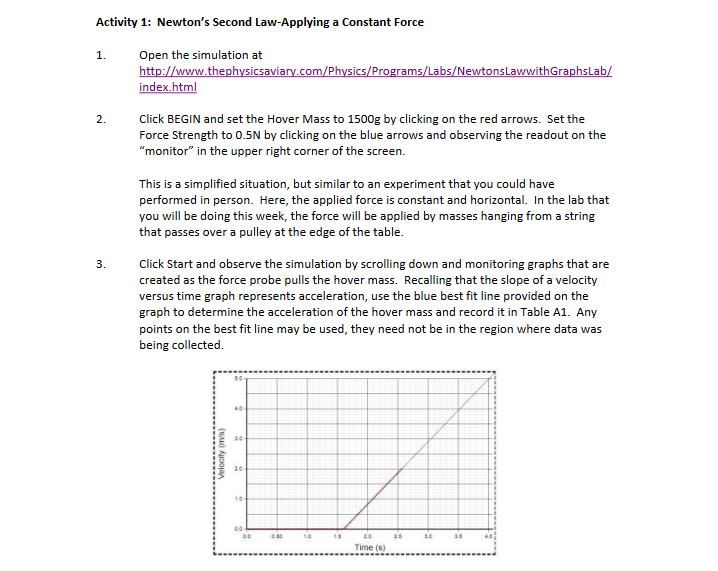
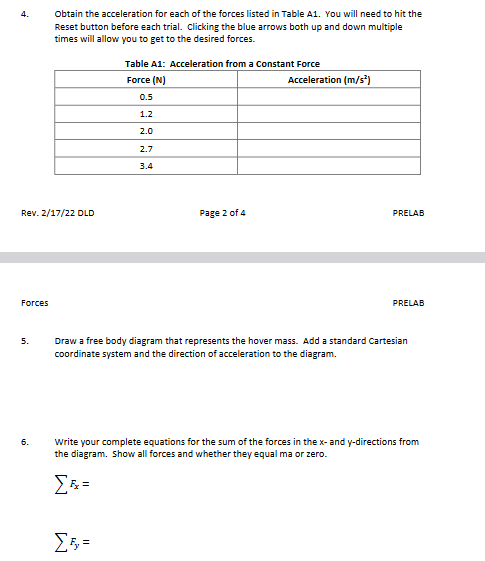
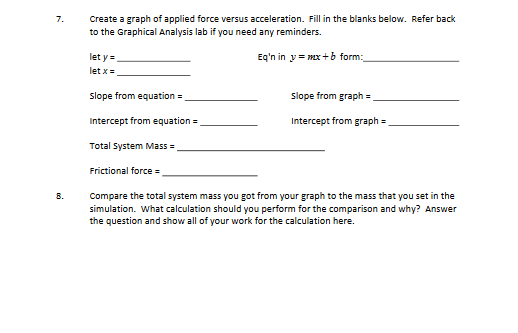
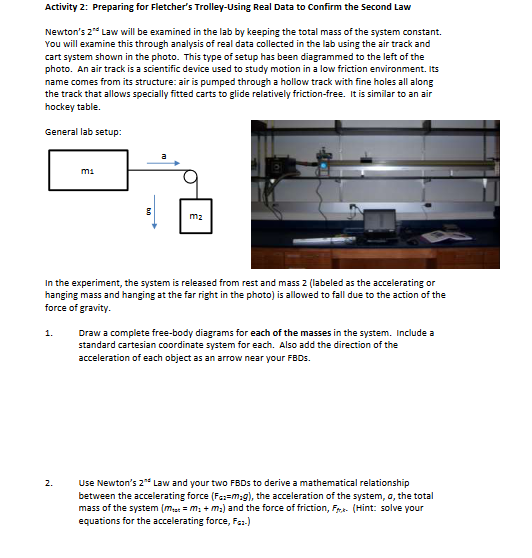
Examining Force and Acceleration Objective Examine and confirm Newton's 2": Law of Motion Examine the force of friction for a "frictionless" system Equipment Computer with internet access and Excel or the equivalent Theory Newton's second law of motion says that the rate of change of momentum of a body is proportional to the force acting on the body and is in the direction of the force. If the mass of the object is constant, a common occurrence, the second law can be restated by saying that the acceleration of a body is proportional to the force acting on the body and is inversely proportional to its mass. Simply put: EF = ma where EF = net force (in Newtons] Im, = total mass of the system (in ke) = acceleration of system (in m/s*] Newton's Second law may be tested experimentally in two ways: 1. keep the total mass constant while varying the accelerating force (hanging mass), thereby changing the acceleration keep the accelerating force (hanging mass) constant while varying the total mass, thereby changing the acceleration. In both the simulation and experiment you will be analyzing, the total system mass was held constant. Friction is an important force that can never be fully eliminated in a real system. It is important to understand that there are two types of friction, static friction and kinetic friction. Neither type is fully understood, but both are empirically known to follow the relationship Fry = AFN where u is a coefficient determined by the type of friction and the surfaces that are in contact. Additionally, while kinetic friction is a constant force, static friction opposes other forces to result in a zero net force and will increase up to a maximum value represented by the relationship above. In trying to verify Newton's Second Law, it is inevitable that friction will be a consideration in any real experiment, regardless of the approach used. Thus, this lab will use a combination of simulations and data analysis to examine friction alone and Newton's 2": Law in a system with minimal friction.Activity 1: Newton's Second Law-Applying a Constant Force 1. Open the simulation at http://www.thephysicsaviary.com/Physics/Programs/Labs/NewtonsLawwithGraphsLab/ index.html 2. Click BEGIN and set the Hover Mass to 1500g by clicking on the red arrows. Set the Force Strength to 0.5N by clicking on the blue arrows and observing the readout on the "monitor" in the upper right corner of the screen. This is a simplified situation, but similar to an experiment that you could have performed in person. Here, the applied force is constant and horizontal. In the lab that you will be doing this week, the force will be applied by masses hanging from a string that passes over a pulley at the edge of the table. 3. Click Start and observe the simulation by scrolling down and monitoring graphs that are created as the force probe pulls the hover mass. Recalling that the slope of a velocity versus time graph represents acceleration, use the blue best fit line provided on the graph to determine the acceleration of the hover mass and record it in Table Al. Any points on the best fit line may be used, they need not be in the region where data was being collected. Velocity Im's) 1.8 Time (5)4. Obtain the acceleration for each of the forces listed in Table A1. You will need to hit the Reset button before each trial. Clicking the blue arrows both up and down multiple times will allow you to get to the desired forces. Table A1: Acceleration from a Constant Force Force (N) Acceleration (m/s]) 0.5 1.2 2.0 2.7 3.4 Rev. 2/17/22 OLD Page 2 of 4 PRELAB Forces PRELAB 5. Draw a free body diagram that represents the hover mass. Add a standard Cartesian coordinate system and the direction of acceleration to the diagram. Write your complete equations for the sum of the forces in the x- and y-directions from the diagram. Show all forces and whether they equal ma or zero. Fx =7. Create a graph of applied force versus acceleration. Fill in the blanks below. Refer back to the Graphical Analysis lab if you need any reminders. let y = Eg'n in y = mx +b form: let x = Slope from equation = Slope from graph = Intercept from equation = Intercept from graph = Total System Mass = Frictional force = E. Compare the total system mass you got from your graph to the mass that you set in the simulation. What calculation should you perform for the comparison and why? Answer the question and show all of your work for the calculation here.Activity 2: Preparing for Fletcher's Trolley-Using Real Data to Confirm the Second Law Newton's 2" Law will be examined in the lab by keeping the total mass of the system constant. You will examine this through analysis of real data collected in the lab using the air track and cart system shown in the photo. This type of setup has been diagrammed to the left of the photo. An air track is a scientific device used to study motion in a low friction environment. Its name comes from its structure: air is pumped through a hollow track with fine holes all along the track that allows specially fitted carts to glide relatively friction-free. It is similar to an air hockey table. General lab setup: a m: mz In the experiment, the system is released from rest and mass 2 (labeled as the accelerating or hanging mass and hanging at the far right in the photo) is allowed to fall due to the action of the force of gravity. 1 . Draw a complete free-body diagrams for each of the masses in the system. Include a standard cartesian coordinate system for each. Also add the direction of the acceleration of each object as an arrow near your FBDS. 2. Use Newton's 2" Law and your two FBDs to derive a mathematical relationship between the accelerating force (For=mig), the acceleration of the system, o, the total mass of the system (m.ce = ma + ma) and the force of friction, Foe. (Hint: solve your equations for the accelerating force, Fes-)
Step by Step Solution
There are 3 Steps involved in it

Get step-by-step solutions from verified subject matter experts
 Study Help