







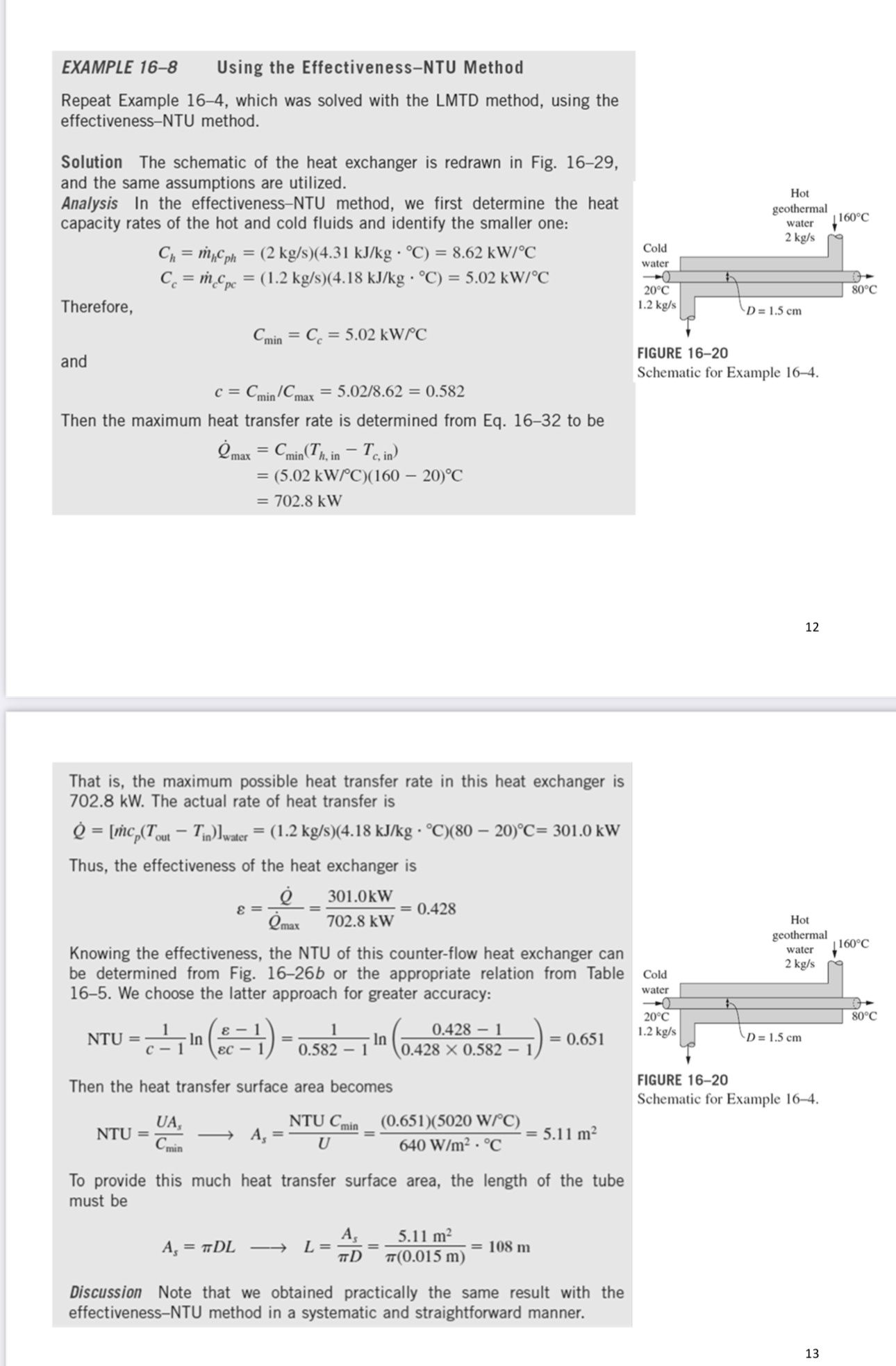
Question: EXAMPLE 1 6 - 8 Using the Effectiveness - NTU Method Repeat Example 1 6 - 4 , which was solved with the LMTD method,
EXAMPLE Using the EffectivenessNTU Method
Repeat Example which was solved with the LMTD method, using the
effectivenessNTU method.
Solution The schematic of the heat exchanger is redrawn in Fig.
and the same assumptions are utilized.
Analysis In the effectivenessNTU method, we first determine the heat
capacity rates of the hot and cold fluids and identify the smaller one:
Therefore,
and
Then the maximum heat transfer rate is determined from Eq to be
That is the maximum possible heat transfer rate in this heat exchanger is
kW The actual rate of heat transfer is
Thus, the effectiveness of the heat exchanger is
Knowing the effectiveness, the NTU of this counterflow heat exchanger can
be determined from Fig. or the appropriate relation from Table
We choose the latter approach for greater accuracy:
NTU
Then the heat transfer surface area becomes
NTU
To provide this much heat transfer surface area, the length of the tube
must be
longrightarrow,
Discussion Note that we obtained practically the same result with the
effectivenessNTU method in a systematic and straightforward manner. I want the solution by chart not equations
Step by Step Solution
There are 3 Steps involved in it
1 Expert Approved Answer
Step: 1 Unlock

Question Has Been Solved by an Expert!
Get step-by-step solutions from verified subject matter experts
Step: 2 Unlock
Step: 3 Unlock
 Study Help