







Question: Example #1: Using variables and physical constants only- a. Derive an expression for mechanical power (P) in terms of some force F, mass m, and
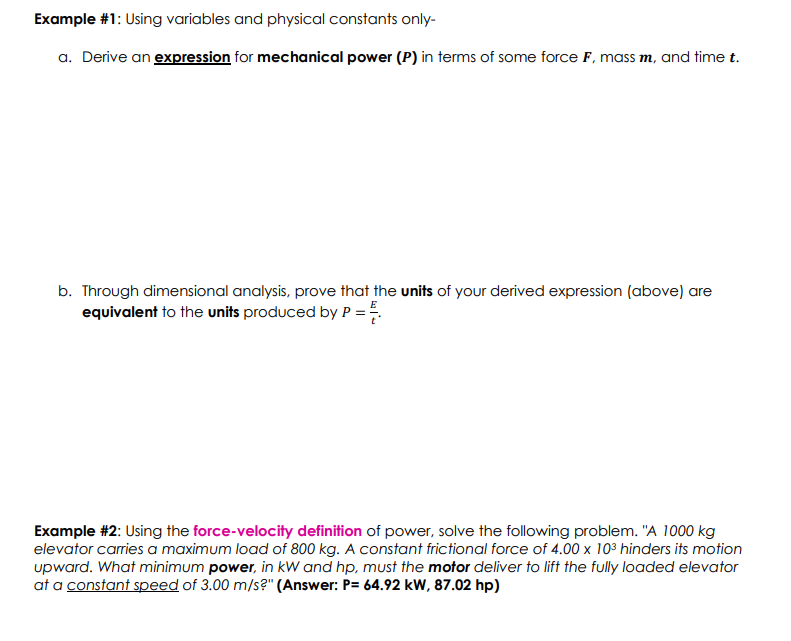
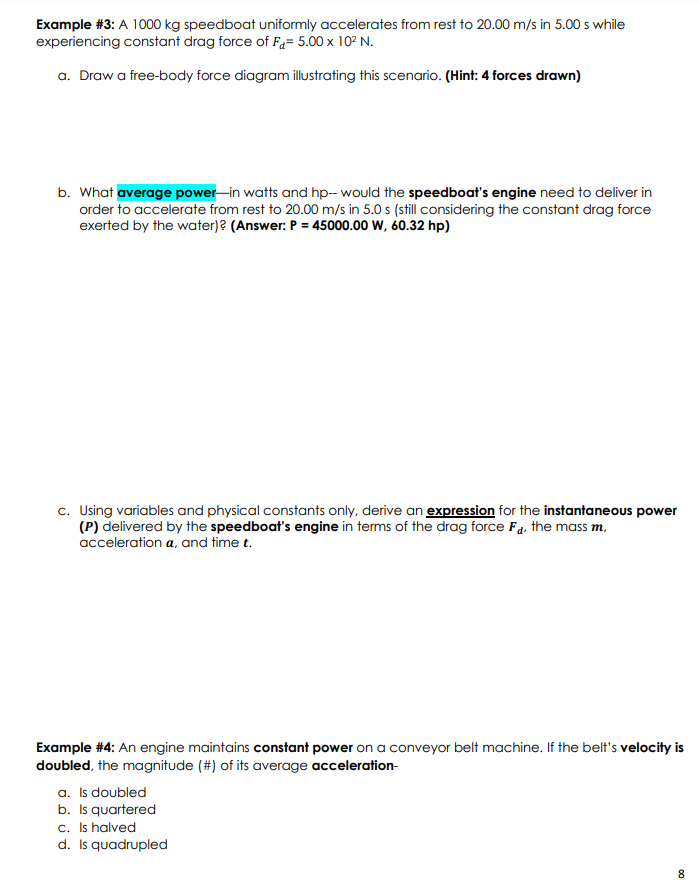
Example #1: Using variables and physical constants only- a. Derive an expression for mechanical power (P) in terms of some force F, mass m, and time t. b. Through dimensional analysis, prove that the units of your derived expression (above) are equivalent to the units produced by P = =. Example #2: Using the force-velocity definition of power, solve the following problem. "A 1000 kg elevator carries a maximum load of 800 kg. A constant frictional force of 4.00 x 10³ hinders its motion upward. What minimum power, in KW and hp, must the motor deliver to lift the fully loaded elevator at a constant speed of 3.00 m/s?" (Answer: P= 64.92 kW, 87.02 hp)Example #3: A 1000 kg speedboat uniformly accelerates from rest to 20.00 m/s in 5.00 s while experiencing constant drag force of Fa= 5.00 x 10² N. a. Draw a free-body force diagram illustrating this scenario. (Hint: 4 forces drawn) b. What average power-in watts and hp-- would the speedboat's engine need to deliver in order to accelerate from rest to 20.00 m/s in 5.0 s (still considering the constant drag force exerted by the water)? (Answer: P = 45000.00 W, 60.32 hp) c. Using variables and physical constants only, derive an expression for the instantaneous power (P) delivered by the speedboat's engine in terms of the drag force Fa. the mass m. acceleration a, and time t. Example #4: An engine maintains constant power on a conveyor belt machine. If the belt's velocity is doubled, the magnitude (#) of its average acceleration- a. Is doubled b. Is quartered C. Is halved d. Is quadrupled
Step by Step Solution
There are 3 Steps involved in it

Get step-by-step solutions from verified subject matter experts
 Study Help