







Question: Example 2 : An Activated Sludge Process The activated sludge process, a two step process, is one of the most commonly used means of biological
Example : An Activated Sludge Process
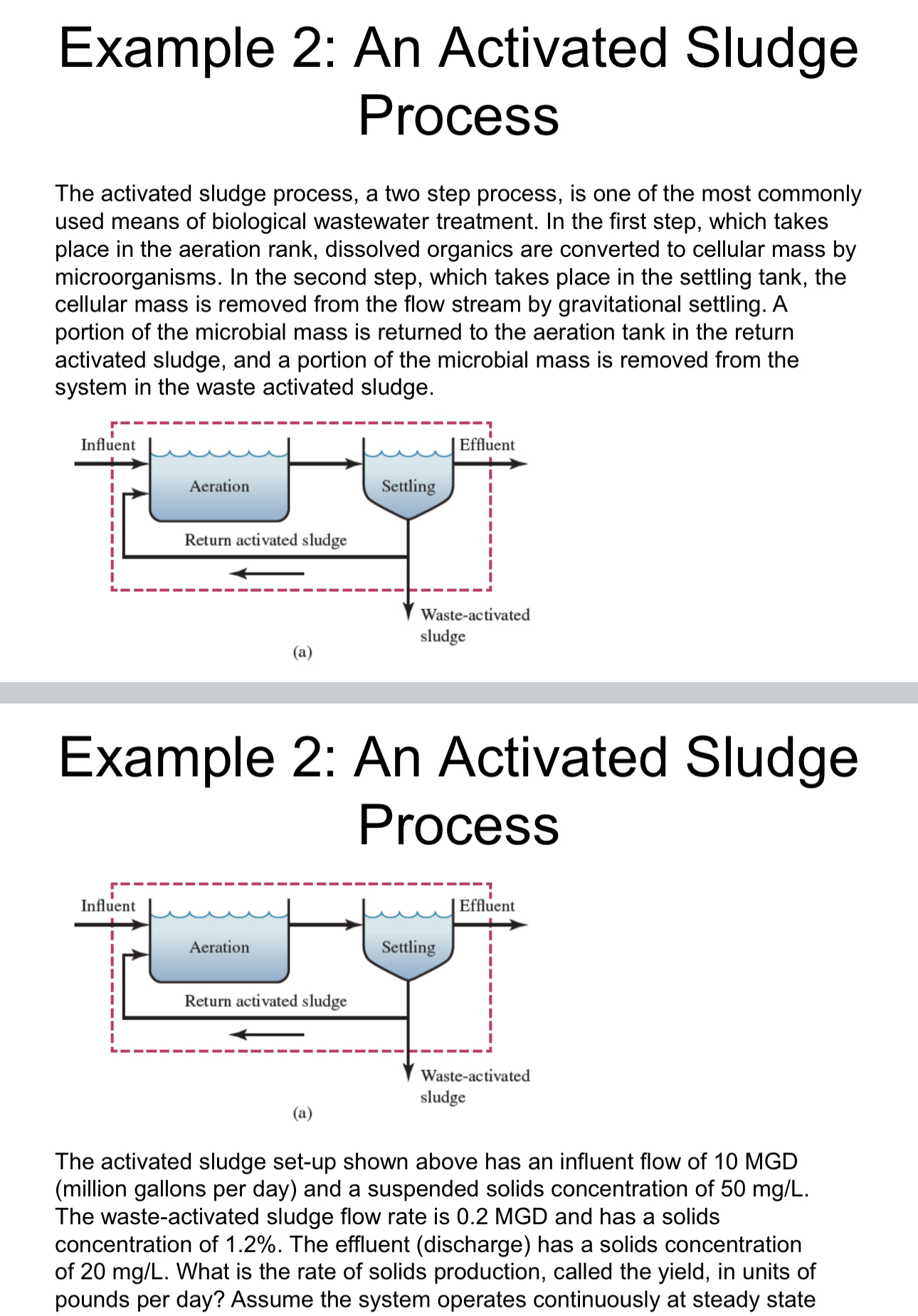
The activated sludge process, a two step process, is one of the most commonly used means of biological wastewater treatment. In the first step, which takes place in the aeration rank, dissolved organics are converted to cellular mass by microorganisms. In the second step, which takes place in the settling tank, the cellular mass is removed from the flow stream by gravitational settling. A portion of the microbial mass is returned to the aeration tank in the return activated sludge, and a portion of the microbial mass is removed from the system in the waste activated sludge.
Example : An Activated Sludge Process
The activated sludge setup shown above has an influent flow of MGD million gallons per day and a suspended solids concentration of The wasteactivated sludge flow rate is MGD and has a solids concentration of The effluent discharge has a solids concentration of What is the rate of solids production, called the yield, in units of pounds per day? Assume the system operates continuously at steady state
Step by Step Solution
There are 3 Steps involved in it
1 Expert Approved Answer
Step: 1 Unlock

Question Has Been Solved by an Expert!
Get step-by-step solutions from verified subject matter experts
Step: 2 Unlock
Step: 3 Unlock
 Study Help