







Question: Example 3: (a) ) A spherical beach ball is being pumped so that its volume is increasing at a rate of 120 cubic centimeters per
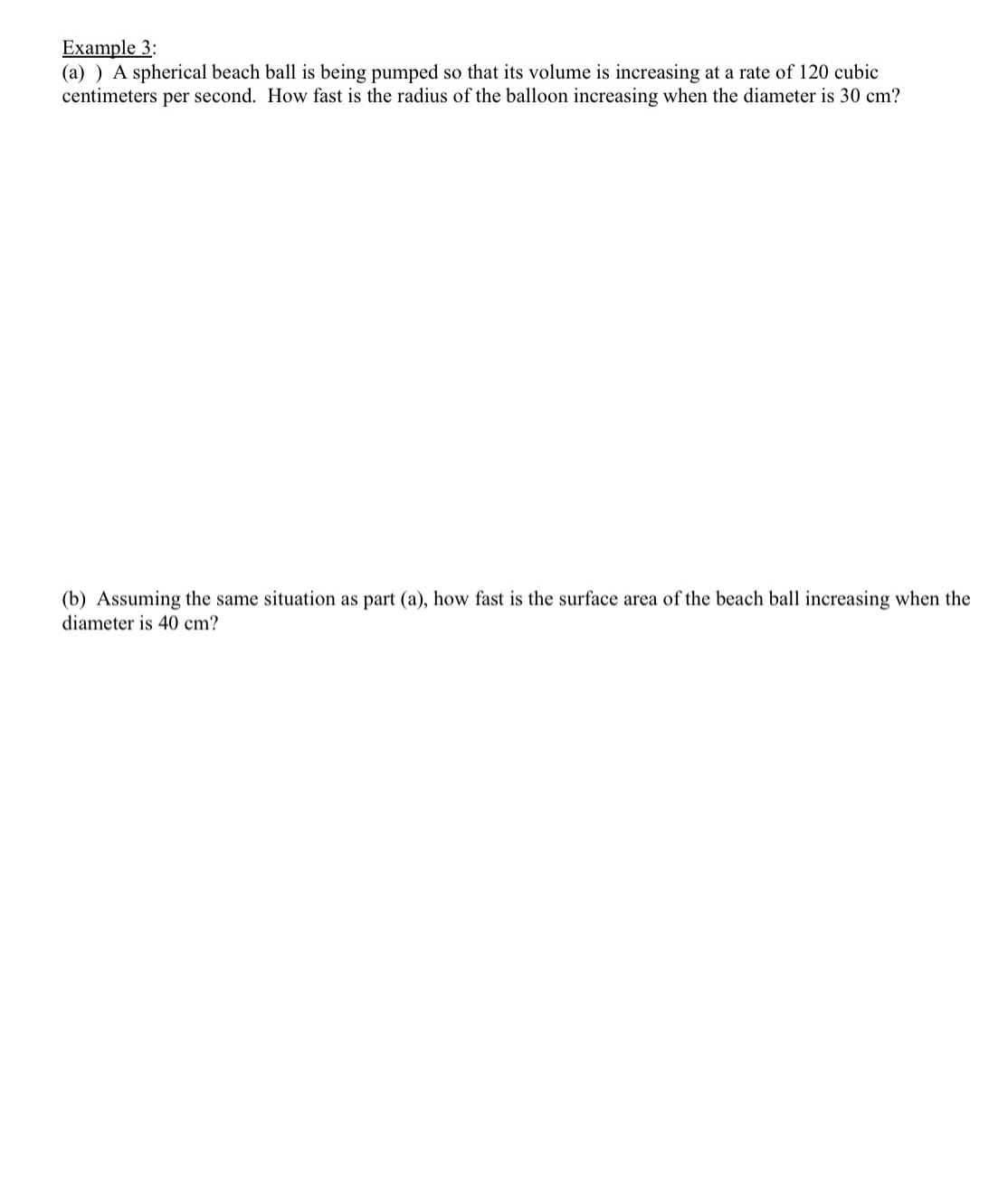
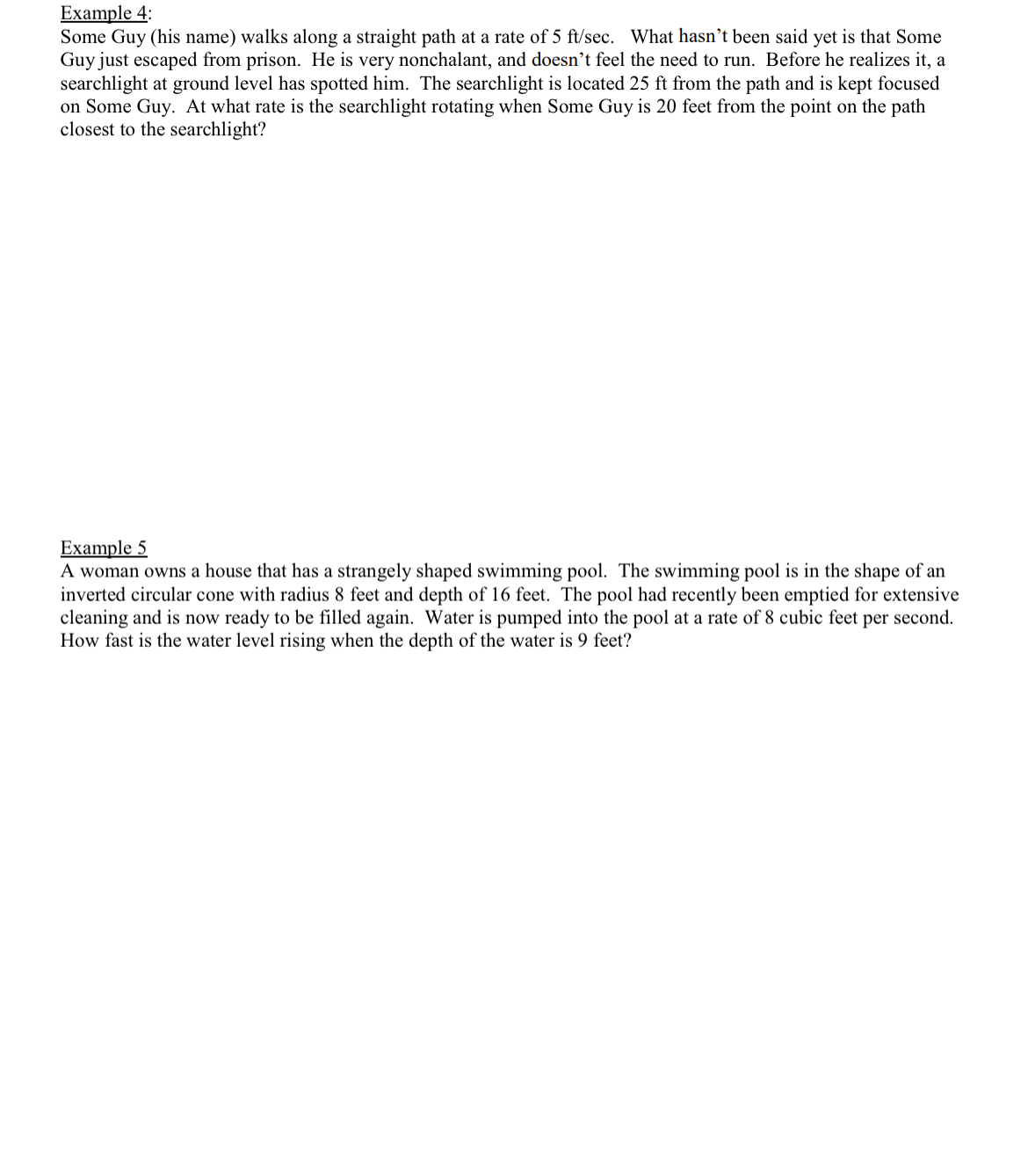
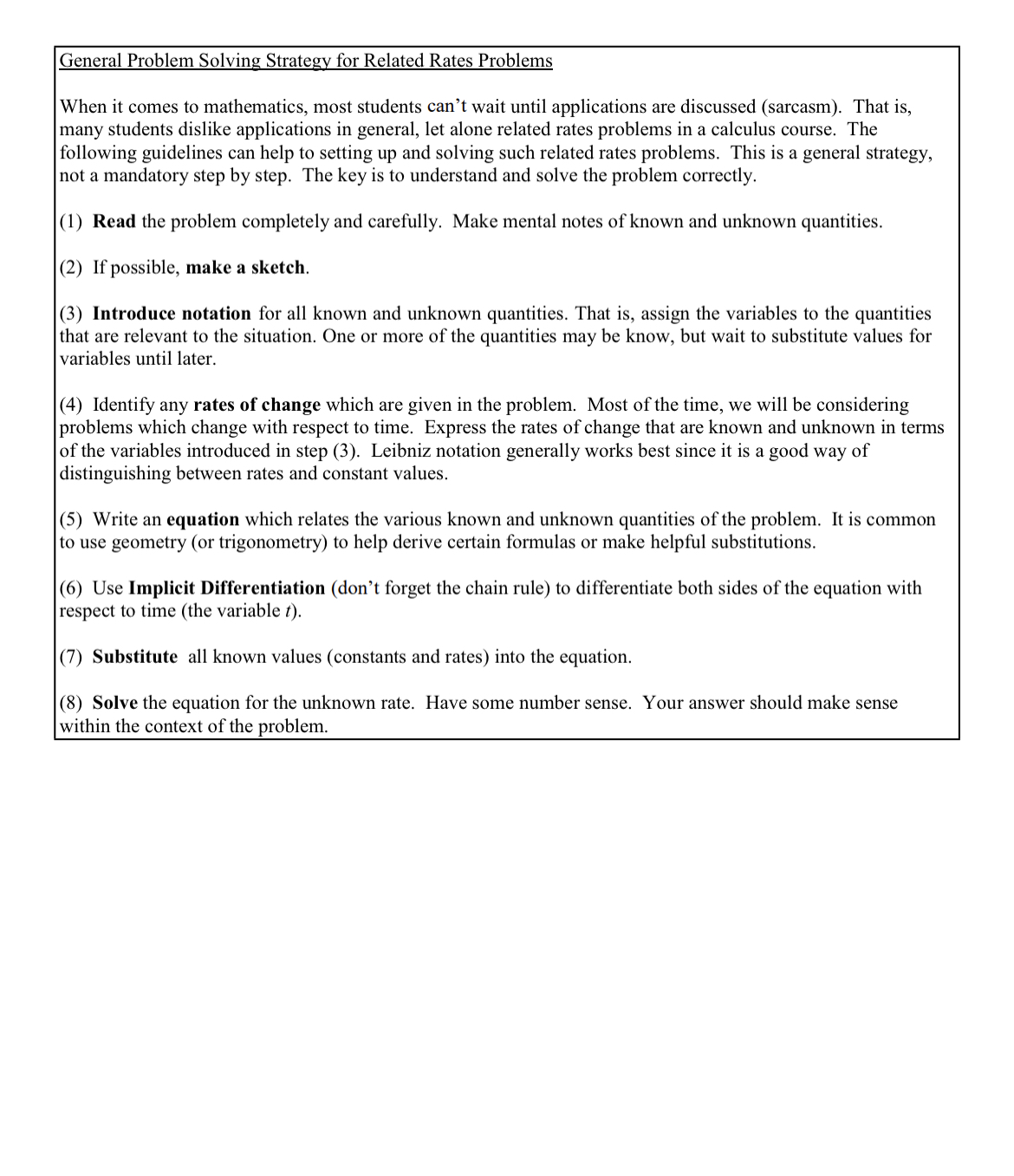
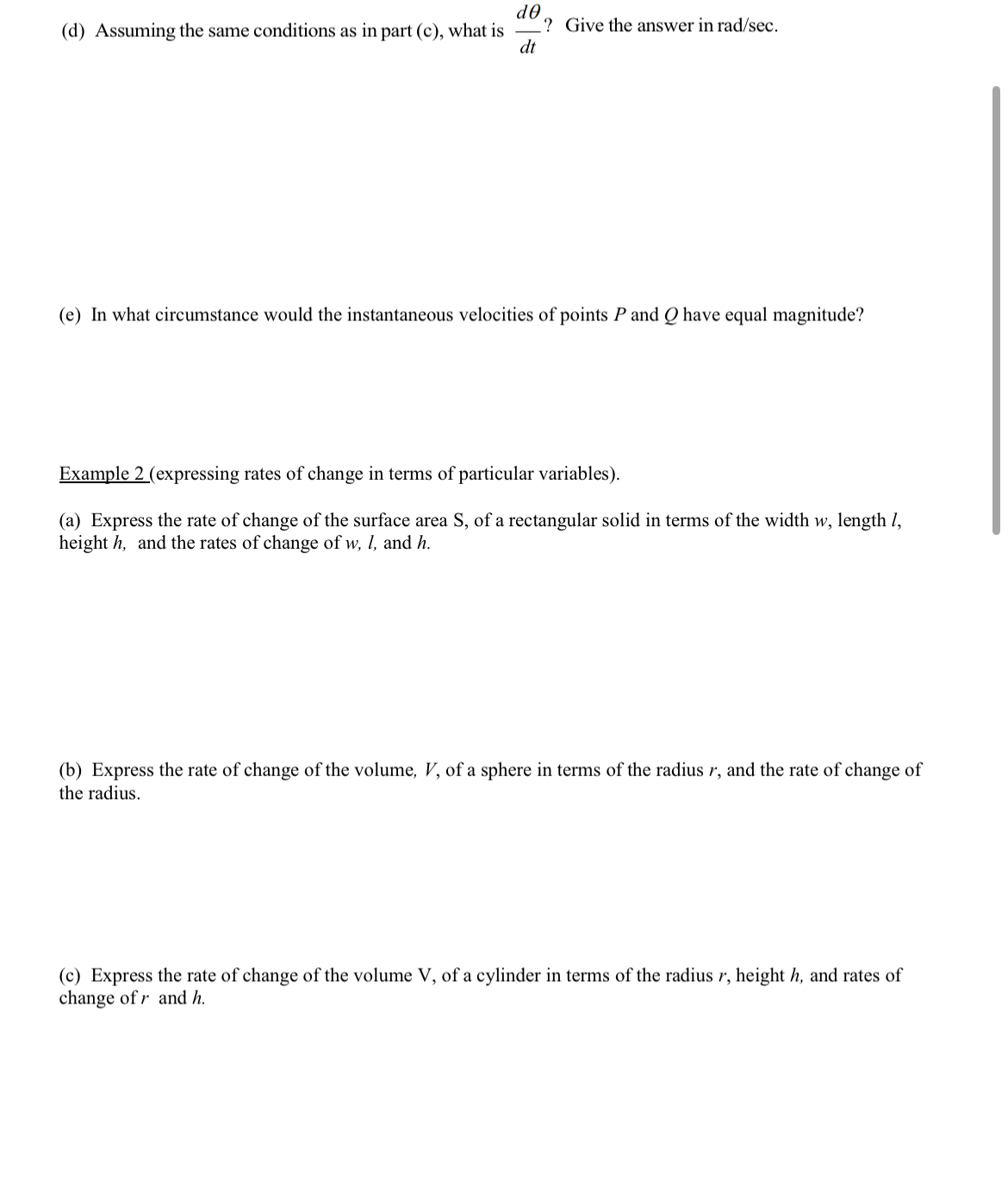
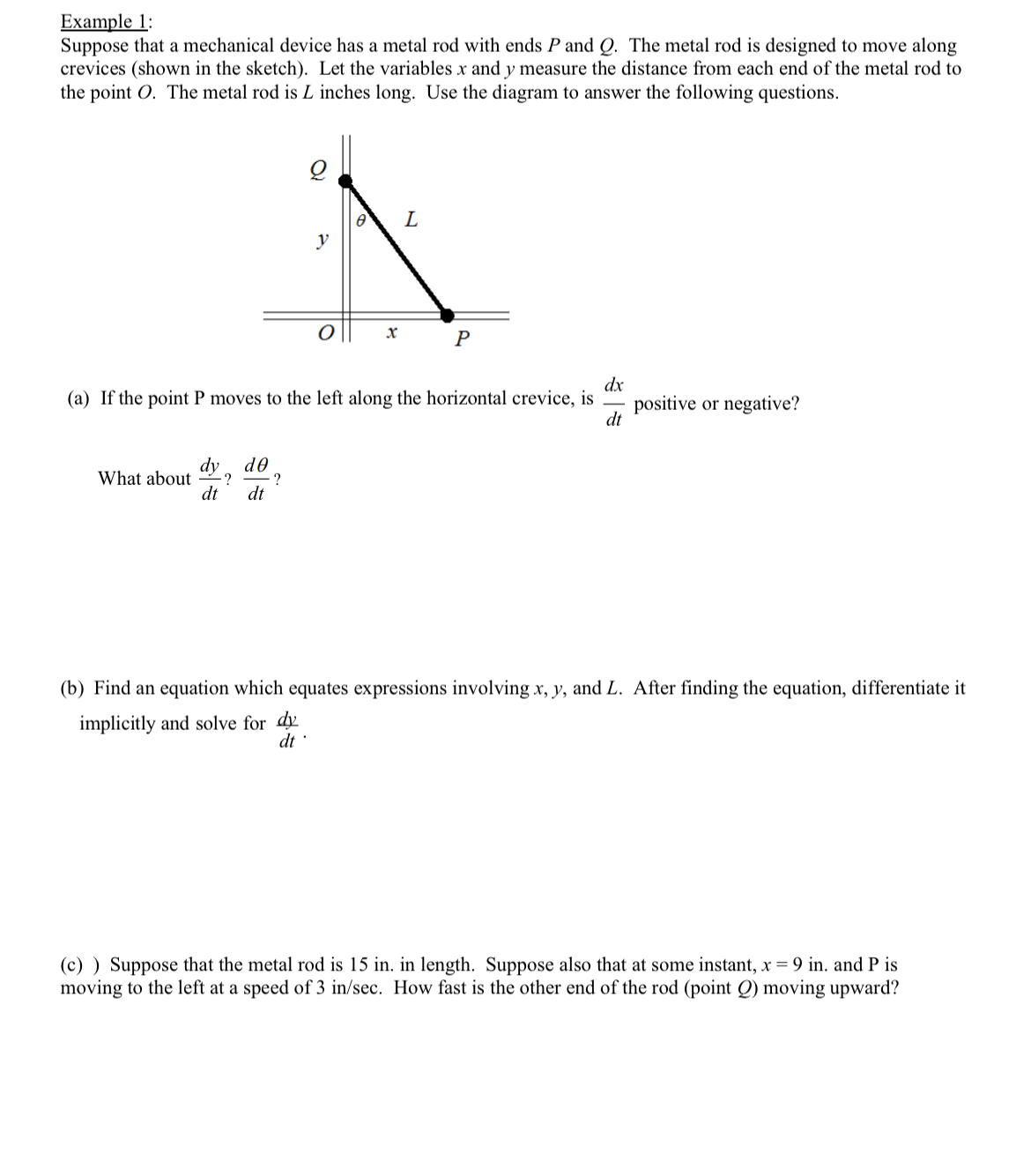
Example 3: (a) ) A spherical beach ball is being pumped so that its volume is increasing at a rate of 120 cubic centimeters per second. How fast is the radius of the balloon increasing when the diameter is 30 cm? (b) Assuming the same situation as part (a), how fast is the surface area of the beach ball increasing when the diameter is 40 cm? Example 4: Some Guy (his name) walks along a straight path at a rate of 5 fsee. What hasn't been said yet is that Some Guy just escaped from prison. He is very nonchalant, and doesn't feel the need to run. Before he realizes it, a searchlight at ground level has spotted him. The searchlight is located 25 ft from the path and is kept focused on Some Guy. At what rate is the searchlight rotating when Some Guy is 20 feet from the point on the path closest to the searchlight? Example 5 A woman owns a house that has a strangely shaped swimming pool. The swimming pool is in the shape of an inverted circular cone with radius 8 feet and depth of 16 feet. The pool had recently been emptied for extensive cleaning and is now ready to be filled again. Water is pumped into the pool at a rate of 8 cubic feet per second. How fast is the water level rising when the depth of the water is 9 feet?l General Problem Solving Strategy for Related Rates Problems When it comes to mathematics, most students can't wait until applications are discussed (sarcasm). That is, many students dislike applications in general, let alone related rates problems in a calculus course. The following guidelines can help to setting up and solving such related rates problems. This is a general strategy, not a mandatory step by step. The key is to understand and solve the problem correctly. (1) Read the problem completely and carefully. Make mental notes of known and unknown quantities. (2) If possible, make a sketch. (3) Introduce notation for all known and unknown quantities. That is, assign the variables to the quantities that are relevant to the situation. One or more of the quantities may be know, but wait to substitute values for variables until later. (4) Identify any rates of change which are given in the problem. Most of the time, we will be considering problems which change with respect to time. Express the rates of change that are known and unknown in terms of the variables introduced in step (3). Leibniz notation generally works best since it is a good way of distinguishing between rates and constant values. (5) Write an equation which relates the various known and unknown quantities of the problem. It is common to use geometry (or trigonometry) to help derive certain formulas or make helpful substitutions. (6) Use Implicit Differentiation (don't forget the chain rule) to differentiate both sides of the equation with respect to time (the variable t). (7) Substitute all known values (constants and rates) into the equation. (8) Solve the equation for the unknown rate. Have some number sense. Your answer should make sense within the context of the problem. d9 (d) Assuming the same conditions as in part (c), what is E ? Give the answer in rad/sec. (e) In what circumstance would the instantaneous velocities of points P and Q have equal magnitude? Example 2 (expressing rates of change in terms of particular variables). (a) Express the rate of change of the surface area S, of a rectangular solid in terms of the width w, length 3, height h, and the rates of change of w, I, and h. (b) Express the rate of change of the volume, V, of a sphere in terms of the radius r, and the rate of change of the radius. (c) Express the rate of change of the volume V, of a cylinder in terms of the radius r, height h, and rates of change of r and h. Example 1: Suppose that a mechanical device has a metal rod with ends P and Q. The metal rod is designed to move along crevices (shown in the sketch). Let the variables x and y measure the distance from each end of the metal rod to the point 0. The metal rod is L inches long. Use the diagram to answer the following questions. (b) Find an equation which equates expressions involving x, y, and L. After nding the equation, differentiate it implicitly and solve for '3' t . (c) ) Suppose that the metal rod is 15 in. in length. Suppose also that at some instant, x = 9 in. and P is moving to the left at a speed of 3 inz'sec. How fast is the other end of the rod (point Q) moving upward
Step by Step Solution
There are 3 Steps involved in it

Get step-by-step solutions from verified subject matter experts
 Study Help