







Question: Example 3 a. Demonstrate the concept of equivalence using the different loan repayment plans described below. Each plan repays a $10000.00 loan in 10 years
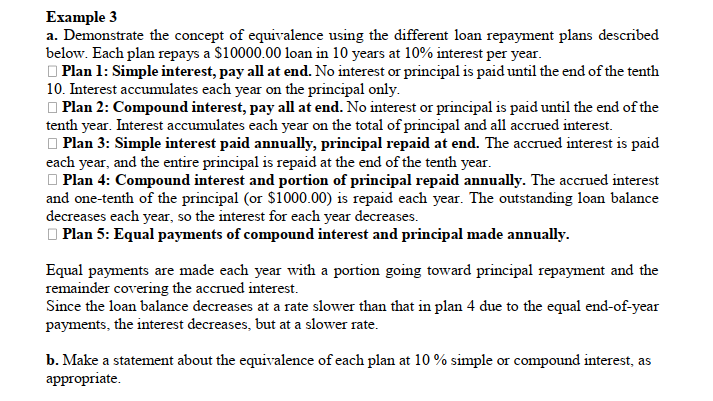
Example 3 a. Demonstrate the concept of equivalence using the different loan repayment plans described below. Each plan repays a $10000.00 loan in 10 years at 10% interest per year. Plan 1: Simple interest, pay all at end. No interest or principal is paid until the end of the tenth 10. Interest accumulates each year on the principal only. Plan 2: Compound interest, pay all at end. No interest or principal is paid until the end of the tenth year. Interest accumulates each year on the total of principal and all accrued interest. Plan 3: Simple interest paid annually, principal repaid at end. The accrued interest is paid each year, and the entire principal is repaid at the end of the tenth year. Plan 4: Compound interest and portion of principal repaid annually. The accrued interest and one-tenth of the principal (or $1000.00) is repaid each year. The outstanding loan balance decreases each year, so the interest for each year decreases. Plan 5: Equal payments of compound interest and principal made annually. Equal payments are made each year with a portion going toward principal repayment and the remainder covering the accrued interest. Since the loan balance decreases at a rate slower than that in plan 4 due to the equal end-of-year payments, the interest decreases, but at a slower rate. b. Make a statement about the equivalence of each plan at 10 % simple or compound interest, as appropriate. Example 3 a. Demonstrate the concept of equivalence using the different loan repayment plans described below. Each plan repays a $10000.00 loan in 10 years at 10% interest per year. Plan 1: Simple interest, pay all at end. No interest or principal is paid until the end of the tenth 10. Interest accumulates each year on the principal only. Plan 2: Compound interest, pay all at end. No interest or principal is paid until the end of the tenth year. Interest accumulates each year on the total of principal and all accrued interest. Plan 3: Simple interest paid annually, principal repaid at end. The accrued interest is paid each year, and the entire principal is repaid at the end of the tenth year. Plan 4: Compound interest and portion of principal repaid annually. The accrued interest and one-tenth of the principal (or $1000.00) is repaid each year. The outstanding loan balance decreases each year, so the interest for each year decreases. Plan 5: Equal payments of compound interest and principal made annually. Equal payments are made each year with a portion going toward principal repayment and the remainder covering the accrued interest. Since the loan balance decreases at a rate slower than that in plan 4 due to the equal end-of-year payments, the interest decreases, but at a slower rate. b. Make a statement about the equivalence of each plan at 10 % simple or compound interest, as appropriate
Step by Step Solution
There are 3 Steps involved in it

Get step-by-step solutions from verified subject matter experts
 Study Help