







Question: EXAMPLE 3.3 Given the function Fx,yz) xy +xz+yz, we simplify as follows: xy +xz+ yz(l) -xy xz yz( x) (Inverse) xy xz (yz) (yz)x (Distributive)
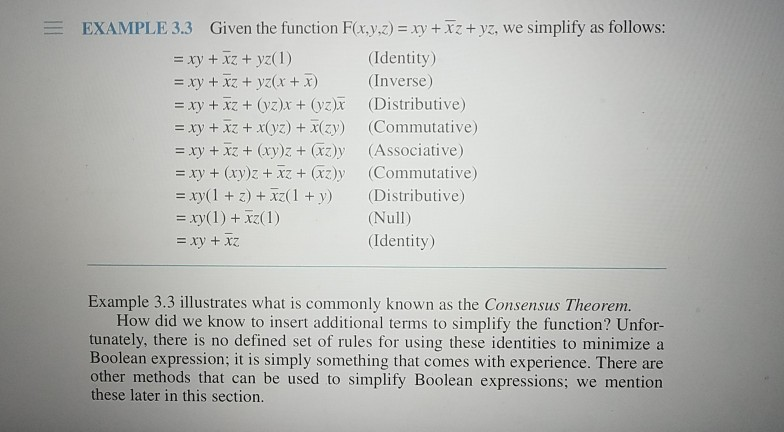
EXAMPLE 3.3 Given the function Fx,yz) xy +xz+yz, we simplify as follows: xy +xz+ yz(l) -xy xz yz( x) (Inverse) xy xz (yz) (yz)x (Distributive) = xy + xz + x(yz) + x(zy) (Commutative) - xy xz (xyz(z)y (Associative) =xy + (xy): + x2+ (x2), (Commutative) =xy( 1 +z)+xz( 1 +y) (Distributive) =xy( 1 ) + xz( 1 ) (Identity) (Null) (Identity) Example 3.3 illustrates what is commonly known as the Consensus Theorem. How did we know to insert additional terms to simplify the function? Unfor- tunately, there is no defined set of rules for using these identities to minimize a Boolean expression; it is simply something that comes with experience. There are other methods that can be used to simplify Boolean expressions; we mention these later in this
Step by Step Solution
There are 3 Steps involved in it

Get step-by-step solutions from verified subject matter experts
 Study Help