







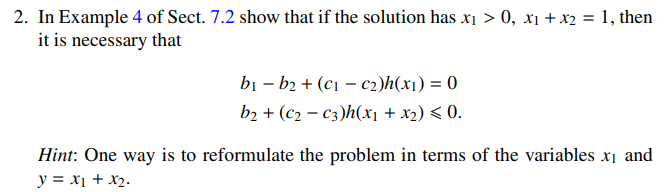
Question: Example 4: 2. In Example 4 of Sect. 7.2 show that if the solution has x > 0, x + x2 = 1, then it
Example 4:
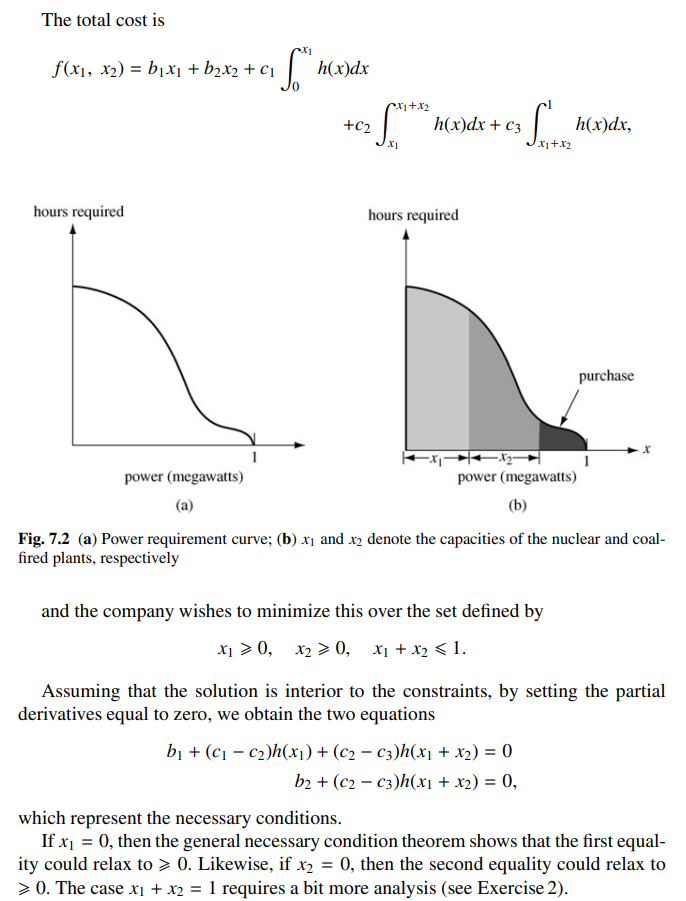
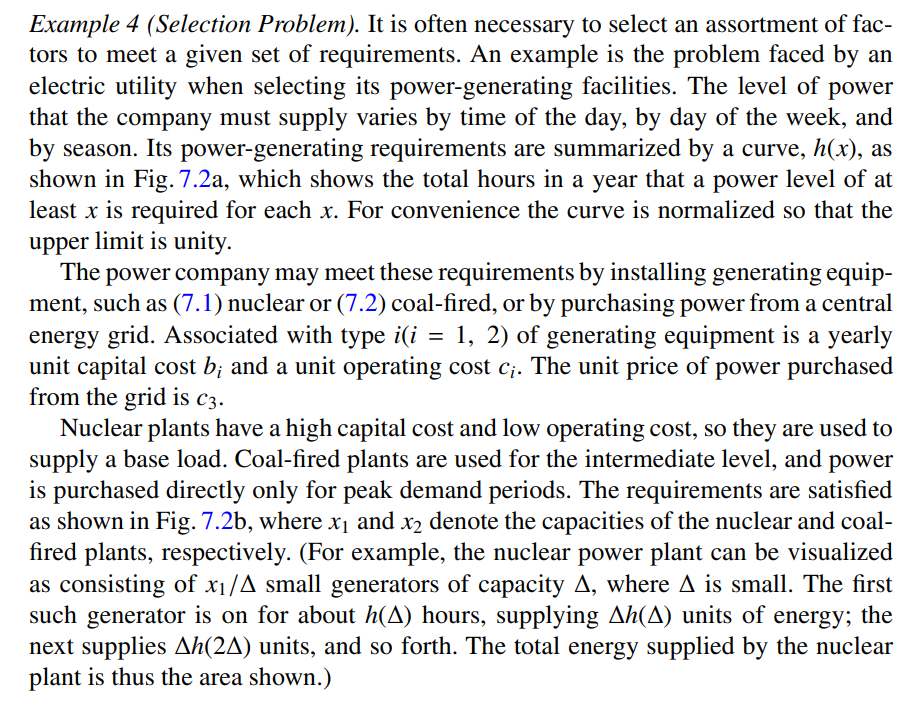
2. In Example 4 of Sect. 7.2 show that if the solution has x > 0, x + x2 = 1, then it is necessary that bi - b2 + (C1 C2)h(x1) = 0 b2 + (C2 - C3)h(x1 + x2) 0, X2 > 0, x1 + x2 0. Likewise, if x2 = 0, then the second equality could relax to > 0. The case x + x2 = 1 requires a bit more analysis (see Exercise 2). Example 4 (Selection Problem). It is often necessary to select an assortment of fac- tors to meet a given set of requirements. An example is the problem faced by an electric utility when selecting its power-generating facilities. The level of power that the company must supply varies by time of the day, by day of the week, and by season. Its power-generating requirements are summarized by a curve, h(x), as shown in Fig. 7.2a, which shows the total hours in a year that a power level of at least x is required for each x. For convenience the curve is normalized so that the upper limit is unity. The power company may meet these requirements by installing generating equip- ment, such as (7.1) nuclear or (7.2) coal-fired, or by purchasing power from a central energy grid. Associated with type ili = 1, 2) of generating equipment is a yearly unit capital cost b; and a unit operating cost ci. The unit price of power purchased from the grid is 03. Nuclear plants have a high capital cost and low operating cost, so they are used to supply a base load. Coal-fired plants are used for the intermediate level, and power is purchased directly only for peak demand periods. The requirements are satisfied as shown in Fig. 7.2b, where x and x2 denote the capacities of the nuclear and coal- fired plants, respectively. (For example, the nuclear power plant can be visualized as consisting of xi/A small generators of capacity A, where A is small. The first such generator is on for about h(A) hours, supplying Ah(A) units of energy; the next supplies Ah(2A) units, and so forth. The total energy supplied by the nuclear plant is thus the area shown.) 2. In Example 4 of Sect. 7.2 show that if the solution has x > 0, x + x2 = 1, then it is necessary that bi - b2 + (C1 C2)h(x1) = 0 b2 + (C2 - C3)h(x1 + x2) 0, X2 > 0, x1 + x2 0. Likewise, if x2 = 0, then the second equality could relax to > 0. The case x + x2 = 1 requires a bit more analysis (see Exercise 2). Example 4 (Selection Problem). It is often necessary to select an assortment of fac- tors to meet a given set of requirements. An example is the problem faced by an electric utility when selecting its power-generating facilities. The level of power that the company must supply varies by time of the day, by day of the week, and by season. Its power-generating requirements are summarized by a curve, h(x), as shown in Fig. 7.2a, which shows the total hours in a year that a power level of at least x is required for each x. For convenience the curve is normalized so that the upper limit is unity. The power company may meet these requirements by installing generating equip- ment, such as (7.1) nuclear or (7.2) coal-fired, or by purchasing power from a central energy grid. Associated with type ili = 1, 2) of generating equipment is a yearly unit capital cost b; and a unit operating cost ci. The unit price of power purchased from the grid is 03. Nuclear plants have a high capital cost and low operating cost, so they are used to supply a base load. Coal-fired plants are used for the intermediate level, and power is purchased directly only for peak demand periods. The requirements are satisfied as shown in Fig. 7.2b, where x and x2 denote the capacities of the nuclear and coal- fired plants, respectively. (For example, the nuclear power plant can be visualized as consisting of xi/A small generators of capacity A, where A is small. The first such generator is on for about h(A) hours, supplying Ah(A) units of energy; the next supplies Ah(2A) units, and so forth. The total energy supplied by the nuclear plant is thus the area shown.)
Step by Step Solution
There are 3 Steps involved in it

Get step-by-step solutions from verified subject matter experts
 Study Help