







Question: Example 4.4: A one-one relationship between entity sets E and F is repre- sented by arrows pointing to both E and F. For instance, Fig.
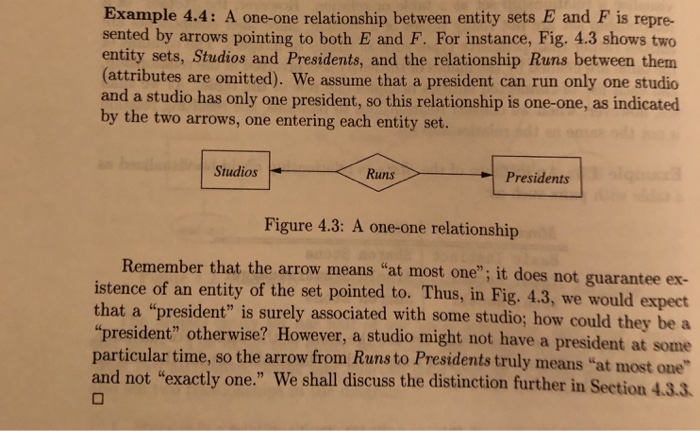

Example 4.4: A one-one relationship between entity sets E and F is repre- sented by arrows pointing to both E and F. For instance, Fig. 4.3 shows two entity sets, Studios and Presidents, and the relationship Runs between them attributes are omitted). We assume that a president can run only one studio and a studio has only one president, so this relationship is one-one, as indicated by the two arrows, one entering each entity set. RunsP R > residents Studios Figure 4.3: A one-one relationship Remember that the arrow means "at most one"; it does not guarantee ex Thus, in Fig. 4.3, we would expect that a "president" is surely associated with some studio; how could they be a istence of an entity of the set pointed to. "president" otherwise? However, a studio might not have a president at some particular time, so the arrow from Runs to Presidents truly means "at most one and not "exactly one." We shall discuss the distinction further in Section 4.3.3
Step by Step Solution
There are 3 Steps involved in it
To decide whether to combine the entity sets Studios and Presidents into a single entity set with at... View full answer

Get step-by-step solutions from verified subject matter experts
 Study Help