







Question: Example 6.3 (Stoecker 3rd. ed.): Water-pumping system (Use Newton-Raphson simulation) (Please do not use the successive substitution method) A water-pumping system consists of two
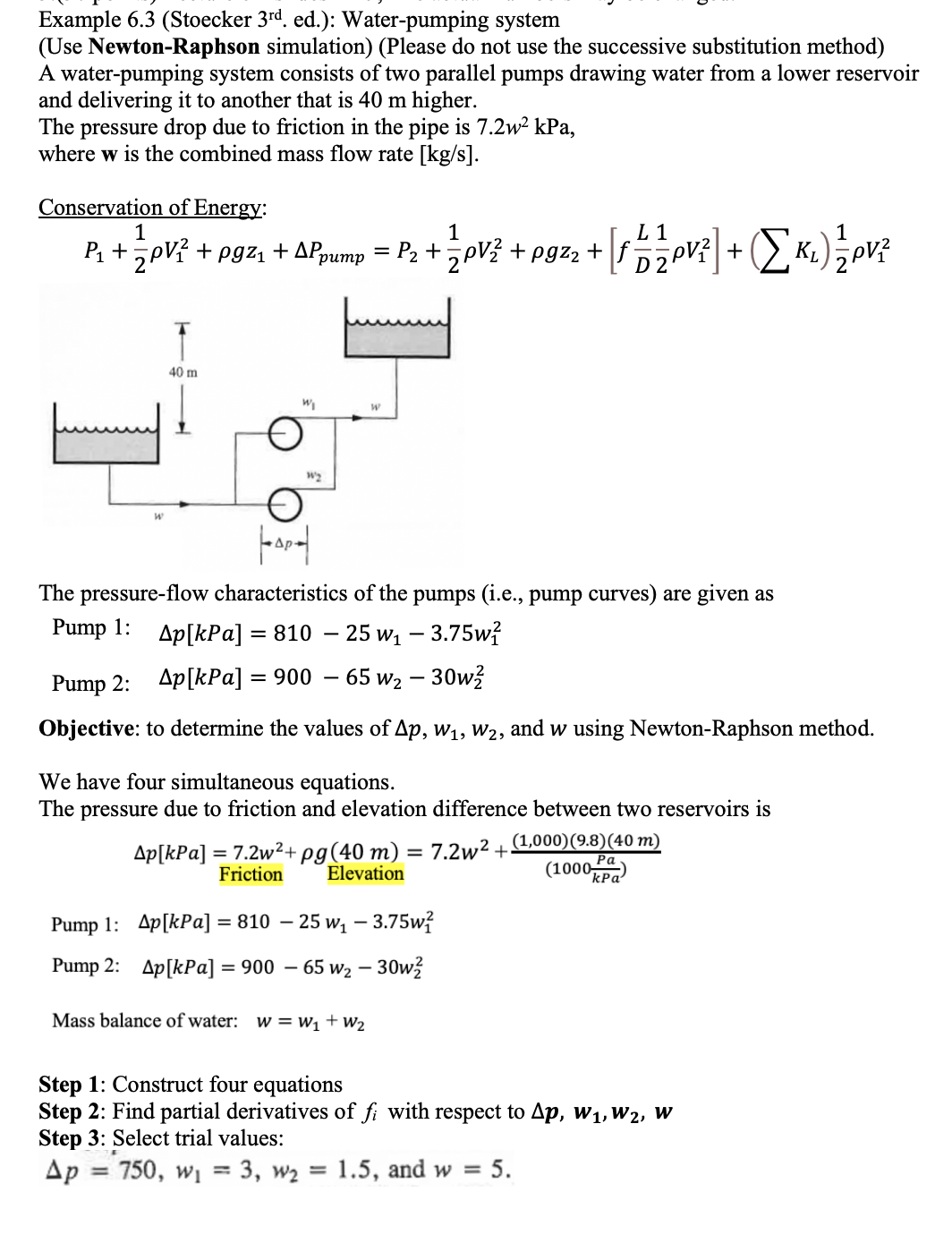
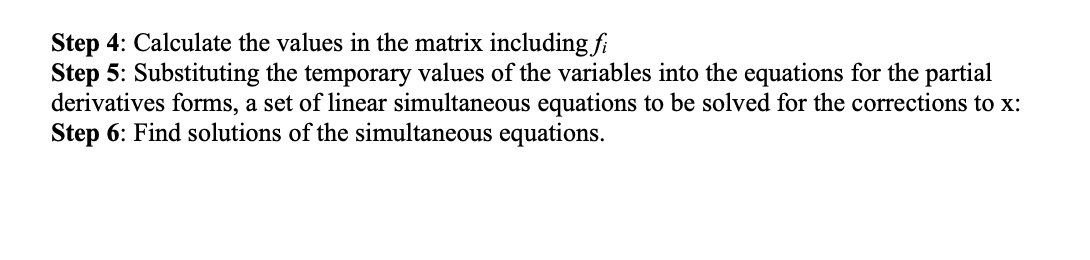
Example 6.3 (Stoecker 3rd. ed.): Water-pumping system (Use Newton-Raphson simulation) (Please do not use the successive substitution method) A water-pumping system consists of two parallel pumps drawing water from a lower reservoir and delivering it to another that is 40 m higher. The pressure drop due to friction in the pipe is 7.2w kPa, where w is the combined mass flow rate [kg/s]. Conservation of Energy: 1 P + PV + pgz + APpump = 1 L 1 P+ PV + pg + 2 + + [ 1/12/12 PV] + ( K) PV ) 40 m W W The pressure-flow characteristics of the pumps (i.e., pump curves) are given as Pump 1: Ap[kPa] = 810 - 25 w - 3.75w Pump 2: Ap[kPa] = 900 - 65 w - 30w Objective: to determine the values of Ap, W1, W2, and w using Newton-Raphson method. We have four simultaneous equations. The pressure due to friction and elevation difference between two reservoirs is Ap[kPa] = 7.2w+ pg (40 m) = 7.2w2+ Friction Elevation Pump 1: Ap[kPa] = 810-25 w - 3.75w Pump 2: Ap[kPa] = 900 - 65 w- 30w Mass balance of water: W = W + W2 Step 1: Construct four equations (1,000) (9.8) (40 m) Pa (1000 kPa Step 2: Find partial derivatives of fi with respect to Ap, W1, W2, W Step 3: Select trial values: Ap = 750, WI = 3, w21.5, and w = 5. Step 4: Calculate the values in the matrix including fi Step 5: Substituting the temporary values of the variables into the equations for the partial derivatives forms, a set of linear simultaneous equations to be solved for the corrections to x: Step 6: Find solutions of the simultaneous equations.
Step by Step Solution
There are 3 Steps involved in it

Get step-by-step solutions from verified subject matter experts
 Study Help