







Question: Example 7 . 4 : ( i need to answer with details, step by step ) A metal disk of radius a rotates with angular
Example : i need to answer with details, step by step
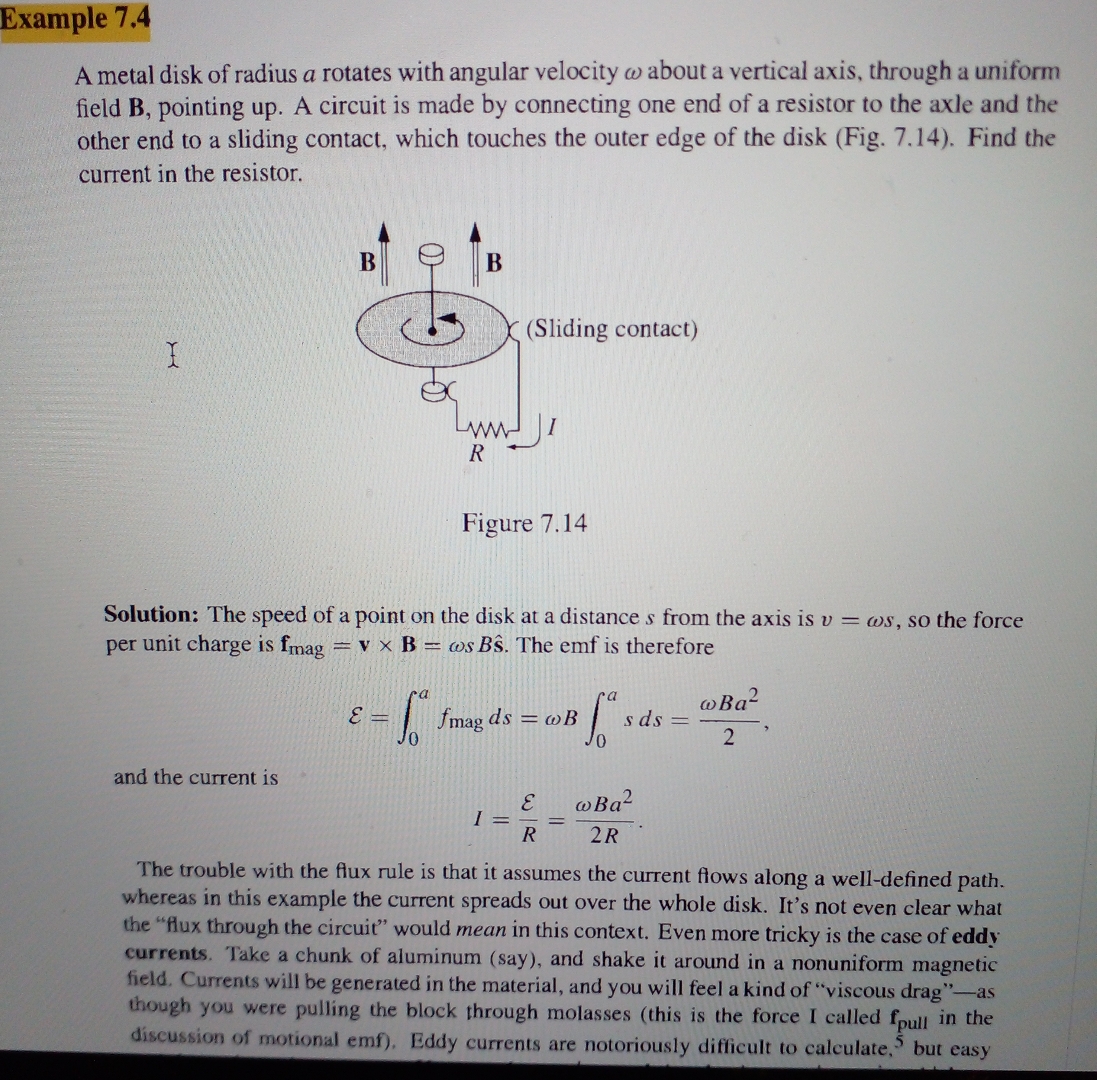
A metal disk of radius a rotates with angular velocity about a vertical axis, through a uniform field pointing up A circuit is made by connecting one end of a resistor to the axle and the other end to a sliding contact, which touches the outer edge of the disk Fig Find the current in the resistor.
Figure
Solution: The speed of a point on the disk at a distance from the axis is so the force per unit charge is The emf is therefore
and the current is
The trouble with the flux rule is that it assumes the current flows along a welldefined path. whereas in this example the current spreads out over the whole disk. It's not even clear what the "flux through the circuit" would mean in this context. Even more tricky is the case of eddy currents. Take a chunk of aluminum say and shake it around in a nonuniform magnetic field. Currents will be generated in the material, and you will feel a kind of "viscous drag"as though you were pulling the block through molasses this is the force I called in the discussion of motional emf Eddy currents are notoriously difficult to calculate, but easy
Step by Step Solution
There are 3 Steps involved in it
1 Expert Approved Answer
Step: 1 Unlock

Question Has Been Solved by an Expert!
Get step-by-step solutions from verified subject matter experts
Step: 2 Unlock
Step: 3 Unlock
 Study Help