







Question: Example: A rock is tossed upward from a cliff that is 120 m above the water. The height of the rock above the water is
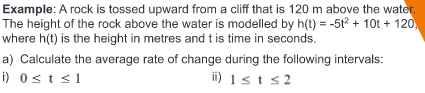

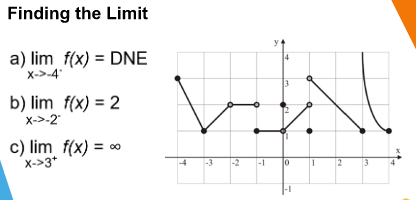
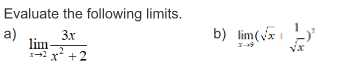
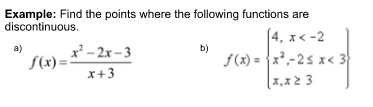
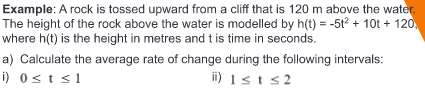

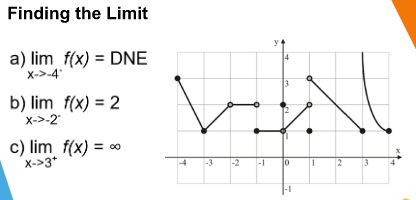
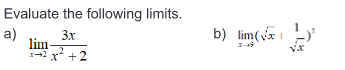
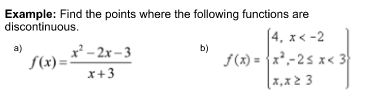
Example: A rock is tossed upward from a cliff that is 120 m above the water. The height of the rock above the water is modelled by h(t) = -512 + 10t + 120, where h(t) is the height in metres and t is time in seconds. a) Calculate the average rate of change during the following intervals: i) Ostsl ii) Ists2b) As the time increases, what do you notice about the average rate of change in height during each 1s interval? What does this mean?Finding the Limit a) lim f(x) = DNE 4 X->4 b) lim f(x) = 2 X->-2 c) lim f(x) = 00 X->3+ -4 -2\fExample: Find the points where the following functions are discontinuous. .X
Step by Step Solution
There are 3 Steps involved in it
1 Expert Approved Answer
Step: 1 Unlock

Question Has Been Solved by an Expert!
Get step-by-step solutions from verified subject matter experts
Step: 2 Unlock
Step: 3 Unlock
 Study Help