







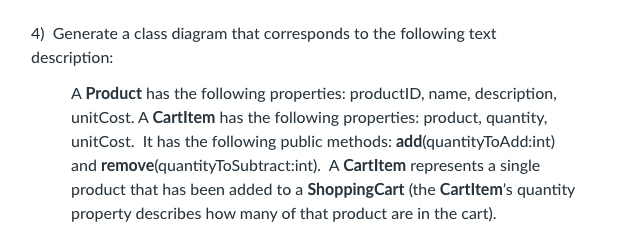
Question: Example Format: 4) Generate a class diagram that corresponds to the following text description: A Product has the following properties:productID, name, description, unitCost. A CartItem
Example Format:
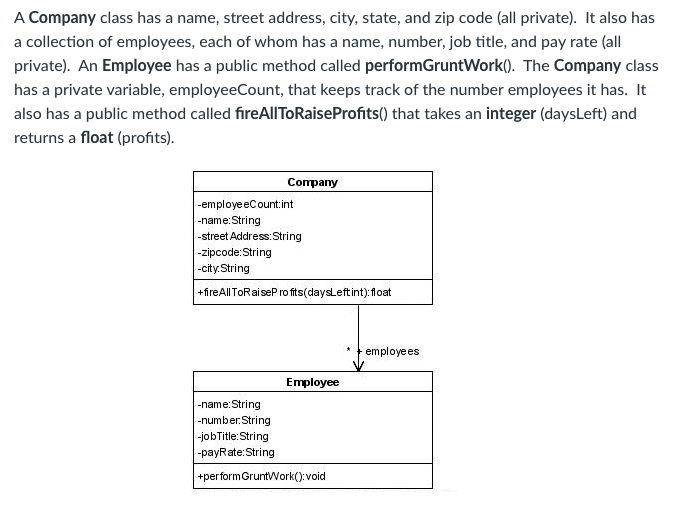
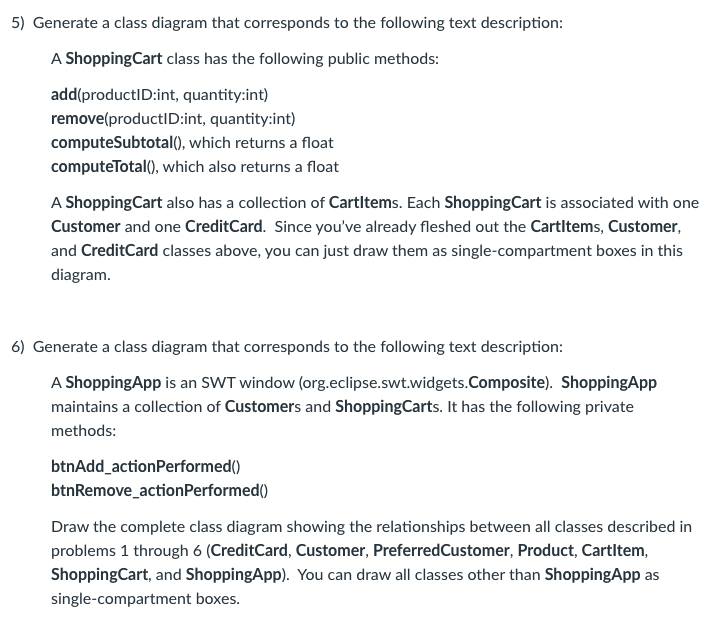
4) Generate a class diagram that corresponds to the following text description: A Product has the following properties:productID, name, description, unitCost. A CartItem has the following properties: product, quantity, unitCost. It has the following public methods: add(quantityToAdd:int) and remove(quantityToSubtract:int). A CartItem represents a single product that has been added to a Shopping Cart (the CartItem's quantity property describes how many of that product are in the cart). 5) Generate a class diagram that corresponds to the following text description: A Shopping Cart class has the following public methods: add(productID:int, quantity:int) remove(productID:int, quantity:int) computeSubtotal, which returns a float computeTotal(), which also returns a float A Shopping Cart also has a collection of CartItems. Each Shopping Cart is associated with one Customer and one CreditCard. Since you've already fleshed out the CartItems, Customer, and Credit Card classes above, you can just draw them as single-compartment boxes in this diagram. 6) Generate a class diagram that corresponds to the following text description: A ShoppingApp is an SWT window (org.eclipse.swt.widgets.Composite). ShoppingApp maintains a collection of Customers and Shopping Carts. It has the following private methods: btnAdd_actionPerformed() btnRemove_action Performed() Draw the complete class diagram showing the relationships between all classes described in problems 1 through 6 (CreditCard, Customer, Preferred Customer, Product, CartItem, Shopping Cart, and ShoppingApp). You can draw all classes other than ShoppingApp as single-compartment boxes. A Company class has a name, street address, city, state, and zip code (all private). It also has a collection of employees, each of whom has a name, number, job title, and pay rate (all private). An Employee has a public method called perform GruntWork(). The Company class has a private variable, employeeCount, that keeps track of the number employees it has. It also has a public method called fire AllToRaise Profits() that takes an integer (daysLeft) and returns a float (profits). Company -employeeCount:int -name:String - street Address: String -zipcode: String -city. String +fire AllToRaiseProfits(daysLeftint): float employees Employee -name:String -numberString -jobTitle:String -payRate: String +perform GruntWork():void 4) Generate a class diagram that corresponds to the following text description: A Product has the following properties:productID, name, description, unitCost. A CartItem has the following properties: product, quantity, unitCost. It has the following public methods: add(quantityToAdd:int) and remove(quantityToSubtract:int). A CartItem represents a single product that has been added to a Shopping Cart (the CartItem's quantity property describes how many of that product are in the cart). 5) Generate a class diagram that corresponds to the following text description: A Shopping Cart class has the following public methods: add(productID:int, quantity:int) remove(productID:int, quantity:int) computeSubtotal, which returns a float computeTotal(), which also returns a float A Shopping Cart also has a collection of CartItems. Each Shopping Cart is associated with one Customer and one CreditCard. Since you've already fleshed out the CartItems, Customer, and Credit Card classes above, you can just draw them as single-compartment boxes in this diagram. 6) Generate a class diagram that corresponds to the following text description: A ShoppingApp is an SWT window (org.eclipse.swt.widgets.Composite). ShoppingApp maintains a collection of Customers and Shopping Carts. It has the following private methods: btnAdd_actionPerformed() btnRemove_action Performed() Draw the complete class diagram showing the relationships between all classes described in problems 1 through 6 (CreditCard, Customer, Preferred Customer, Product, CartItem, Shopping Cart, and ShoppingApp). You can draw all classes other than ShoppingApp as single-compartment boxes. A Company class has a name, street address, city, state, and zip code (all private). It also has a collection of employees, each of whom has a name, number, job title, and pay rate (all private). An Employee has a public method called perform GruntWork(). The Company class has a private variable, employeeCount, that keeps track of the number employees it has. It also has a public method called fire AllToRaise Profits() that takes an integer (daysLeft) and returns a float (profits). Company -employeeCount:int -name:String - street Address: String -zipcode: String -city. String +fire AllToRaiseProfits(daysLeftint): float employees Employee -name:String -numberString -jobTitle:String -payRate: String +perform GruntWork():void
Step by Step Solution
There are 3 Steps involved in it

Get step-by-step solutions from verified subject matter experts
 Study Help