







Question: Example : #include #include using namespace std; // The declaration for class 'Student' is fully given. Do nothing to it. // As for other classes,
Example :
#include
// The declaration for class 'Student' is fully given. Do nothing to it. // As for other classes, the declaration are partially given. Complete the rest.
class Student{ string name; public: Student(string n = ""); string getName() const; void setName(string n); void print() const; };
class Mentor{ public: Mentor(string n, double c); };
class Coach{ public: Coach(string n, double c, string e); };
class Support{ public: Support(string n, double c, string p); };
class Mentee{ public: Mentee(string n, int l); };
//-------------------------------------------------------------------------------------------------------------
// Definition for the class 'Student' is fully given. Do nothing to it.
Student::Student(string n) : name(n) {} string Student::getName() const { return name; } void Student::setName(string n) { name = n; } void Student::print() const { cout
int main() { // system("pause"); // uncomment this line if you are using VS Code return 0; } //
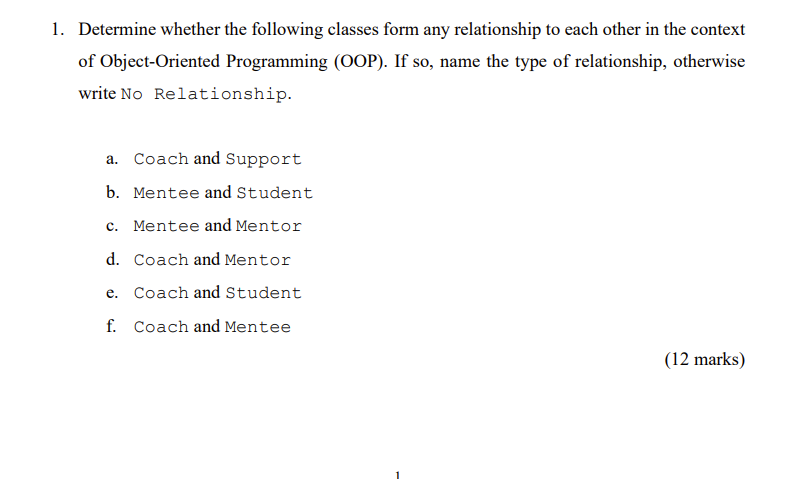
A school is currently running a mentoring programme for its students. The students are divided into two groups, mentors and mentees. Mentors are more knowledgeable students and offer helps to mentees. They are chosen from those students with good CPAs. The programme offers two types of mentoring: Coaching-based mentoring: mentors will coach their mentees in particular areas, e.g., CH programming, Game Programming, etc. Therefore, a mentor must be expert in that area. Support-based mentoring: mentors offer their supports to the mentees without having to meet face to face. Thus, the mentor need to provide their phone numbers. Further, each mentee is assigned with only one mentor. Mentees progress are kept track based on their levels, i.e. from level 1 to 5 where 5 indicates a mastery level. Given a class diagram that models the above problem in Figure 1 and the details about the class diagram in Table 2. Answer the questions 1 to 3 below. Note: As for questions 1 and 2, write your answers on papers, and for question 3, write your program using any C++ IDE such as DevCpp. Use the codebase program provided, main.cpp. 1. Determine whether the following classes form any relationship to each other in the context of Object-Oriented Programming (OOP). If so, name the type of relationship, otherwise write No Relationship. a. Coach and Support b. Mentee and Student c. Mentee and Mentor d. Coach and Mentor e. Coach and Student f. Coach and Mentee (12 marks)
Step by Step Solution
There are 3 Steps involved in it

Get step-by-step solutions from verified subject matter experts
 Study Help