


Question: example using these references: Ricketts, H. T. (1907). Observations on the Virus and Means of Transmission of Rocky Mountain Spotted Fever. The Journal of Infectious

example using these references: Ricketts, H. T. (1907). Observations on the Virus and Means of Transmission of Rocky Mountain Spotted Fever. The Journal of Infectious Diseases, 4(1), 141-153. http://www.jstor.org/stable/30101875, Parola, P., & Raoult, D. (2001). Ticks and Tickborne Bacterial Diseases in Humans: An Emerging Infectious Threat. Clinical Infectious Diseases, 32(6), 897-928. http://www.jstor.org/stable/4461489, Chochlakis, D., Ioannou, I., Sandalakis, V., Dimitriou, T., Kassinis, N., Papadopoulos, B., Tselentis, Y., & Psaroulaki, A. (2012). Spotted Fever Group Rickettsiae in Ticks in Cyprus. Microbial Ecology, 63(2), 314-323. http://www.jstor.org/stable/41412419, Polo, G., Carlos, M. A., Labruna, M. B., Ferreira, F., & Brockmann, D. (2018). Hosts mobility and spatial spread of Rickettsia rickettsii. PLoS Computational Biology, 14(12)https://doi.org/10.1371/journal.pcbi.1006636
example using these references: Ricketts, H. T.
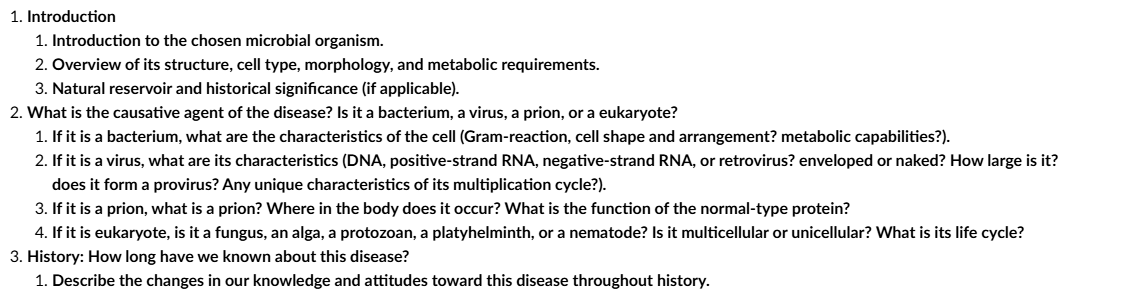
1. Introduction 1. Introduction to the chosen microbial organism. 2. Overview of its structure, cell type, morphology, and metabolic requirements. 3. Natural reservoir and historical significance (if applicable). 2. What is the causative agent of the disease? Is it a bacterium, a virus, a prion, or a eukaryote? 1. If it is a bacterium, what are the characteristics of the cell (Gram-reaction, cell shape and arrangement? metabolic capabilities?). 2. If it is a virus, what are its characteristics (DNA, positive-strand RNA, negative-strand RNA, or retrovirus? enveloped or naked? How large is it? does it form a provirus? Any unique characteristics of its multiplication cycle?). 3. If it is a prion, what is a prion? Where in the body does it occur? What is the function of the normal-type protein? 4. If it is eukaryote, is it a fungus, an alga, a protozoan, a platyhelminth, or a nematode? Is it multicellular or unicellular? What is its life cycle? 3. History: How long have we known about this disease? 1. Describe the changes in our knowledge and attitudes toward this disease throughout history

Step by Step Solution

There are 3 Steps involved in it

1 Expert Approved Answer
Step: 1 Unlock blur-text-image
Question Has Been Solved by an Expert!

Get step-by-step solutions from verified subject matter experts

Step: 2 Unlock
Step: 3 Unlock

Students Have Also Explored These Related Accounting Questions!