







Question: Examples Enter the main chart along the sloping axis at 5 MPa and go across to the 2 mol% HS curve (the second of the
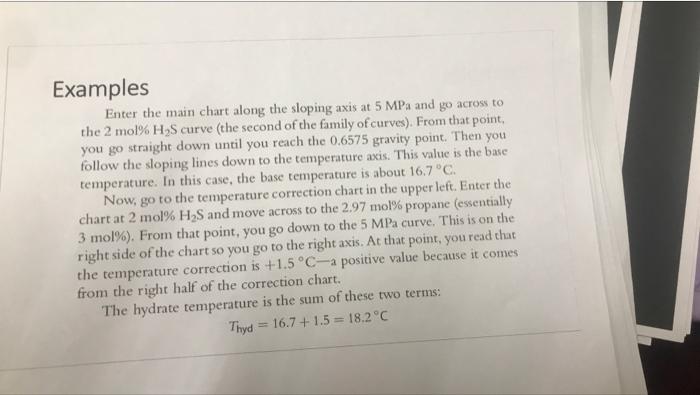
Examples Enter the main chart along the sloping axis at 5 MPa and go across to the 2 mol% HS curve (the second of the family of curves). From that point, you go straight down until you reach the 0.6575 gravity point. Then you follow the sloping lines down to the temperature axis. This value is the base temperature. In this case, the base temperature is about 16.7C. Now, go to the temperature correction chart in the upper left. Enter the chart at 2 mol% H2S and move across to the 2.97 mol% propane (essentially 3 mol%). From that point, you go down to the 5 MPa curve. This is on the right side of the chart so you go to the right axis. At that point, you read that the temperature correction is +1.5C-a positive value because it comes from the right half of the correction chart. The hydrate temperature is the sum of these two terms: Thyd = 16.7+1.5 = 18.2C Examples Enter the main chart along the sloping axis at 5 MPa and go across to the 2 mol% HS curve (the second of the family of curves). From that point, you go straight down until you reach the 0.6575 gravity point. Then you follow the sloping lines down to the temperature axis. This value is the base temperature. In this case, the base temperature is about 16.7C. Now, go to the temperature correction chart in the upper left. Enter the chart at 2 mol% H2S and move across to the 2.97 mol% propane (essentially 3 mol%). From that point, you go down to the 5 MPa curve. This is on the right side of the chart so you go to the right axis. At that point, you read that the temperature correction is +1.5C-a positive value because it comes from the right half of the correction chart. The hydrate temperature is the sum of these two terms: Thyd = 16.7+1.5 = 18.2C
Step by Step Solution
There are 3 Steps involved in it

Get step-by-step solutions from verified subject matter experts
 Study Help