Question: Excel is fine. Please show work. Thanks! Lecture ? Mini Case Solid Metal Backgund Solid Metal is a fairly largesized manufacturing rm which produced unique
Excel is fine. Please show work. Thanks!
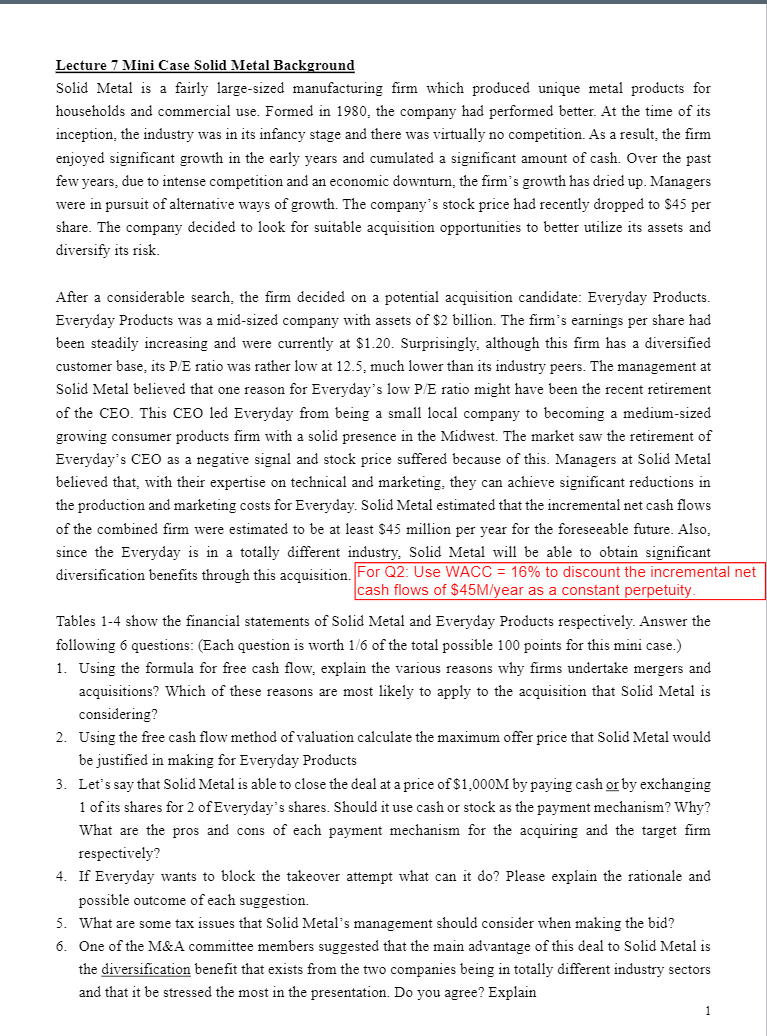
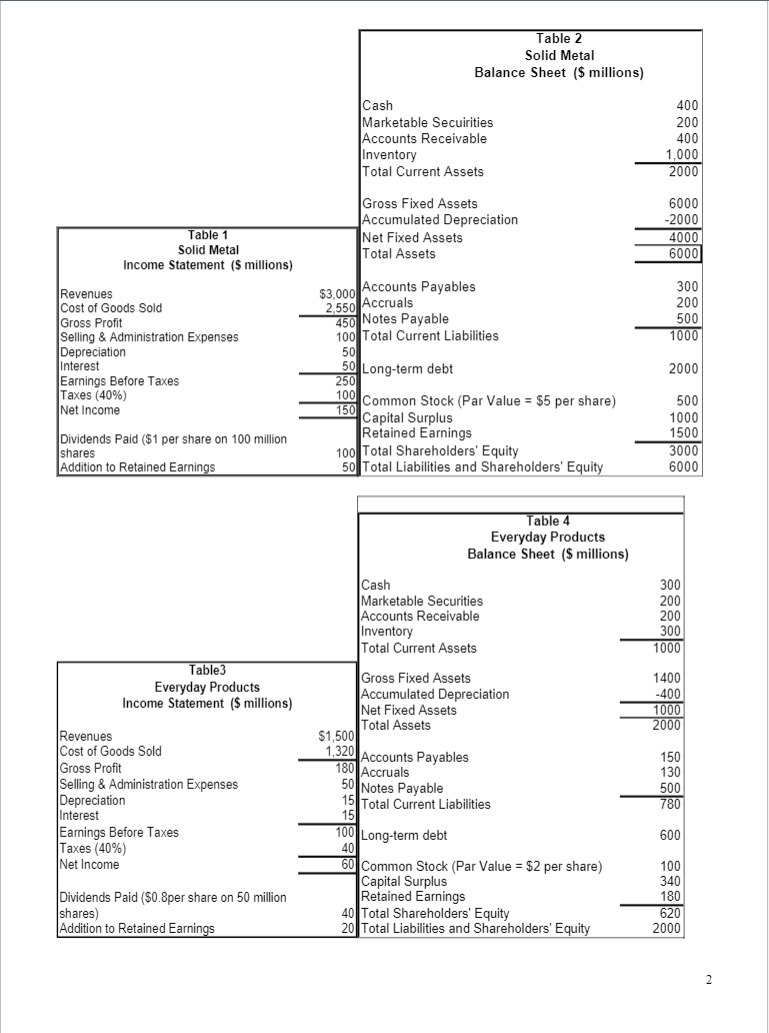
Lecture ? Mini Case Solid Metal Backgund Solid Metal is a fairly largesized manufacturing rm which produced unique metal products for households and commercial use. Formed in 193i], the company had peiformed better. At the time of its inception= the industry was inits infancy stage and there was virtually no oompetition. As a result, the rm enjoyed signicant growth in the early years and cumulated a signicant amount of cash. Over the past few years, due to intense competition and an economic downturn, the rm= 5 growth has dried up. hianagers were in pursuit of alternative ways of growth. The oompany's stock price had recently dropped to $45 per share. The company decided to look for suitable acquisition opportunities to better utilize its assets and diversify its risk. After a considerable search= the rm decided on a potential acquisition candidate: Everyday Products. Everyday Products was a midsized company with assets of $2 billion. The rm=s earnings per share had been steadily increasing and were currently at $1.20. Surprisingly, although this rm has a diversied customer base, its P.-'E ratio was rather low at 12.5, much lower than its industry peers. The management at Solid Metal believed that one reason for Everyday's low PIE ratio might have been the recent retirement of the CEO. This CED led Everyday om being a small local company to becoming a mediumsized growing consumer products rm with a solid presence in the Dclidwest. The market saw the retirement of Everyday's CEO as a negative signal and stock prise suffered because of this. Managers at Solid Metal believed that, with their expertise on technical and marketing, they can achieve signicant reductions in the production and marketing costs for Everyday. Solid Metal estimated that the incremental net cash ows of the combined rm were estimated to be at least $45 million per year for the foreseeable rture. Also, since the Everyday is in a totally diEerent industry, Solid Metal will be able to obtain signicant divmjcao bwets mmgh this acquisition. For Q2: Use WAGE = 16% to discount the incremental net cash ows of $45Miyear as a constant perpetuity. Tables 14 show the nancial statements of Solid Metal and Everyday Products respectively. Answer the following 6 questions: (Each question is worth lid of the total possible 100 points for this mini case.) 1. Using the formula for free cash ow, explain the various reasons why rms undertake mergers and acquisitions? Which of these reasons are most likely to apply to the acquisition that Solid Metal is considering? 2. Using the free cash ow method of valuation calculate the maximum ier price that Solid Metal would be justied in making for Everyday Products 3. Let's say that Solid Metal is able to close the deal at aprice of SLGDDM bypaying cash gby exchanging l of its shares for 2 of Everyday's shares. Should it use cash or stock as the payment mechanism? Why? What are the pros and cons of each payment mechanism for the acquiring and the target rm respectively? 4. If Everyday wants to block the takeover attempt what can it do? Please explain the rationale and possible outcome of each suggestion. 5. What are some tax issues that Solid Metal=s management should consider when making the bid? 6. 0116 of the MA committee members suggested that the main advantage of this deal to Solid Metal is the diversication benet that exists from the two oompanies being in totally diEerent industry sectors and that it be stressed the most inthe presentation. Do you agree? Explain Table 2 Solid Metal Balance Sheet ($ millions) Cash 400 Marketable Secuirities 200 Accounts Receivable 400 Inventory 1,000 Total Current Assets 2000 Gross Fixed Assets 6000 Accumulated Depreciation 2000 Table 1 Net Fixed Assets 4000 Solid Metal Total Assets 6000 Income Statement ($ millions) 300 Revenues $3,000 Accounts Payables Cost of Goods Sold 2,550 Accruals 200 Gross Profit 450 Notes Payable 500 Selling & Administration Expenses 100 Total Current Liabilities 1000 Depreciation 50 Interest 50 Long-term debt 2000 Earnings Before Taxes 250 Taxes (40%) 100 500 150 Common Stock (Par Value = $5 per share) Net Income Capital Surplus 1000 1500 Dividends Paid ($1 per share on 100 million Retained Earnings shares 100 Total Shareholders' Equity 3000 Addition to Retained Earnings 50 Total Liabilities and Shareholders' Equity 6000 Table 4 Everyday Products Balance Sheet ($ millions) Cash 300 Marketable Securities 200 Accounts Receivable 200 nventory 300 Total Current Assets 1000 Table3 Gross Fixed Assets 1400 Everyday Products Accumulated Depreciation -400 Income Statement ($ millions) Net Fixed Assets 1000 Total Assets 2000 Revenues $1,500 Cost of Goods Sold 1,320 Accounts Payables 150 Gross Profit 180 Accruals 130 Selling & Administration Expenses 50 Notes Payable 500 Depreciation 15 Total Current Liabilities 780 Interest Eamings Before Taxes 100 Long-term debt 600 Taxes (40%) 40 Net Income 60 Common Stock (Par Value = $2 per share) 100 Capital Surplus 340 Dividends Paid ($0.8per share on 50 million Retained Earnings 180 shares) 40 Total Shareholders' Equity 620 Addition to Retained Earnings 20 Total Liabilities and Shareholders' Equity 2000 2









 Study Help