







Question: Excel Online Structured Activity: Refunding Analysis Mullet Technologies is considering whether or not to refund a $100 million, 14% coupon, 30 -year bond issue that
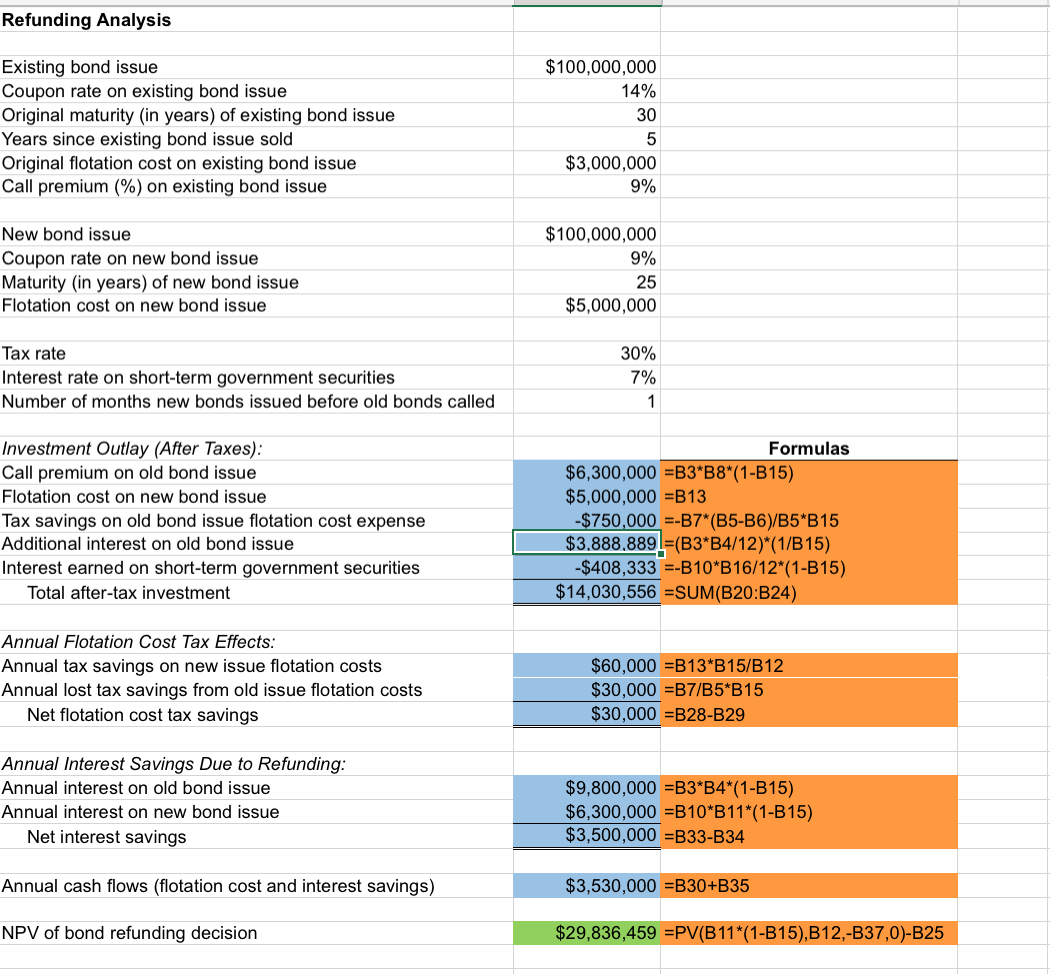
Excel Online Structured Activity: Refunding Analysis Mullet Technologies is considering whether or not to refund a $100 million, 14% coupon, 30 -year bond issue that was sold 5 years ago. It is amortizing $3 million of flotation costs on the 14% bonds over the issue's 30 -year life. Mullet's investment banks have indicated that the company could se year issue at an interest rate of 9% in today's market. Neither they nor Mullet's management anticipate that interest rates will fall below 9% any time soon, but there is a chance that rates will increase. A call premium of 9% would be required to retire the old bonds, and flotation costs on the new issue would amount to $5 million. Mullet's marginal federalplus-state tax rate is 30%. The new bonds would be issued 1 month before the old bonds are called, with the proceeds being invested in short-term government securities returning 7% annually during the interim period. The data has been collected in the Microsoft Excel Online file below. Open the spreadsheet and perform the required analysis to answer the question below. Open spreadsheet Conduct a complete bond refunding analysis. What is the bond refunding's NPV? Do not round intermediate calculations. Round your answer to the nearest dollar. $ Refunding Analysis Existing bond issue $100,000,000 Coupon rate on existing bond issue Original maturity (in years) of existing bond issue Years since existing bond issue sold Original flotation cost on existing bond issue Call premium (\%) on existing bond issue New bond issue $100,000,000 Coupon rate on new bond issue Maturity (in years) of new bond issue Flotation cost on new bond issue $5,000,000 Tax rate 30% Interest rate on short-term government securities Number of months new bonds issued before old bonds called 1 Investment Outlay (After Taxes): Call premium on old bond issue Flotation cost on new bond issue Tax savings on old bond issue flotation cost expense Additional interest on old bond issue Interest earned on short-term government securities Total after-tax investment \begin{array}{l} Formulas \\ $6,300,000=B3B8(1B15)$5,000,000=B13$750,000=B7(B5B6)/B5B15$3,888,889=(B3B4/12)(1/B15)$408,333=B10B16/12(1B15)$14,030,556=SUM(B20:B24)\hline \hline\end{array} Annual Flotation Cost Tax Effects: Annual tax savings on new issue flotation costs Annual lost tax savings from old issue flotation costs Net flotation cost tax savings \begin{aligned}\( \$ 60,000 & =B 13^{*} \mathrm{~B} 15 / \mathrm{B} 12 \\ \$ 30,000 & =B 7 / B 5^{*} \mathrm{~B} 15 \\ \)\hline\( \$ \$ 30,000 & =B 28-B 29\end{aligned} \) Annual Interest Savings Due to Refunding: Annual interest on old bond issue Annual interest on new bond issue Net interest savings Annual cash flows (flotation cost and interest savings) NPV of bond refunding decision $9,800,000$6,300,000$3,530,000$29,836,459=B3B4(1B15)=B10B11(1B15)=B33B34=B30+B35=PV(B11(1B15),B12,B37,0)B25
Step by Step Solution
There are 3 Steps involved in it

Get step-by-step solutions from verified subject matter experts
 Study Help