







Question: excess(A) = excess(41) + excess(A2). = 17.7.2 Deduce from Exercise 17.7.1 that if any polygon II is split into triangles Ai, then excess(II) = excess(A1)
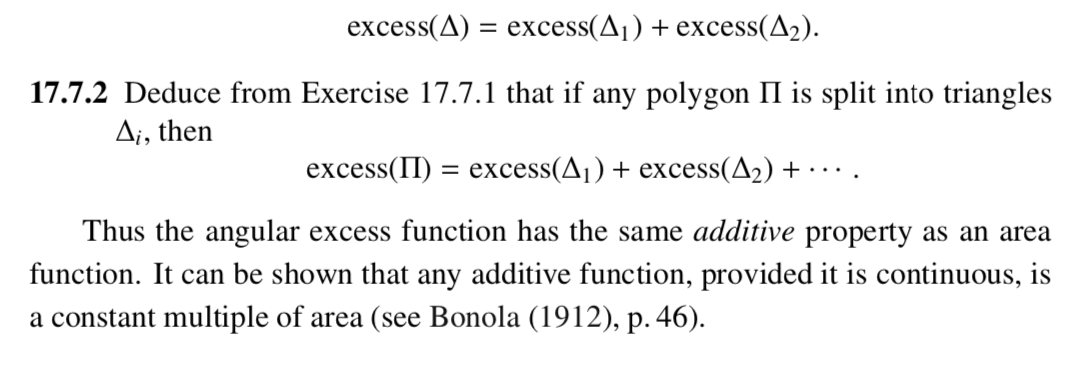
excess(A) = excess(41) + excess(A2). = 17.7.2 Deduce from Exercise 17.7.1 that if any polygon II is split into triangles Ai, then excess(II) = excess(A1) + excess(42) + .... = Thus the angular excess function has the same additive property as an area function. It can be shown that any additive function, provided it is continuous, is a constant multiple of area (see Bonola (1912), p. 46). excess(A) = excess(41) + excess(A2). = 17.7.2 Deduce from Exercise 17.7.1 that if any polygon II is split into triangles Ai, then excess(II) = excess(A1) + excess(42) + .... = Thus the angular excess function has the same additive property as an area function. It can be shown that any additive function, provided it is continuous, is a constant multiple of area (see Bonola (1912), p. 46)
Step by Step Solution
There are 3 Steps involved in it

Get step-by-step solutions from verified subject matter experts
 Study Help