



Question: exempt vs nonexempt how to properly classify exempt employees on the federal and California levels FLSA Exempt Classification Test The duties tests. An employee who
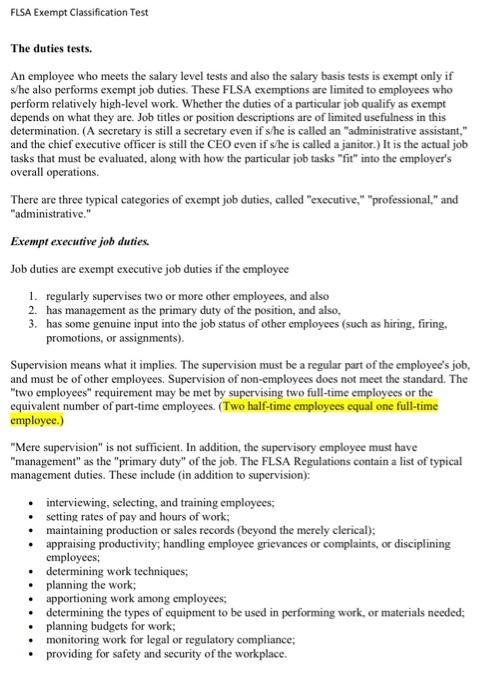
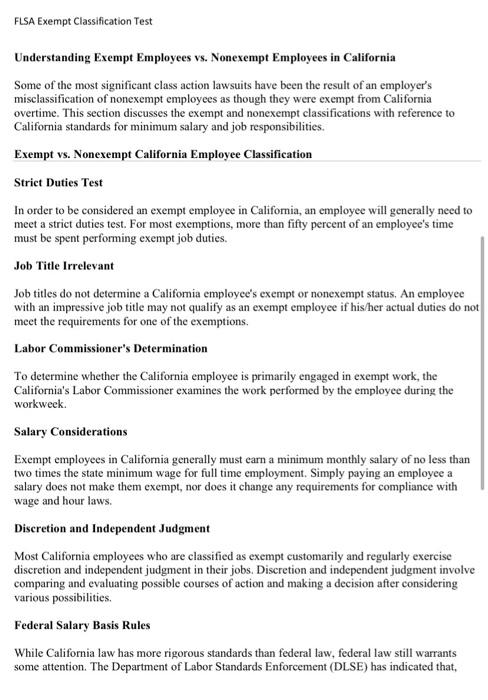
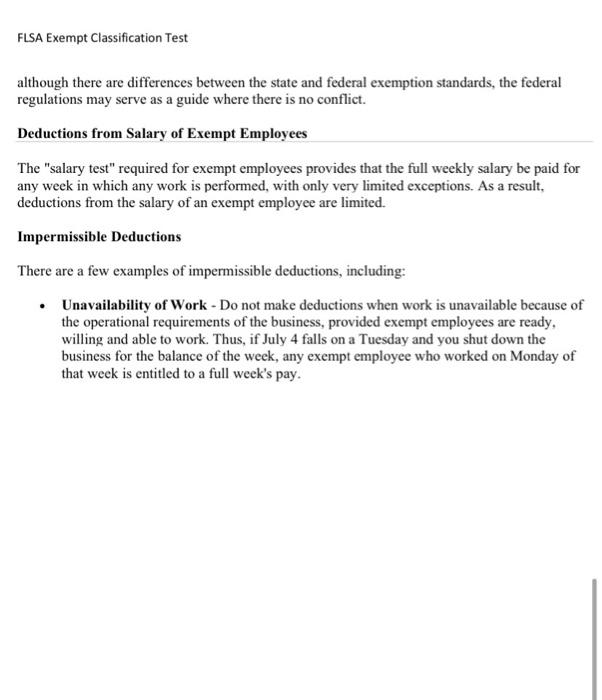
FLSA Exempt Classification Test The duties tests. An employee who meets the salary level tests and also the salary basis tests is exempt only if she also performs exempt job duties. These FLSA exemptions are limited to employees who perform relatively high-level work. Whether the duties of a particular job qualify as exempt depends on what they are. Job titles or position descriptions are of limited usefulness in this determination. (A secretary is still a secretary even if s/he is called an "administrative assistant," and the chief executive officer is still the CEO even if she is called a janitor.) It is the actual job tasks that must be evaluated, along with how the particular job tasks "fit" into the employer's overall operations. There are three typical categories of exempt job duties, called "executive, "professional," and "administrative." Exempt executive job duties. Job duties are exempt executive job duties if the employee 1. regularly supervises two or more other employees, and also 2. has management as the primary duty of the position, and also, 3. has some genuine input into the job status of other employees (such as hiring, firing, promotions, or assignments). Supervision means what it implies. The supervision must be a regular part of the employee's job, and must be of other employees: Supervision of non-employees does not meet the standard. The "two employees" requirement may be met by supervising two full-time employees or the equivalent number of part-time employees. (Two half-time cmployees cqual one full-time employee.) "Mere supervision" is not sufficient. In addition, the supervisory cmployee must have "management" as the "primary duty" of the job. The FLSA Regulations contain a list of typical management duties. These include (in addition to supervision): - interviewing, selecting, and training employecs; - setting rates of pay and hours of work; - maintaining production or sales records (beyond the merely clerical); - appraising productivity; handling employee grievances or complaints, or disciplining employees; - determining work techniques, - planning the work; - apportioning work among employees; - determining the types of equipment to be used in performing work, or materials needed; - planning budgets for work; - monitoring work for legal or regulatory compliance; - providing for safety and security of the workplace. FLSA Exempt Classification Test Understanding Exempt Employees vs. Nonexempt Employees in California Some of the most significant class action lawsuits have been the result of an employer's misclassification of nonexempt employees as though they were exempt from California overtime. This section discusses the exempt and nonexempt classifications with reference to California standards for minimum salary and job responsibilities. Exempt vs. Nonexempt California Employee Classification Strict Duties Test In order to be considered an exempt employee in Califomia, an employee will generally need to meet a strict duties test. For most exemptions, more than fifty percent of an employee's time must be spent performing exempt job duties. Job Title Irrelevant Job titles do not determine a California employee's exempt or nonexempt status. An employee with an impressive job title may not qualify as an exempt employee if his/her actual duties do not meet the requirements for one of the exemptions. Labor Commissioner's Determination To determine whether the California employee is primarily engaged in exempt work, the California's Labor Commissioner examines the work performed by the employee during the workweek. Salary Considerations Exempt employees in Califomia generally must earn a minimum monthly salary of no less than two times the state minimum wage for full time employment. Simply paying an employee a salary does not make them exempt, nor does it change any requirements for compliance with wage and hour laws. Discretion and Independent Judgment Most California employees who are classified as exempt customarily and regularly exercise discretion and independent judgment in their jobs. Discretion and independent judgment involve comparing and evaluating possible courses of action and making a decision after considering various possibilities. Federal Salary Basis Rules While California law has more rigorous standards than federal law, federal law still warrants some attention. The Department of Labor Standards Enforcement (DLSE) has indicated that, FLSA Exempt Classification Test although there are differences between the state and federal exemption standards, the federal regulations may serve as a guide where there is no conflict. Deductions from Salary of Exempt Employees The "salary test" required for exempt employees provides that the full weekly salary be paid for any week in which any work is performed, with only very limited exceptions. As a result, deductions from the salary of an exempt employee are limited. Impermissible Deductions There are a few examples of impermissible deductions, including: - Unavailability of Work - Do not make deductions when work is unavailable because of the operational requirements of the business, provided exempt employees are ready, willing and able to work. Thus, if July 4 falls on a Tuesday and you shut down the business for the balance of the week, any exempt employee who worked on Monday of that week is entitled to a full week's pay
Step by Step Solution
There are 3 Steps involved in it

Get step-by-step solutions from verified subject matter experts