







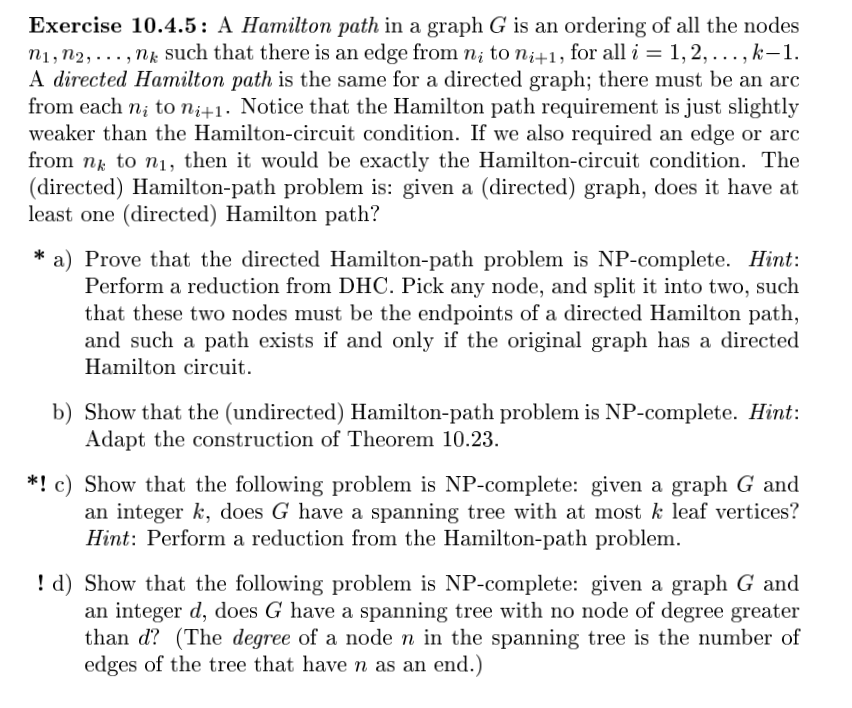
Question: Exercise 1 0 . 4 . 5 : A Hamilton path in a graph G is an ordering of all the nodes n 1 ,
Exercise : A Hamilton path in a graph is an ordering of all the nodes
dots, such that there is an edge from to for all dots,
A directed Hamilton path is the same for a directed graph; there must be an arc
from each to Notice that the Hamilton path requirement is just slightly
weaker than the Hamiltoncircuit condition. If we also required an edge or arc
from to then it would be exactly the Hamiltoncircuit condition. The
directed Hamiltonpath problem is: given a directed graph, does it have at
least one directed Hamilton path?
a Prove that the directed Hamiltonpath problem is NPcomplete. Hint:
Perform a reduction from DHC Pick any node, and split it into two, such
that these two nodes must be the endpoints of a directed Hamilton path,
and such a path exists if and only if the original graph has a directed
Hamilton circuit.
b Show that the undirected Hamiltonpath problem is NPcomplete. Hint:
Adapt the construction of Theorem
c Show that the following problem is NPcomplete: given a graph and
an integer does have a spanning tree with at most leaf vertices?
Hint: Perform a reduction from the Hamiltonpath problem.
d Show that the following problem is NPcomplete: given a graph and
an integer does have a spanning tree with no node of degree greater
than The degree of a node in the spanning tree is the number of
edges of the tree that have as an end.
Step by Step Solution
There are 3 Steps involved in it
1 Expert Approved Answer
Step: 1 Unlock

Question Has Been Solved by an Expert!
Get step-by-step solutions from verified subject matter experts
Step: 2 Unlock
Step: 3 Unlock
 Study Help