





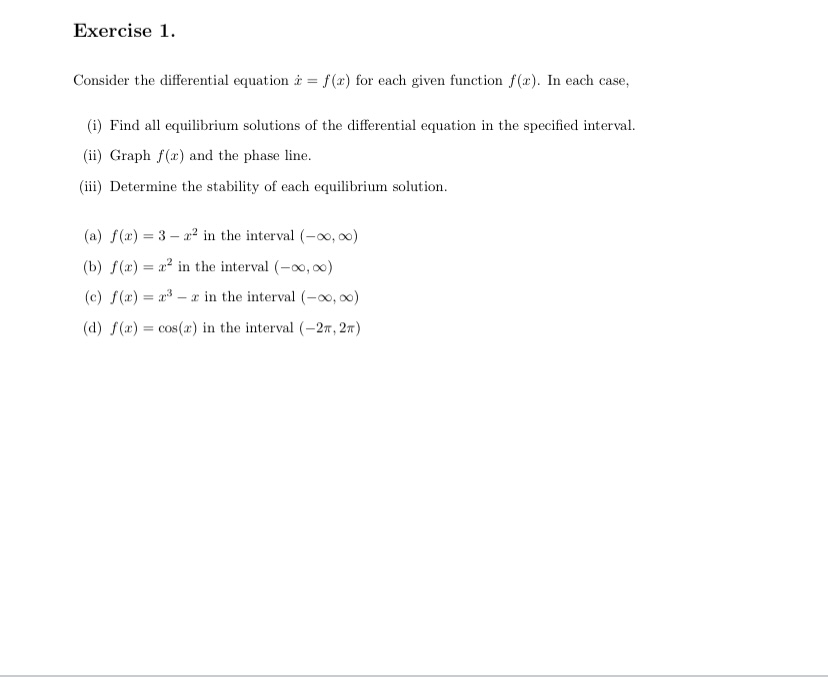
Question: Exercise 1. Consider the differential equation & = f(x) for each given function f(x). In each case, (i) Find all equilibrium solutions of the differential
Exercise 1. Consider the differential equation &Exercise 1. Consider the differential equation &
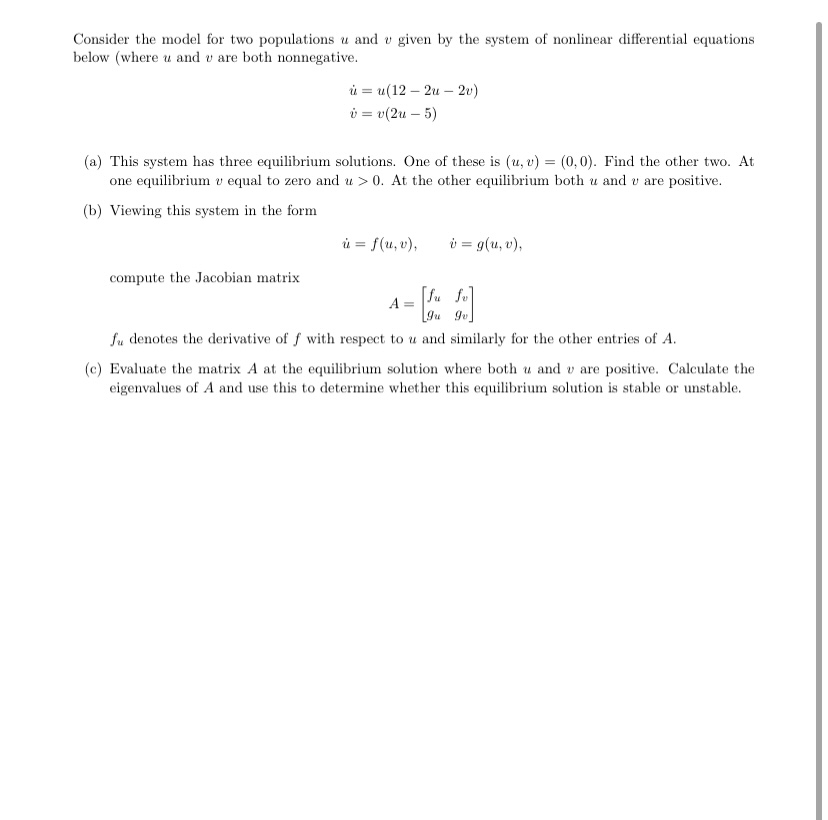
Exercise 1. Consider the differential equation & = f(x) for each given function f(x). In each case, (i) Find all equilibrium solutions of the differential equation in the specified interval. (ii) Graph f(x) and the phase line. (iii) Determine the stability of each equilibrium solution. (a) f(x) = 3-2 in the interval (-0o, co) (b) f(x) = a' in the interval (-00, co) (c) f(x) = 23 - z in the interval (-00, 00) (d) f(x) = cos(x) in the interval (-27, 27)Consider the model for two populations 1.: and u given by the system of nonlinear dierentiel equations below {where ti. and u are both nonnegetive. ti: u{12 2t: 2o} 13:1:[2115} [a] This system has three equilibrium solutions. l[Zine of these is {1511:} I {0.0). Find the other two. At one equilibrium u equal to zero and u 2} I). At the other equilibrium both it and u are positive. {b} Viewing this system in the form 1"- = in\"? \"l? 12' = Eli-H11}, [: '"l u .91: f" denotes the derivative of f with respect to u and similarly,' for the other entries of A. compute the Jacobian matrix [oi Evaluate the matrix A at the equilibrium solution where hoth n and 1: are positive. Calculate the eigenvalues of A and use this to determine whether this equilibrium solution is stable or unstable

Step by Step Solution

There are 3 Steps involved in it

1 Expert Approved Answer
Step: 1 Unlock blur-text-image

Question Has Been Solved by an Expert!

Get step-by-step solutions from verified subject matter experts

Step: 2 Unlock
Step: 3 Unlock

Students Have Also Explored These Related Mathematics Questions!