



Question: Exercise 1 Consider the following utility function, defined over the consumptions of L goods: u(x1,,xL)=v1(x1,,xL1)+v2(xL,a) where a is a scalar parameter. We denote the budget
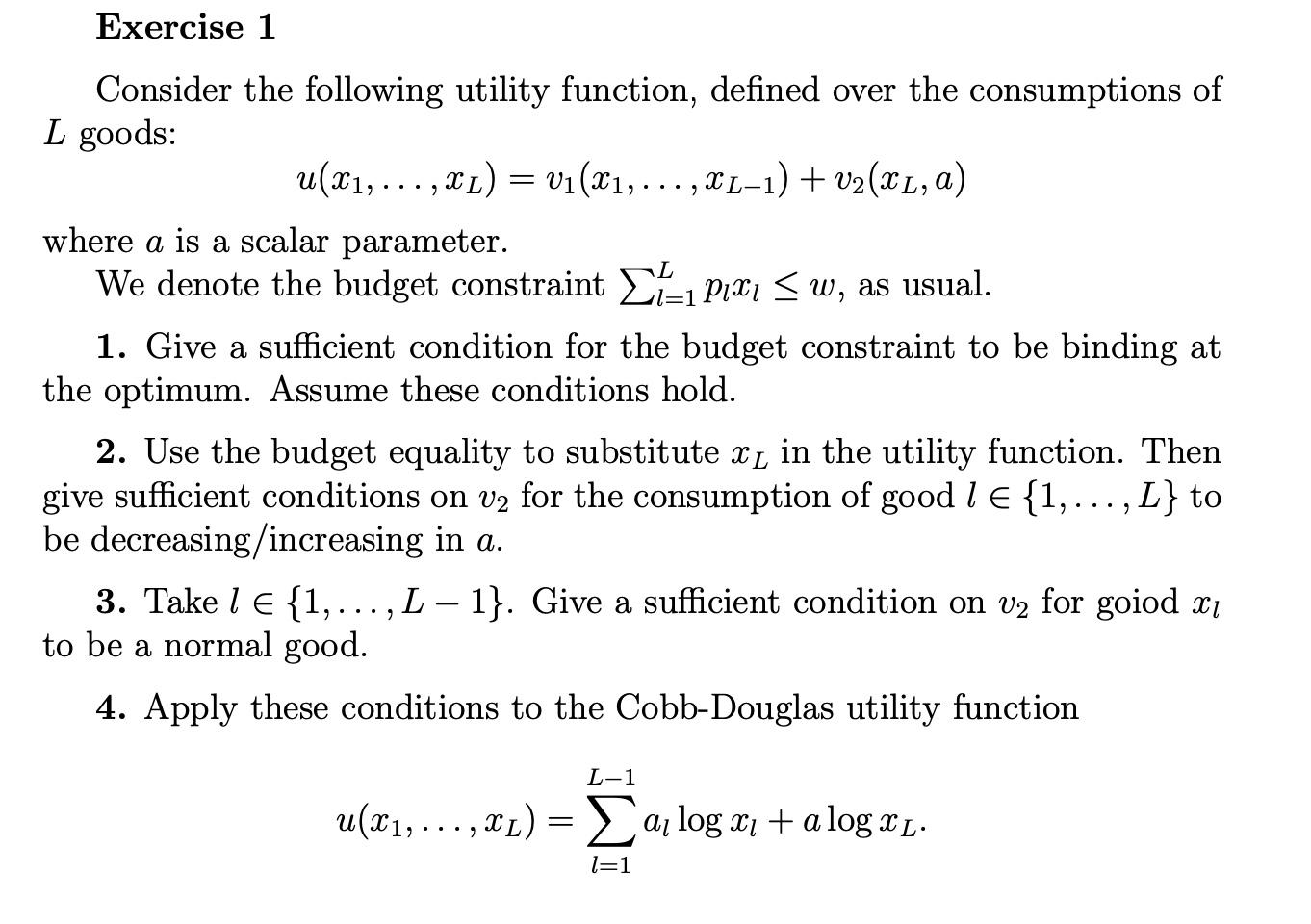
Exercise 1 Consider the following utility function, defined over the consumptions of L goods: u(x1,,xL)=v1(x1,,xL1)+v2(xL,a) where a is a scalar parameter. We denote the budget constraint l=1Lplxlw, as usual. 1. Give a sufficient condition for the budget constraint to be binding at the optimum. Assume these conditions hold. 2. Use the budget equality to substitute xL in the utility function. Then give sufficient conditions on v2 for the consumption of good l{1,,L} to be decreasing/increasing in a. 3. Take l{1,,L1}. Give a sufficient condition on v2 for goiod xl to be a normal good. 4. Apply these conditions to the Cobb-Douglas utility function u(x1,,xL)=l=1L1allogxl+alogxL Exercise 1 Consider the following utility function, defined over the consumptions of L goods: u(x1,,xL)=v1(x1,,xL1)+v2(xL,a) where a is a scalar parameter. We denote the budget constraint l=1Lplxlw, as usual. 1. Give a sufficient condition for the budget constraint to be binding at the optimum. Assume these conditions hold. 2. Use the budget equality to substitute xL in the utility function. Then give sufficient conditions on v2 for the consumption of good l{1,,L} to be decreasing/increasing in a. 3. Take l{1,,L1}. Give a sufficient condition on v2 for goiod xl to be a normal good. 4. Apply these conditions to the Cobb-Douglas utility function u(x1,,xL)=l=1L1allogxl+alogxL
Step by Step Solution
There are 3 Steps involved in it

Get step-by-step solutions from verified subject matter experts