Question: Exercise 1 Exercise 4 Consider the following relation: 1. Provide the pseudo-code of the BCNF decomposition algorithm. Stock(#prod. #dep. pname, quantity) 2. What are the
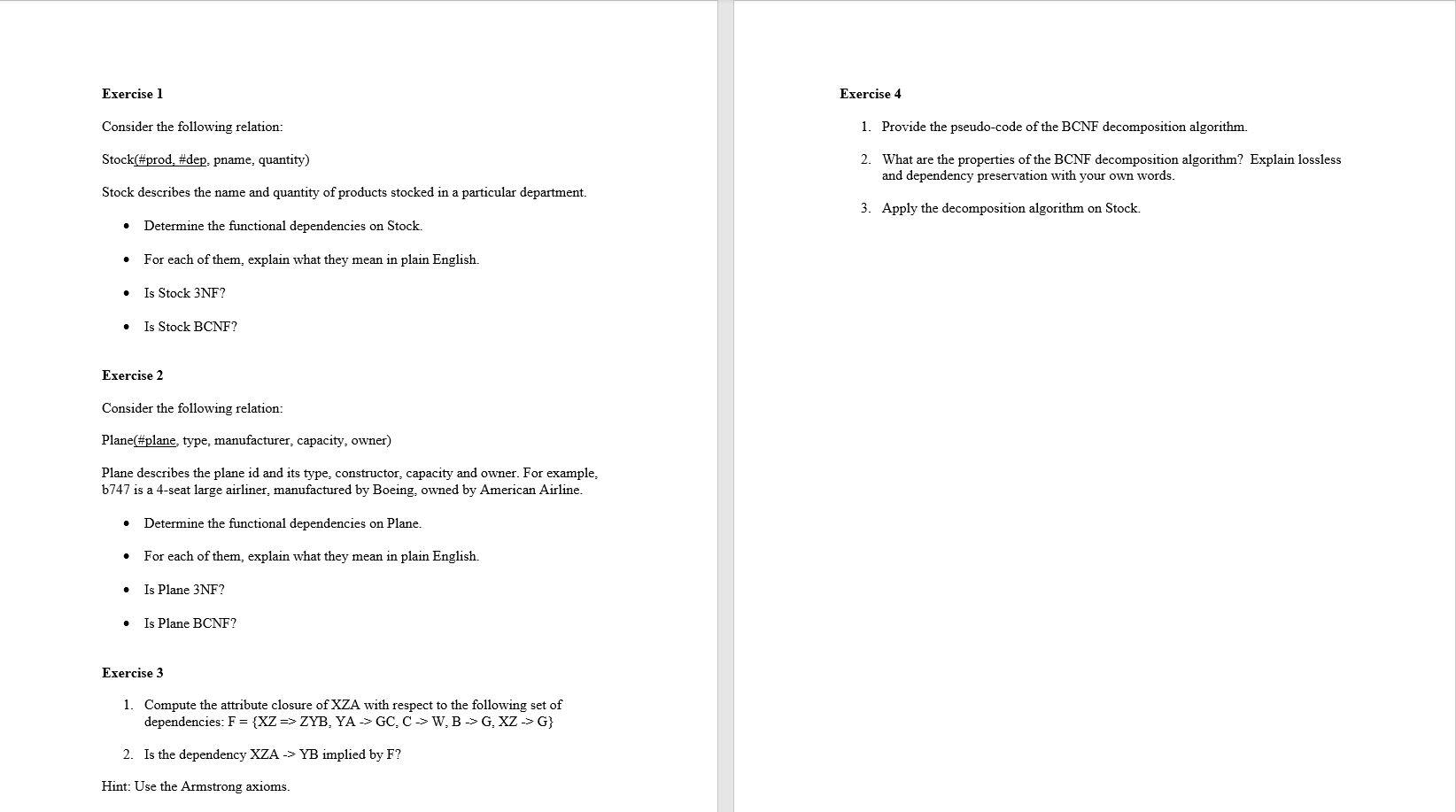
Exercise 1 Exercise 4 Consider the following relation: 1. Provide the pseudo-code of the BCNF decomposition algorithm. Stock(#prod. #dep. pname, quantity) 2. What are the properties of the BCNF decomposition algorithm? Explain lossless and dependency preservation with your own words. Stock describes the name and quantity of products stocked in a particular department. 3. Apply the decomposition algorithm on Stock. Determine the functional dependencies on Stock. . For each of them, explain what they mean in plain English. . Is Stock 3NF? Is Stock BCNF? Exercise 2 Consider the following relation: Plane(#plane, type, manufacturer, capacity, owner) Plane describes the plane id and its type, constructor, capacity and owner. For example, 6747 is a 4-seat large airliner, manufactured by Boeing, owned by American Airline. Determine the functional dependencies on Plane. For each of them, explain what they mean in plain English. Is Plane 3NF? Is Plane BCNF? Exercise 3 1. Compute the attribute closure of XZA with respect to the following set of dependencies: F = {XZ => ZYB, YA > GC, C> W. B->G, XZ > G} 2. Is the dependency XZA > YB implied by F? Hint: Use the Armstrong axioms. Exercise 1 Exercise 4 Consider the following relation: 1. Provide the pseudo-code of the BCNF decomposition algorithm. Stock(#prod. #dep. pname, quantity) 2. What are the properties of the BCNF decomposition algorithm? Explain lossless and dependency preservation with your own words. Stock describes the name and quantity of products stocked in a particular department. 3. Apply the decomposition algorithm on Stock. Determine the functional dependencies on Stock. . For each of them, explain what they mean in plain English. . Is Stock 3NF? Is Stock BCNF? Exercise 2 Consider the following relation: Plane(#plane, type, manufacturer, capacity, owner) Plane describes the plane id and its type, constructor, capacity and owner. For example, 6747 is a 4-seat large airliner, manufactured by Boeing, owned by American Airline. Determine the functional dependencies on Plane. For each of them, explain what they mean in plain English. Is Plane 3NF? Is Plane BCNF? Exercise 3 1. Compute the attribute closure of XZA with respect to the following set of dependencies: F = {XZ => ZYB, YA > GC, C> W. B->G, XZ > G} 2. Is the dependency XZA > YB implied by F? Hint: Use the Armstrong axioms









 Study Help