







Question: Exercise 1 is a Bit Slice, while Exercise 2 is an 8-Bit ALU. In the demonstration for Exercise 1, we only observed 8 input combinations.
Exercise 1 is a Bit Slice, while Exercise 2 is an 8-Bit ALU.
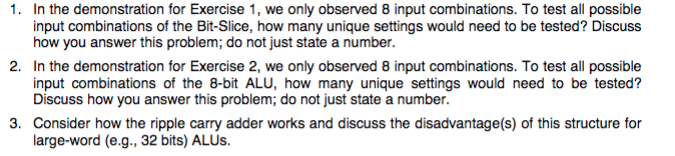
In the demonstration for Exercise 1, we only observed 8 input combinations. To test all possible input combinations of the Bit-Slice, how many unique settings would need to be tested? Discuss how you answer this problem; do not just state a number. In the demonstration for Exercise 2, we only observed 8 input combinations. To test all possible input combinations of the 8-bit ALU, how many unique settings would need to be tested? Discuss how you answer this problem; do not just state a number. Consider how the ripple carry adder works and discuss the disadvantage(s) of this structure for large-word (e.g., 32 bits) ALUs 1. 2. 3. In the demonstration for Exercise 1, we only observed 8 input combinations. To test all possible input combinations of the Bit-Slice, how many unique settings would need to be tested? Discuss how you answer this problem; do not just state a number. In the demonstration for Exercise 2, we only observed 8 input combinations. To test all possible input combinations of the 8-bit ALU, how many unique settings would need to be tested? Discuss how you answer this problem; do not just state a number. Consider how the ripple carry adder works and discuss the disadvantage(s) of this structure for large-word (e.g., 32 bits) ALUs 1. 2. 3
Step by Step Solution
There are 3 Steps involved in it

Get step-by-step solutions from verified subject matter experts
 Study Help