







Question: Exercise 1. It was the most stupid internship Prof Stanley ever had. In 2005 when he was still an undergraduate student at University Hong Kong,
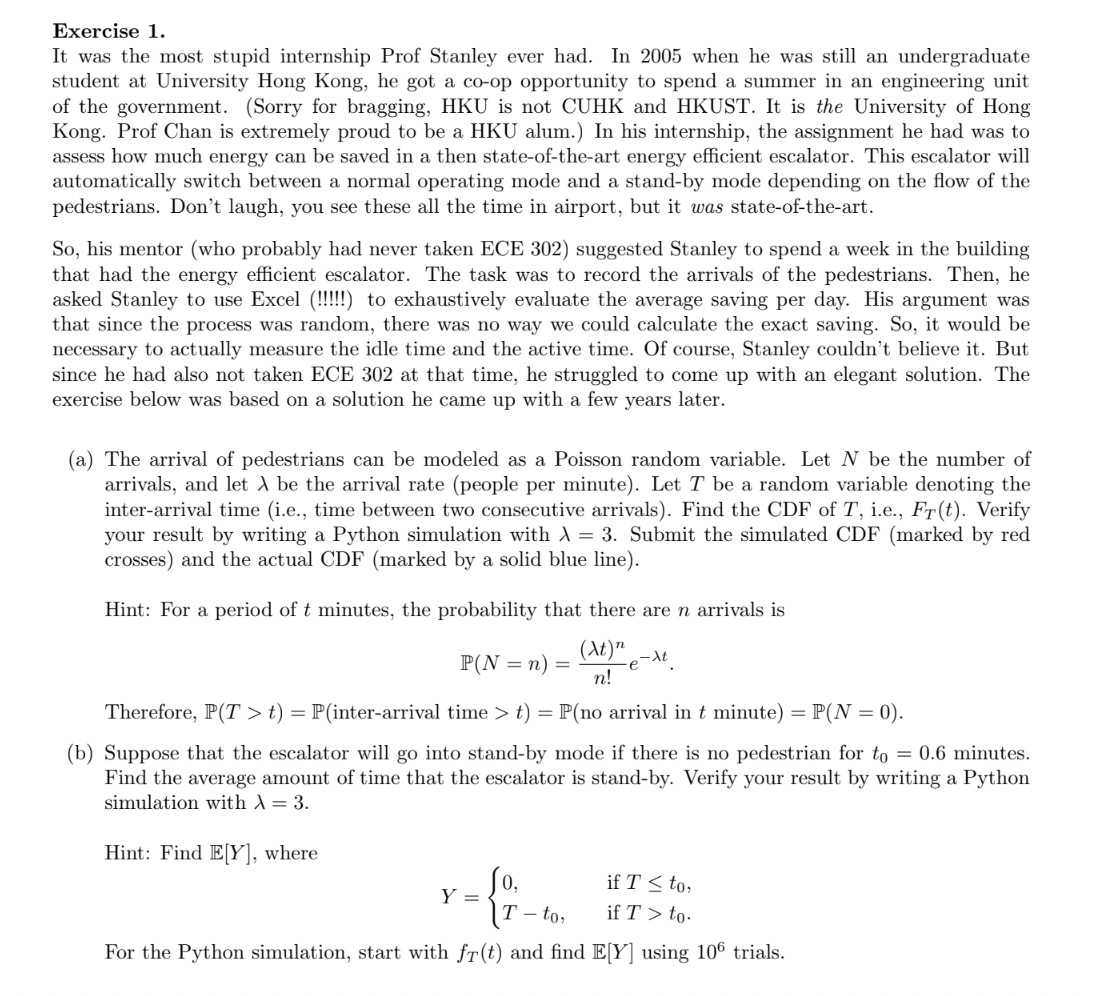
Exercise 1. It was the most stupid internship Prof Stanley ever had. In 2005 when he was still an undergraduate student at University Hong Kong, he got a co-op opportunity to spend a summer in an engineering unit of the government. (Sorry for bragging, HKU is not CUHK and HKUST. It is the University of Hong Kong. Prof Chan is extremely proud to be a HKU alum.) In his internship, the assignment he had was to assess how much energy can be saved in a then state-of-the-art energy efficient escalator. This escalator will automatically switch between a normal operating mode and a stand-by mode depending on the flow of the pedestrians. Don't laugh, yvou see these all the time in airport, but it was state-of-the-art. So, his mentor (who probably had never taken ECE 302) suggested Stanley to spend a week in the building that had the energy efficient escalator. The task was to record the arrivals of the pedestrians. Then, he that since the process was random, there was no way we could calculate the exact saving. So, it would be necessary to actually measure the idle time and the active time. Of course, Stanley couldn't believe it. But since he had also not taken ECE 302 at that time, he struggled to come up with an elegant solution. The exercise below was based on a solution he came up with a few years later. (a) The arrival of pedestrians can be modeled as a Poisson random variable. Let N be the number of arrivals, and let )\\ be the arrival rate (people per minute). Let T be a random variable denoting the inter-arrival time (i.e., time between two consecutive arrivals). Find the CDF of T, i.e., Fr(t). Verify your result by writing a Python simulation with A = 3. Submit the simulated CDF (marked by red crosses) and the actual CDF (marked by a solid blue line). Hint: For a period of minutes, the probability that there are n arrivals is 0" n! P(N =n) = Therefore, P(T > t) = P(inter-arrival time > ) = P(no arrival in minute) = P(N = 0). (b) Suppose that the escalator will go into stand-by mode if there is no pedestrian for o = 0.6 minutes. Find the average amount of time that the escalator is stand-by. Verify your result by writing a Python simulation with A = 3. Hint: Find E[Y], where Y 0, if T
Step by Step Solution
There are 3 Steps involved in it

Get step-by-step solutions from verified subject matter experts
 Study Help