







Question: Exercise 1 (Problem 3.21 in Bertsekas-Tsitsiklis). We start with a stick of length 6'. We break it at a point which is chosen according to
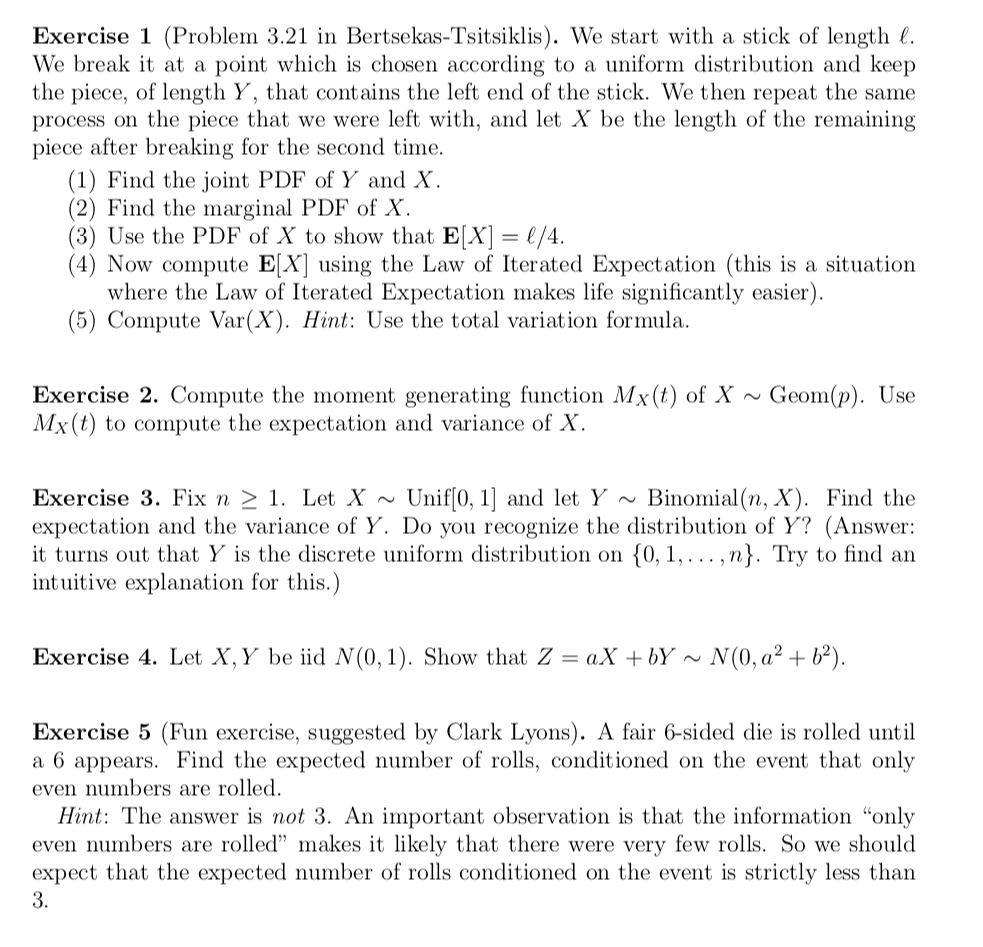
Exercise 1 (Problem 3.21 in Bertsekas-Tsitsiklis). We start with a stick of length 6'. We break it at a point which is chosen according to a uniform distribution and keep the piece, of length Y, that contains the left end of the stick. We then repeat the same process on the piece that we were left with, and let X be the length of the remaining piece after breaking for the second time. (1) Find the joint PDF of Y and X. (2) Find the marginal PDF of X. (3) Use the PDF of X to show that E[X] = 6/4. (4) Now compute E[X] using the Law of Iterated Expectation (this is a situation where the Law of Iterated Expectation makes life significantly easier). (5) Compute Var(X). Hint: Use the total variation formula. Exercise 2. Compute the moment generating function M x(t) of X ~ Geom(p). Use Mx(t) to compute the expectation and variance of X. Exercise 3. Fix n 2 1. Let X ~ Unif[0, 1] and let Y ~ Binomial(n,X). Find the expectation and the variance of Y. Do you recognize the distribution of Y? (Answer: it turns out that Y is the discrete uniform distribution on {0, 1,. .. ,n}. Try to nd an intuitive explanation for this.) Exercise 4. Let X,Y be iid N(0,1). Show that Z = aX +bY ~ J'\ '(0,u.2 + b2). Exercise 5 (Fun exercise, suggested by Clark Lyons). A fair 6-sided die is rolled until a 6 appears. Find the expected number of rolls, conditioned on the event that only even numbers are rolled. Hint: The answer is not 3. An important observation is that the information \"only even numbers are rolled\" makes it likely that there were very few rolls. So we should expect that the expected number of rolls conditioned on the event is strictly less than 3
Step by Step Solution
There are 3 Steps involved in it

Get step-by-step solutions from verified subject matter experts
 Study Help