







Question: Exercise 1 Transporting Fruits at Future Logistics Future Logistics (FL) ships avocados and mangos once a week from Queensland to Sydney. This morning they have
Exercise 1
Transporting Fruits at Future Logistics
Future Logistics (FL) ships avocados and mangos once a week from Queensland to Sydney. This morning they have 39 tons of avocados and 36 tons of mangos on hand. The fruits all go to the Fruit Market in Sydney and therefore can be mixed on the company's three trucks. The capacities of the three tracks are 27, 31, and 28 tons, respectively.
To make it easy for transportation, fruits are packed in 20-pound cartons. Assume that there are 2000 pounds in a ton so that 39 tons of avocado are packed into 3900 cartons, and 36 tons of mangos are packed into 3600 cartons.
The travelling costs of the trucks are negligible and independent of what fruits they ship; all three trucks will be used in this shipment.
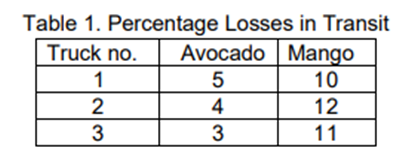
Spoilage occurs during the transportation of fruit from Queensland to Sydney. Because of differences in their refrigeration systems, the fruit losses differ by the truck as follows:
For example, 5% of avocados in each carton placed in truck 1 and 11% of the mangoes placed in truck 3 will be spoiled upon arrival in Sydney.
FL sells the unspoiled avocadoes for $20 per carton and unspoiled mangoes for $32 per carton. Because of spoilage during transport to Sydney, however, FL must discount the amounts for which it sells cartons of fruit. For example, because 5% of the avocados shipped in truck 1 will be spoiled by the time they reach Sydney, FL will be able to sell cartons shipped on truck 1 for only $20*(1-0.05) = $19. Similarly, because 11% of the mangoes shipped on truck 3 will have spoiled, FL can sell cartons of mangoes shipped on truck 3 for only $32*(1-0.11) = $28.48. As such, the number of cartons of each fruit loaded on each truck will impact its revenue from selling fruits in Sydney.
Let A1, A2, and A3 be the number of cartons of avocado loaded on trucks 1, 2, and 3, respectively, and let M1, M2, and M3 be the numbers of cartons of mango loaded on trucks 1, 2, and 3, respectively.
Questions:
(a) Suppose that FL plans to put the same number of cartons for each fruit on each truck, in other words, suppose that FL sets A1 = A2 = A3 = 1300 and M1 = M2 = M3 = 1200. Is this a feasible plan?
(b) Irrespective of whether or not the plan in part (a) is feasible, what is the total revenue that FL would earn under this plan?
(c) Intuitively, do you think the plan in part (a) is a good plan? Why or why not?
(d) Suppose FL plans to fill up truck 1 with mangos because truck 1 has the lowest spoilage rate for mango, fill up truck 3 with avocados because truck 3 has the lowest spoilage rate for avocados, and then put all the remaining fruit to truck 2. What is the resulted plan? Is this plan feasible? What is the total revenue?
(e) How should FL load the avocado and mango to the three trucks, in order to maximize its total revenue? What is the maximized total revenue?
\f
Step by Step Solution
There are 3 Steps involved in it

Get step-by-step solutions from verified subject matter experts
 Study Help