







Question: Exercise 1 Vending Machine. A vending machine sells small, packaged, ready to eat items (chocolate bars, cookies, candies, etc.). Each item has a price and
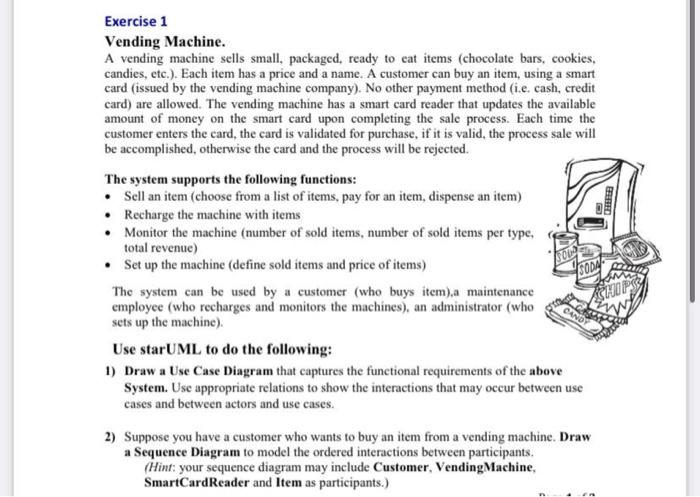
Exercise 1 Vending Machine. A vending machine sells small, packaged, ready to eat items (chocolate bars, cookies, candies, etc.). Each item has a price and a name. A customer can buy an item, using a smart card (issued by the vending machine company). No other payment method (i.e. cash, credit card) are allowed. The vending machine has a smart card reader that updates the available amount of money on the smart card upon completing the sale process. Each time the customer enters the card, the card is validated for purchase, if it is valid, the process sale will be accomplished, otherwise the card and the process will be rejected. The system supports the following functions: Sell an item (choose from a list of items, pay for an item, dispense an item) Recharge the machine with items Monitor the machine (number of sold items, number of sold items per type, total revenue) Set up the machine (define sold items and price of items) The system can be used by a customer (who buys item),a maintenance employee (who recharges and monitors the machines), an administrator (who sets up the machine) Use starUML to do the following: 1) Draw a Use Case Diagram that captures the functional requirements of the above System. Use appropriate relations to show the interactions that may occur between use cases and between actors and use cases. HOLD song SHOP CANDY 2) Suppose you have a customer who wants to buy an item from a vending machine. Draw a Sequence Diagram to model the ordered interactions between participants. (Hint: your sequence diagram may include Customer, Vending Machine, SmartCard Reader and Item as participants.)
Step by Step Solution
There are 3 Steps involved in it

Get step-by-step solutions from verified subject matter experts
 Study Help