







Question: Exercise 1: Which steps is not valid? Exercise 2: a) The sum of any three consecutive even numbers is always a multiple of 6 b)
Exercise 1: Which steps is not valid?
Exercise 2:
a) The sum of any three consecutive even numbers is always a multiple of 6
b) The sum of any four consecutive odd numbers is always a multiple of 8
c) Prove that if you add the squares of two consecutive integer numbers and then add one, you always get an even number.
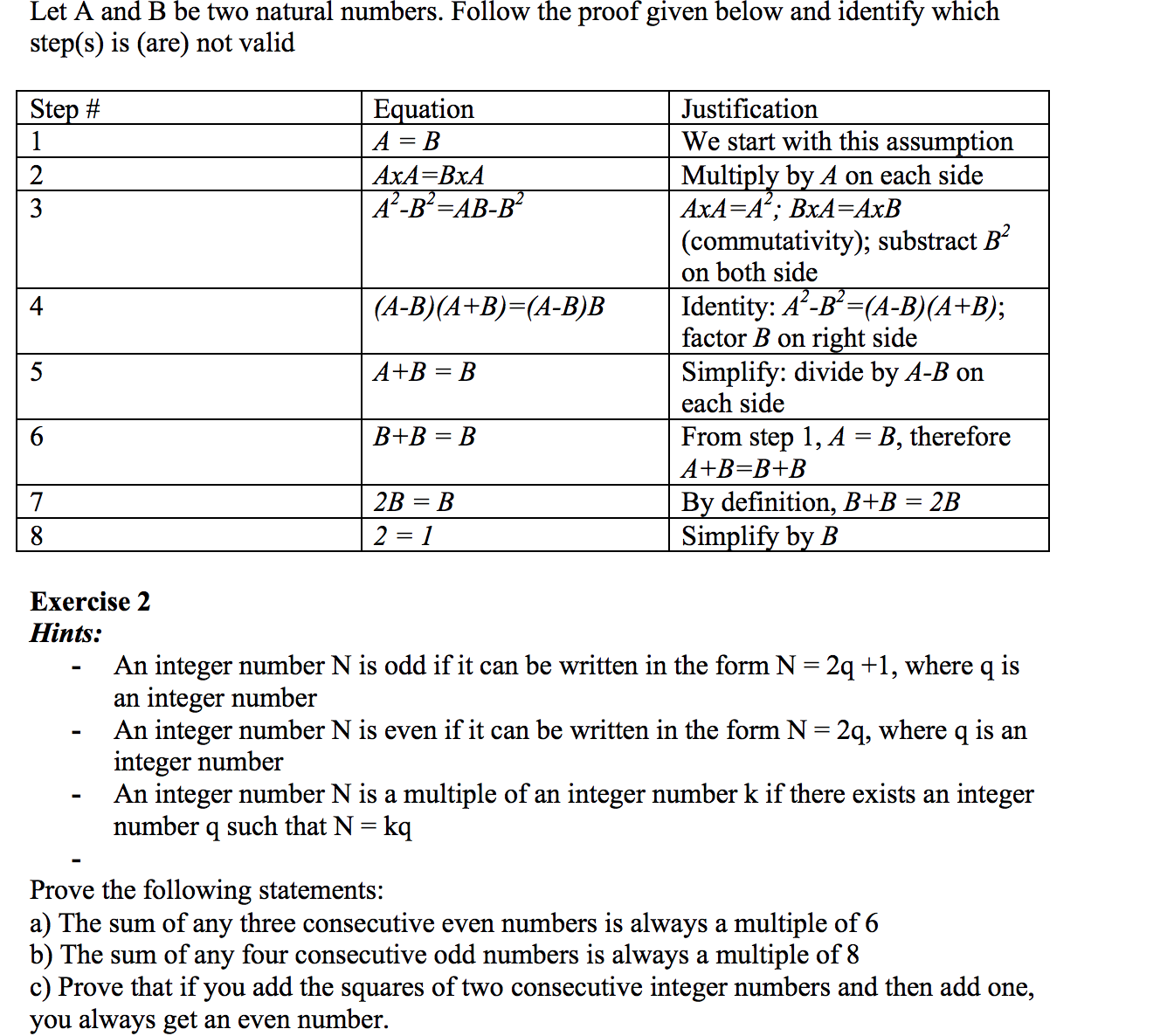
Let A and B be two natural numbers. Follow the proof given below and identify which step(s) is (are) not valid Justication We start with this assum ntion AxA=BxA Multi :1 b A on each side A -B =AB-B AxA =A ; BxA =AxB (commutativity); substract 32 on both side (A-B)(A+B)=(A-B)B Identity: A - . =(A-B)(A+B); factor B on ri_ht side A+B = B Simplify: divide by A-B on each side B+B = B From step 1, A = B, therefore A+B=B+B E c uation E. || CU _ _ 23 = B B denition, B+B = 28 2 = I Sim-1i b B Exercise 2 Hints: - An integer number N is odd if it can be written in the form N = 2q +1, where q is an integer number - An integer number N is even if it can be written in the form N = 2q, where q is an integer number - An integer number N is a multiple of an integer number k if there exists an integer number q such that N = kq Prove the following statements: a) The sum of any three consecutive even numbers is always a multiple of 6 b) The sum of any four consecutive odd numbers is always a multiple of 8 c) Prove that if you add the squares of two consecutive integer numbers and then add one, you always get an even number
Step by Step Solution
There are 3 Steps involved in it

Get step-by-step solutions from verified subject matter experts
 Study Help