







Question: Exercise 1.13 Suppose that we are developing a new version of the AMD Barcelona proces- sor with a 4 GHz clock rate. We have added
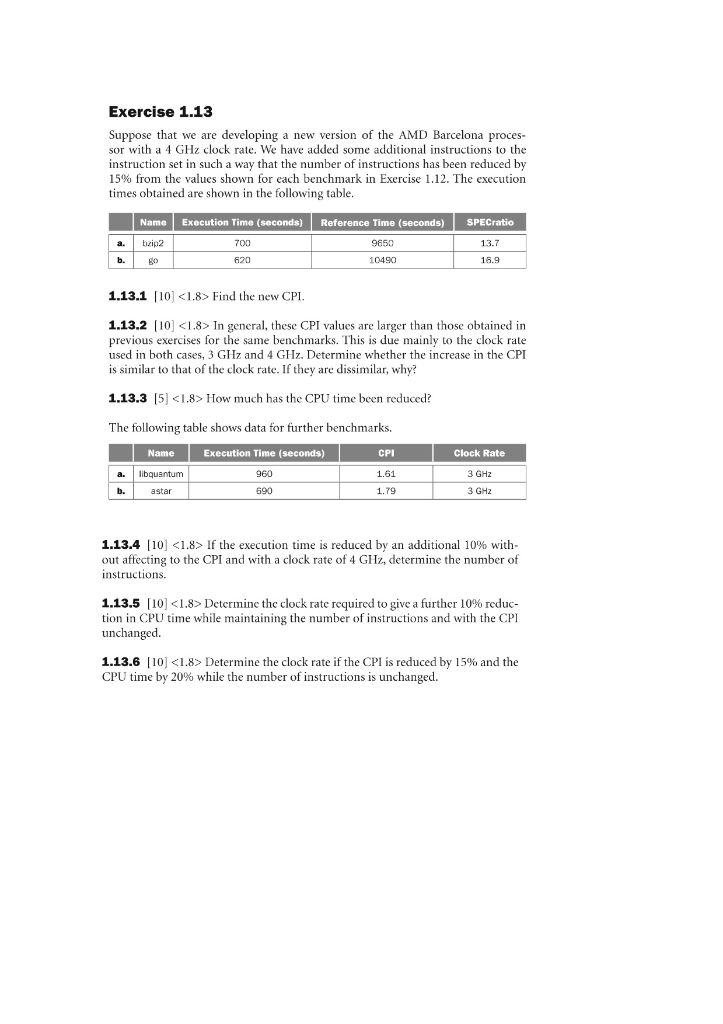
Exercise 1.13 Suppose that we are developing a new version of the AMD Barcelona proces- sor with a 4 GHz clock rate. We have added some additional instructions to the instruction set in such a way that the number of instructions has been reduced by 15% from the values shown for each benchmark in Exercise 1.12. The execution times obtained are shown in the following table. Execution Time (seconds) Reference Time (seconds) SPECratio Name bzip2 a. 700 9650 10490 13.7 15.9 620 1.13.1 (10) Find the new CPI. 1.13.2 (10) In general, these CPI values are larger than those obtained in previous exercises for the same benchmarks. This is due mainly to the clock rate used in both cases, 3 GHz and 4 GHz. Determine whether the increase in the CPI is similar to that of the clock rate. If they are dissimilar, why? 1.13.3 [5] How much has the CPU time been reduced? Clock Rate The following table shows data for further benchmarks. Name Execution Time (seconds) CPI a. libquantum 960 1.61 b. astar 690 1. 793 3 GHz GHz 1.13.4 [10] If the execution time is reduced by an additional 10% with out affecting to the CPI and with a clock rate of 4 GII2, determine the number of instructions. 1.13.5 (10) Determine the clock rate required to give a further 10% reduc- tion in CPU time while maintaining the number of instructions and with the CPI unchanged. 1.13.6 (10) Determine the clock rate if the CPI is reduced by 15% and the CPU time by 20% while the number of instructions is unchanged. Exercise 1.13 Suppose that we are developing a new version of the AMD Barcelona proces- sor with a 4 GHz clock rate. We have added some additional instructions to the instruction set in such a way that the number of instructions has been reduced by 15% from the values shown for each benchmark in Exercise 1.12. The execution times obtained are shown in the following table. Execution Time (seconds) Reference Time (seconds) SPECratio Name bzip2 a. 700 9650 10490 13.7 15.9 620 1.13.1 (10) Find the new CPI. 1.13.2 (10) In general, these CPI values are larger than those obtained in previous exercises for the same benchmarks. This is due mainly to the clock rate used in both cases, 3 GHz and 4 GHz. Determine whether the increase in the CPI is similar to that of the clock rate. If they are dissimilar, why? 1.13.3 [5] How much has the CPU time been reduced? Clock Rate The following table shows data for further benchmarks. Name Execution Time (seconds) CPI a. libquantum 960 1.61 b. astar 690 1. 793 3 GHz GHz 1.13.4 [10] If the execution time is reduced by an additional 10% with out affecting to the CPI and with a clock rate of 4 GII2, determine the number of instructions. 1.13.5 (10) Determine the clock rate required to give a further 10% reduc- tion in CPU time while maintaining the number of instructions and with the CPI unchanged. 1.13.6 (10) Determine the clock rate if the CPI is reduced by 15% and the CPU time by 20% while the number of instructions is unchanged
Step by Step Solution
There are 3 Steps involved in it

Get step-by-step solutions from verified subject matter experts
 Study Help