







Question: Exercise 11-47 Physical Quantities Method with By-Product (LO 11-8, 10) Trans-Pacific Lumber runs a mill in the Northwest that produces two grades of lumber, A
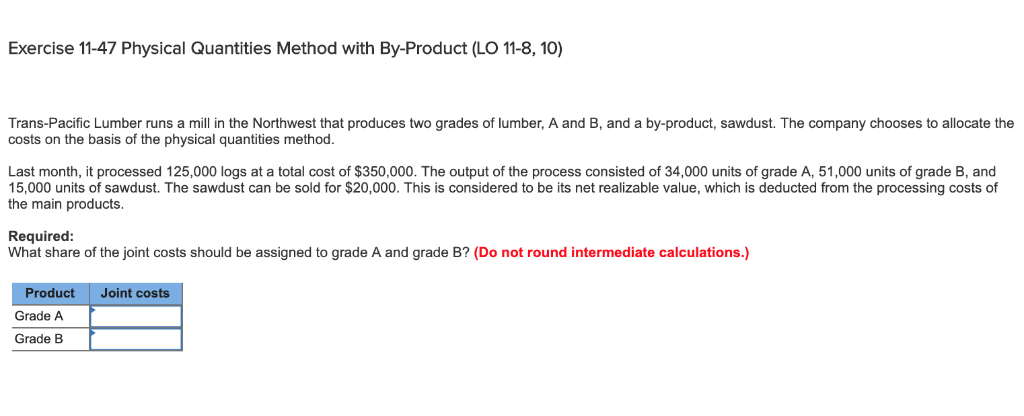
Exercise 11-47 Physical Quantities Method with By-Product (LO 11-8, 10) Trans-Pacific Lumber runs a mill in the Northwest that produces two grades of lumber, A and B, and a by-product, sawdust. The company chooses to allocate the costs on the basis of the physical quantities method Last month, it processed 125,000 logs at a total cost of $350,000. The output of the process consisted of 34,000 units of grade A, 51,000 units of grade B, and 15,000 units of sawdust. The sawdust can be sold for $20,000. This is considered to be its net realizable value, which is deducted from the processing costs of the main products. Required What share of the joint costs should be assigned to grade A and grade B? (Do not round intermediate calculations.) Product Joint costs Grade A Grade B
Step by Step Solution
There are 3 Steps involved in it

Get step-by-step solutions from verified subject matter experts
 Study Help