





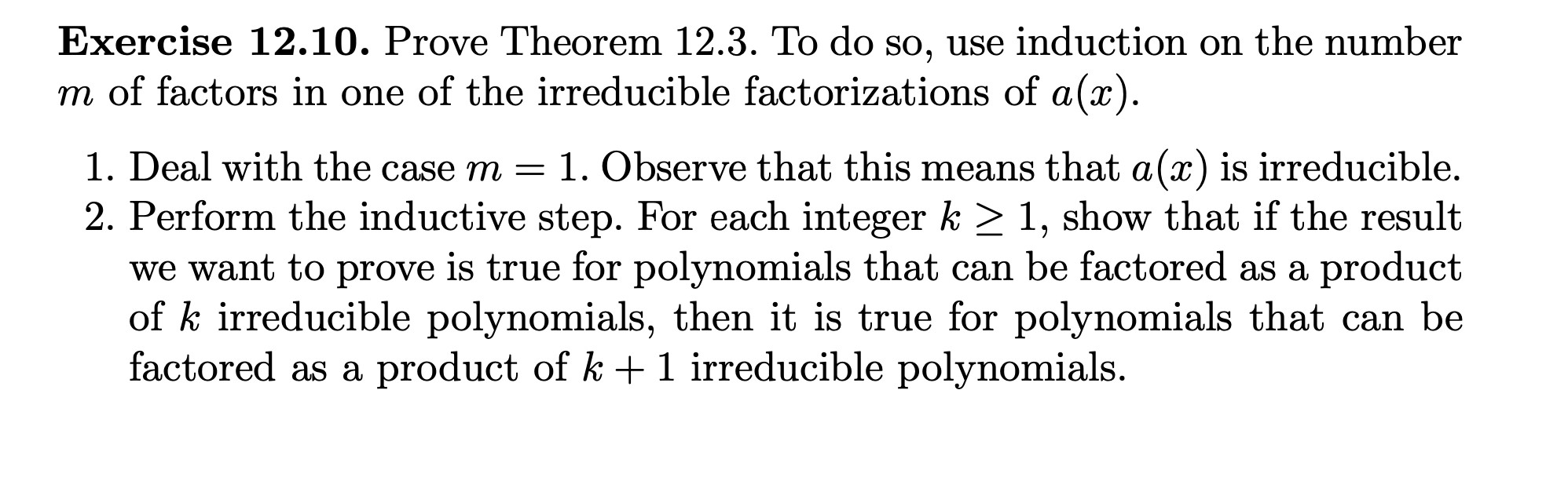
Question: Exercise 12.10. Prove Theorem 12.3. To do so, use induction on the number m of factors in one of the irreducible factorizations of (1(1):). 1.
Exercise 12.10. Prove Theorem 12.3. To do so, useExercise 12.10. Prove Theorem 12.3. To do so, use
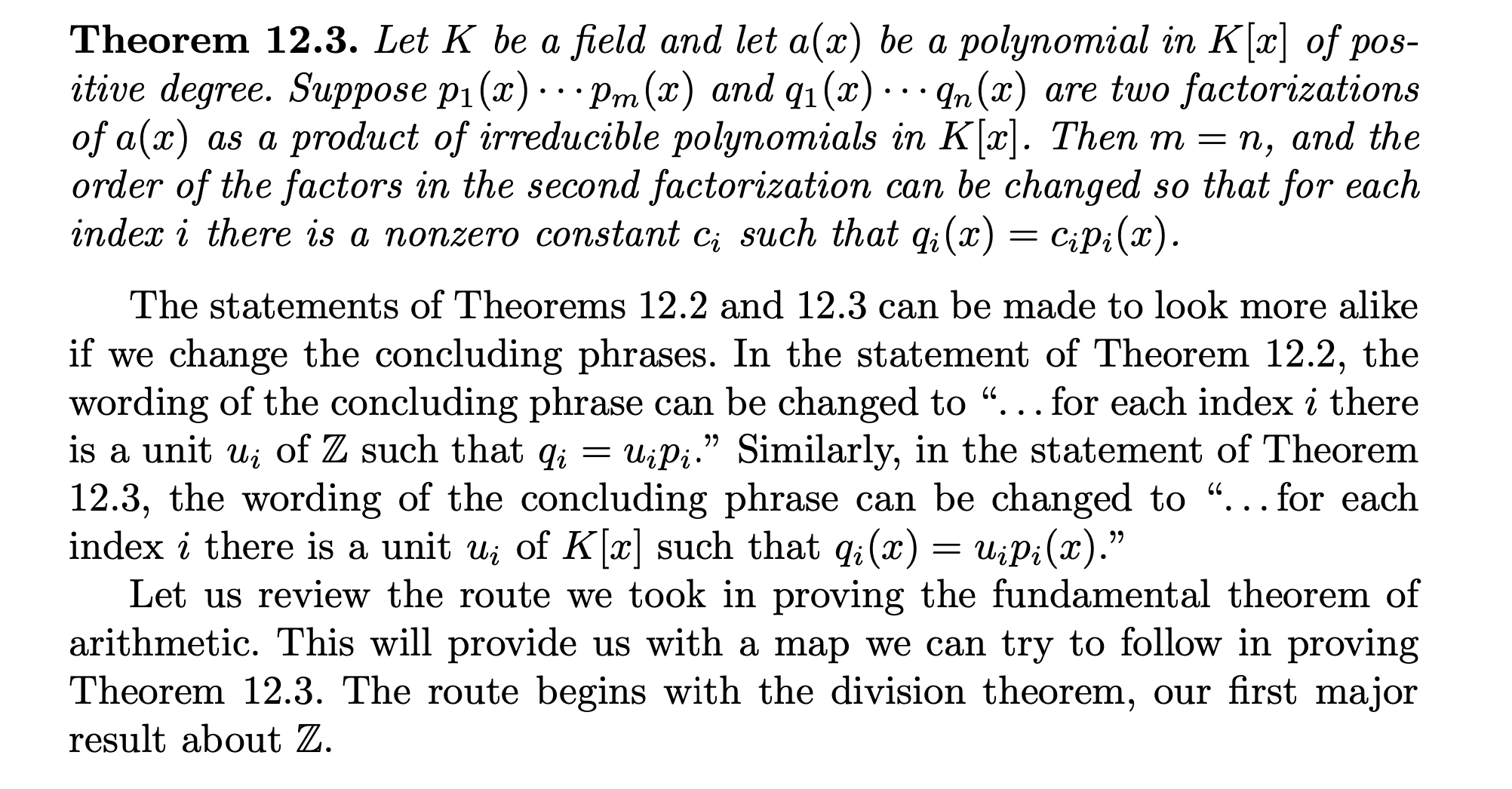
Exercise 12.10. Prove Theorem 12.3. To do so, use induction on the number m of factors in one of the irreducible factorizations of (1(1):). 1. Deal With the case m = 1. Observe that this means that a(:r;) is irreducible. 2. Perform the inductive step. For each integer k 2 1, show that if the result we want to prove is true for polynomials that can be factored as a product of k irreducible polynomials, then it is true for polynomials that can be factored as a product of k + 1 irreducible polynomials. Theorem 12.3. Let K be a eld and let a(:c) be a polynomial in K [as] of pos- itive degree. Suppose p1(:t) - - - pm(x) and q1(:c) - - . qn(w) are two factorizations of a(:c) as a product of irreducible polynomials in K [:12] Then m = n, and the order of the factors in the second factorization can be changed so that for each indesci there is a nonzero constant cz- such that qi(a:) = cip7;(:c). The statements of Theorems 12.2 and 12.3 can be made to look more alike if we change the concluding phrases. In the statement of Theorem 12.2, the wording of the concluding phrase can be changed to \". . . for each index i there is a unit uz- of Z such that qz- = uipi.\" Similarly, in the statement of Theorem 12.3, the wording of the concluding phrase can be changed to \". . . for each index i there is a unit W of K [x] such that (1,; (:c) = mpg-(1:)? Let us review the route we took in proving the fundamental theorem of arithmetic. This will provide us with a map we can try to follow in proving Theorem 12.3. The route begins with the division theorem, our rst major result about Z

Step by Step Solution

There are 3 Steps involved in it

1 Expert Approved Answer
Step: 1 Unlock blur-text-image
Question Has Been Solved by an Expert!

Get step-by-step solutions from verified subject matter experts

Step: 2 Unlock
Step: 3 Unlock

Students Have Also Explored These Related Mathematics Questions!