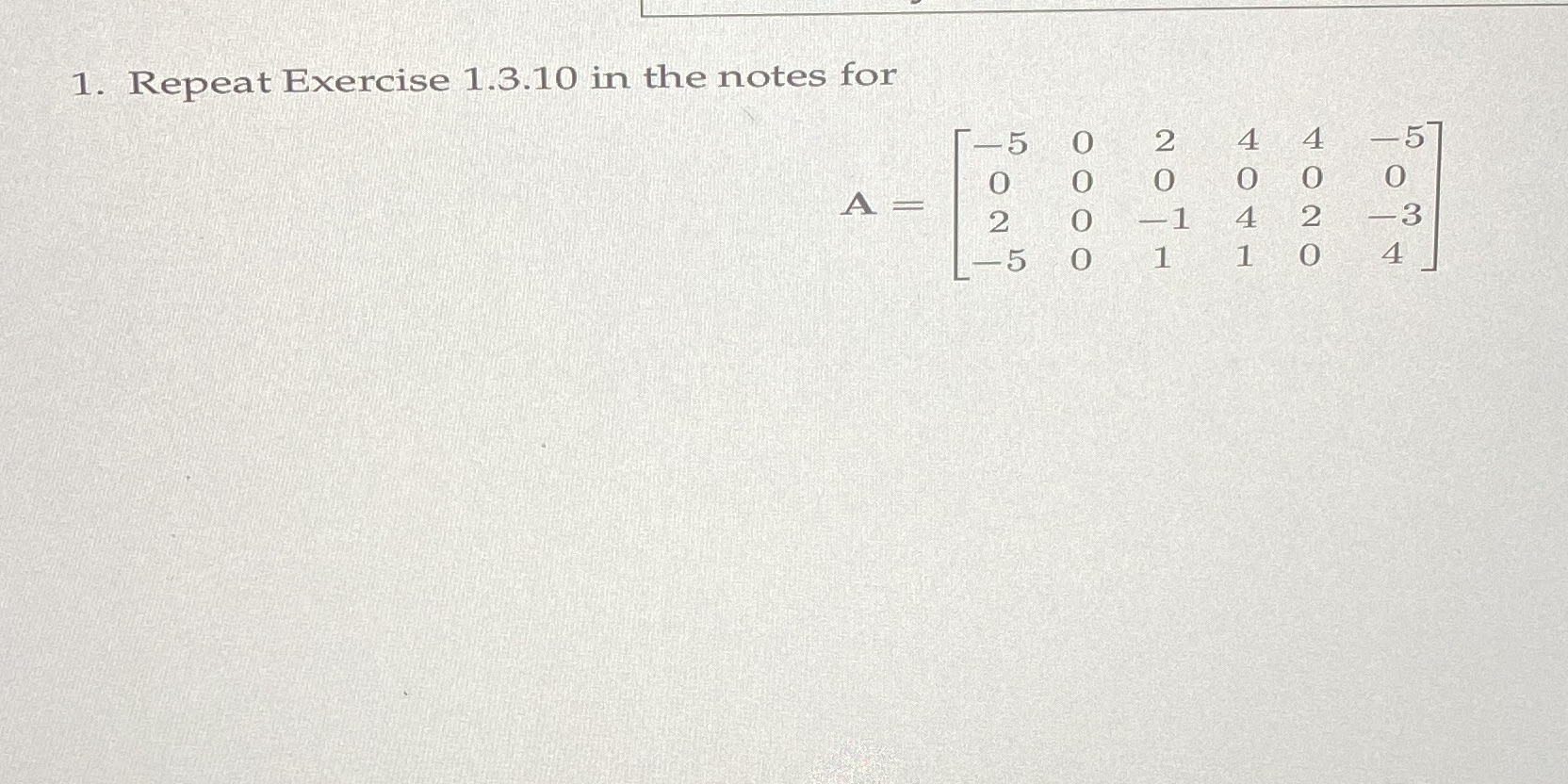
Question: Exercise 1.3.10: Compute the rank in 2 ways: using the definition of Linear independence with setting a system of equations using alpha and the rank
Exercise 1.3.10: Compute the rank in 2 ways: using the definition of Linear independence with setting a system of equations using alpha and the rank and determinant theorem.
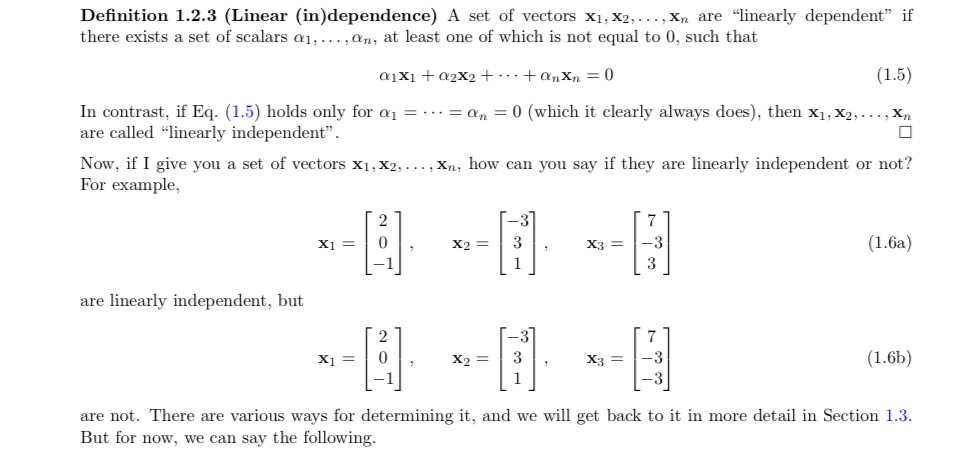
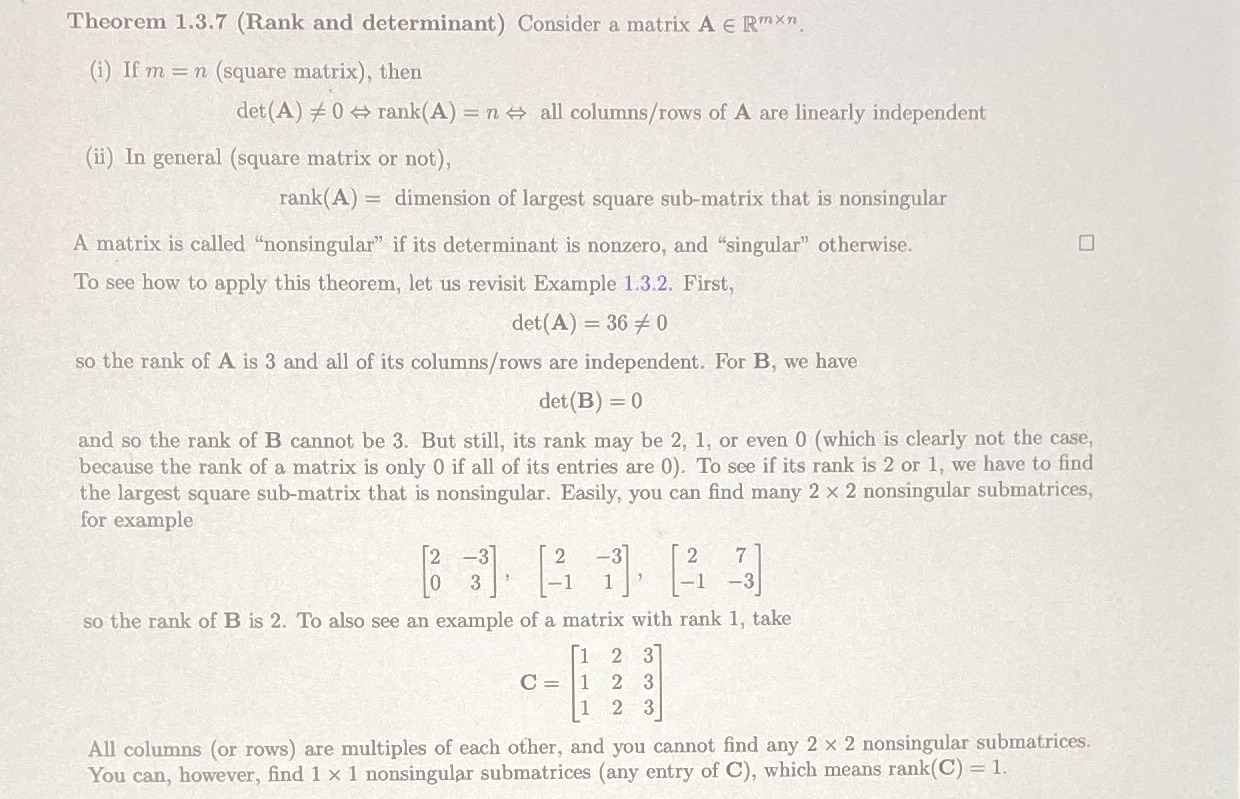
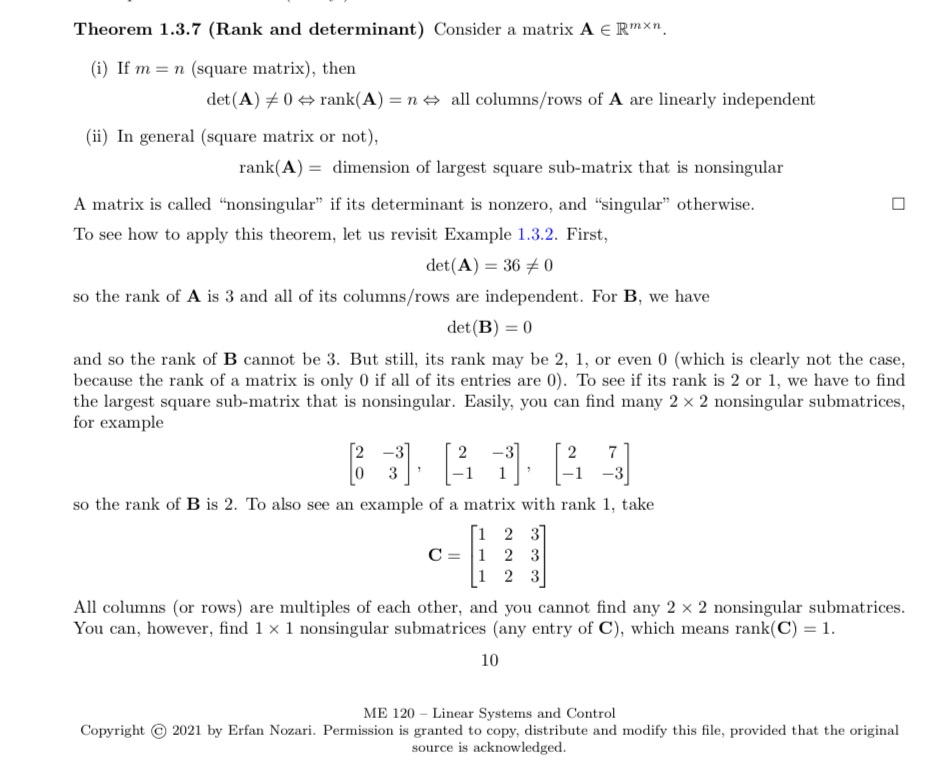
Definition 1.2.3 (Linear (in)dependence) A set of vectors X1, X2, ..., Xn are "linearly dependent" if there exists a set of scalars o1, ..., On, at least one of which is not equal to 0, such that (1X1 + 02x2 + . . . + OnXn =0 (1.5) In contrast, if Eq. (1.5) holds only for a1 = ... = On =0 (which it clearly always does), then X1, X2, . .., Xn are called "linearly independent". Now, if I give you a set of vectors X1, X2, ..., Xn, how can you say if they are linearly independent or not? For example, X1= X2 = X3 = 3 (1.6a) 3 are linearly independent, but X1 = X2 = X3 = 3 (1.6b) are not. There are various ways for determining it, and we will get back to it in more detail in Section 1.3. But for now, we can say the following.1. Repeat Exercise 1.3.10 in the notes for -5 O A - HION HAOR ONO 2Theorem 1.3.7 (Rank and determinant) Consider a matrix A E Rmxn. (i) If m = n (square matrix), then det(A) # 0 all columns/rows of A are linearly independent (ii) In general (square matrix or not), rank(A) = dimension of largest square sub-matrix that is nonsingular A matrix is called "nonsingular" if its determinant is nonzero, and "singular" otherwise. To see how to apply this theorem, let us revisit Example 1.3.2. First, det (A) = 36 # 0 so the rank of A is 3 and all of its columns/rows are independent. For B, we have det (B) = 0 and so the rank of B cannot be 3. But still, its rank may be 2, 1, or even 0 (which is clearly not the case, because the rank of a matrix is only 0 if all of its entries are 0). To see if its rank is 2 or 1, we have to find the largest square sub-matrix that is nonsingular. Easily, you can find many 2 x 2 nonsingular submatrices, for example so the rank of B is 2. To also see an example of a matrix with rank 1, take C = All columns (or rows) are multiples of each other, and you cannot find any 2 x 2 nonsingular submatrices. You can, however, find 1 x 1 nonsingular submatrices (any entry of C), which means rank(C) = 1. 10 ME 120 - Linear Systems and Control Copyright @ 2021 by Erfan Nozari. Permission is granted to copy, distribute and modify this file, provided that the original source is acknowledged









 Study Help