







Question: Exercise 1.5. In Example 1.2.4, we considered an agent who sold the lookback option for V0=1.376 and bought 0=0.1733 shares of stock at time zero.
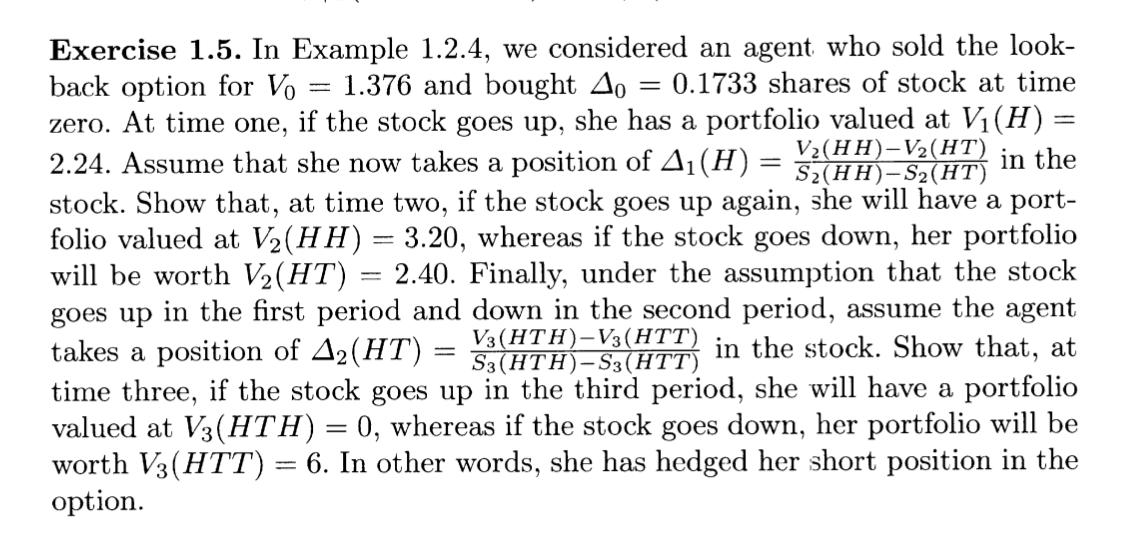

Exercise 1.5. In Example 1.2.4, we considered an agent who sold the lookback option for V0=1.376 and bought 0=0.1733 shares of stock at time zero. At time one, if the stock goes up, she has a portfolio valued at V1(H)= 2.24. Assume that she now takes a position of 1(H)=S2(HH)S2(HT)V2(HH)V2(HT) in the stock. Show that, at time two, if the stock goes up again, she will have a portfolio valued at V2(HH)=3.20, whereas if the stock goes down, her portfolio will be worth V2(HT)=2.40. Finally, under the assumption that the stock goes up in the first period and down in the second period, assume the agent takes a position of 2(HT)=S3(HTH)S3(HTT)V3(HTH)V3(HTT) in the stock. Show that, at time three, if the stock goes up in the third period, she will have a portfolio valued at V3(HTH)=0, whereas if the stock goes down, her portfolio will be worth V3(HTT)=6. In other words, she has hedged her short position in the option. V2=1S2+(1+r)(X11S1)
Step by Step Solution
There are 3 Steps involved in it

Get step-by-step solutions from verified subject matter experts
 Study Help