







Question: Exercise 1.6: Code pasted below Code: class XYLine { XYPoint start; // An object variable. XYPoint end; // Another one. public void printSlope () {
Exercise 1.6: Code pasted below
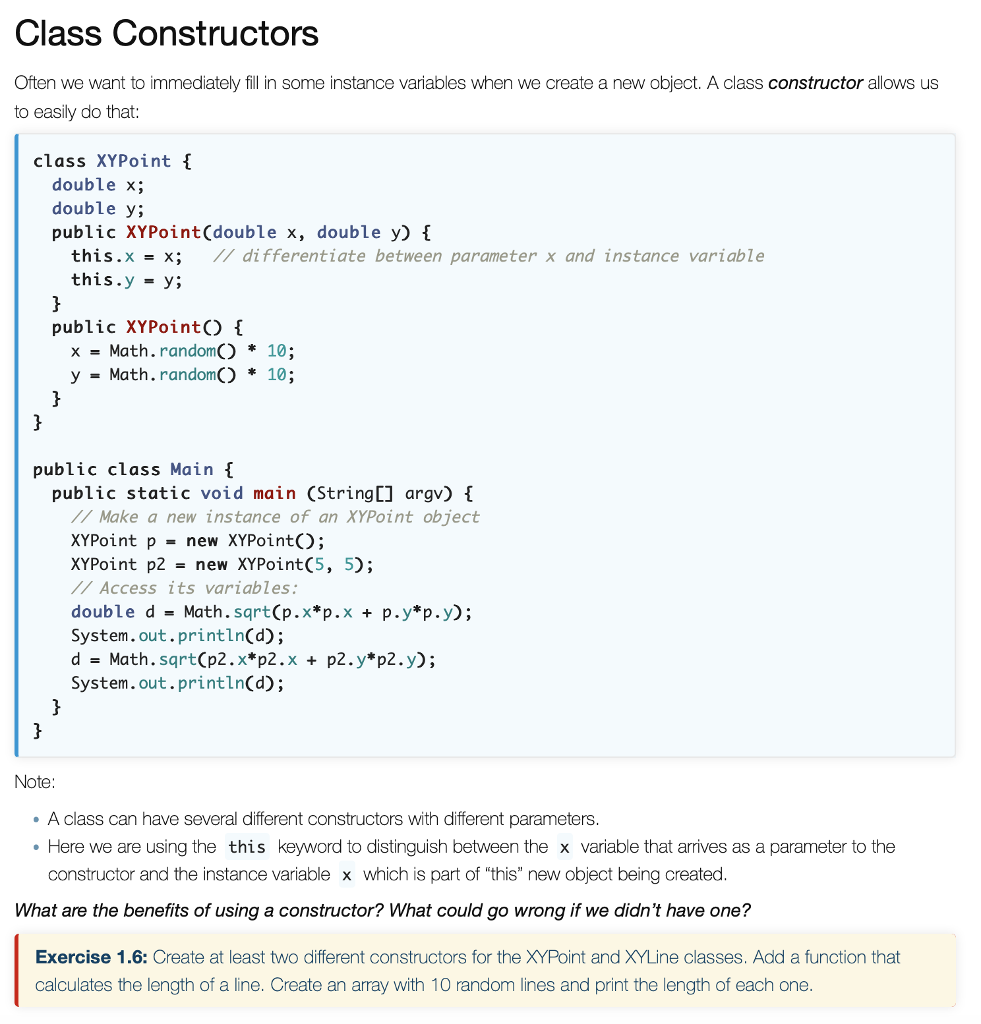
Code:
class XYLine {
XYPoint start; // An object variable.
XYPoint end; // Another one.
public void printSlope () {
double s = (end.y - start.y) / (end.x - start.x);
System.out.println ("Slope = " + s);
}
}
class XYPoint {
double x;
double y;
public XYPoint(double x, double y) {
this.x = x; // differentiate between parameter x and instance variable
this.y = y;
}
public XYPoint() {
x = Math.random() * 10;
y = Math.random() * 10;
}
}
public class Main {
public static void main (String[] argv) {
// Make a new instance of an XYPoint object
XYPoint p = new XYPoint();
XYPoint p2 = new XYPoint(5, 5);
// Access its variables:
double d = Math.sqrt(p.x*p.x + p.y*p.y);
System.out.println(d);
d = Math.sqrt(p2.x*p2.x + p2.y*p2.y);
System.out.println(d);
}
}
Class Constructors Often we want to immediately fill in some instance variables when we create a new object. A class constructor allows us to easily do that class XYPoint i double x; double y; public XYPoint(double x, double y) i this . x-x; this.y - y; differentiate between parameter x and instance variable public XYPointO xMath. randomO * 10; y-Math.randomO 10; public class Main { public static void main (String[] argv) I Make a new instance of an XYPoint object XYPoint p new XYPointQ; XYPoint p2 new XYPoint(5, 5); Access its variables: double d Math.sqrt (p.x*p.x p.y*p.y); System.out.println(d); d-Math. sqrt(p2.xp2.x + p2.y*p2.y); System. out.println(d) Note: A class can have several different constructors with different parameters Here we are using the this keyword to distinguish between the x variable that arrives as a parameter to the constructor and the instance variable x which is part of "this" new object being created What are the benefits of using a constructor? What could go wrong if we didn't have one? Exercise 1.6: Create at least two different constructors for the XYPoint and XYLine classes. Add a function that calculates the length of a line. Create an array with 10 random lines and print the length of each one Class Constructors Often we want to immediately fill in some instance variables when we create a new object. A class constructor allows us to easily do that class XYPoint i double x; double y; public XYPoint(double x, double y) i this . x-x; this.y - y; differentiate between parameter x and instance variable public XYPointO xMath. randomO * 10; y-Math.randomO 10; public class Main { public static void main (String[] argv) I Make a new instance of an XYPoint object XYPoint p new XYPointQ; XYPoint p2 new XYPoint(5, 5); Access its variables: double d Math.sqrt (p.x*p.x p.y*p.y); System.out.println(d); d-Math. sqrt(p2.xp2.x + p2.y*p2.y); System. out.println(d) Note: A class can have several different constructors with different parameters Here we are using the this keyword to distinguish between the x variable that arrives as a parameter to the constructor and the instance variable x which is part of "this" new object being created What are the benefits of using a constructor? What could go wrong if we didn't have one? Exercise 1.6: Create at least two different constructors for the XYPoint and XYLine classes. Add a function that calculates the length of a line. Create an array with 10 random lines and print the length of each one
Step by Step Solution
There are 3 Steps involved in it

Get step-by-step solutions from verified subject matter experts
 Study Help