



Question: Exercise 19-25 (Static) Return on Investment; Goal Congruence Issues [LO 19-1] As indicated in the chapter, return on investment (ROI) is well entrenched in business
![Exercise 19-25 (Static) Return on Investment; Goal Congruence Issues [LO 19-1]](https://dsd5zvtm8ll6.cloudfront.net/si.experts.images/questions/2024/10/66fbbde17c985_17766fbbde113236.jpg)
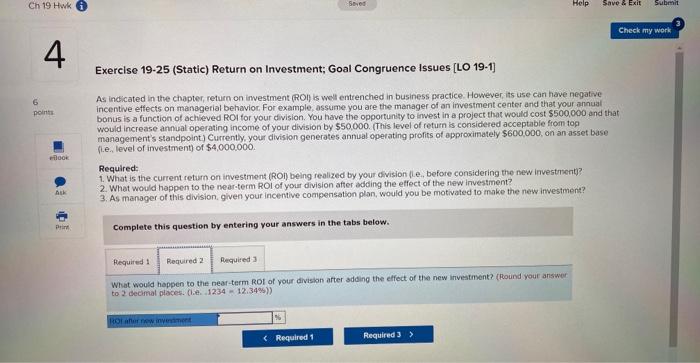
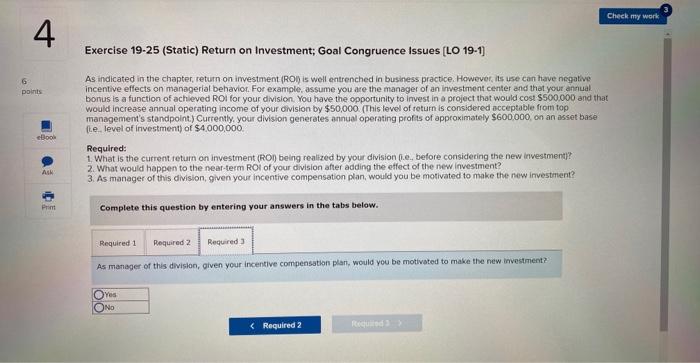
Exercise 19-25 (Static) Return on Investment; Goal Congruence Issues [LO 19-1] As indicated in the chapter, return on investment (ROI) is well entrenched in business practice. However, its use can have negative incentive effects on managerial behavior. For example, assume you are the manager of an investment center and that your annual bonus is a function of achieved ROI for your division. You have the opportunity to irvest in a project that would cost $500.000 and that would increase annual operating income of your division by $50.000. This level of return is considered acceptabie from top. management's standpoint) Currently. your division generates annuat operating profits of approximately $600.000, on an asset base (i.e. level of investment) of $4,000,000. Required: 1. What is the current return on investment (ROI) being realized by your division (i.e., bofore considering the new investment?? 2. What would happen to the near-term ROl of your division after adding the effect of the new investment? 3. As manager of this division, given your incentive compensation plan, would you be motivated to make the new investment? Complete this question by entering your answers in the tabs below. What is the current return on investment (ROI) being realized by your division (l.e., before considering the new investmenty)? Exercise 19-25 (Static) Return on Investment; Goal Congruence Issues [LO 19-1] As indicated in the chapter, return on imvestment (ROI) is well entrenched in business practice. However, its use can have negative incentive effects on managerial behavior. For example, assume you are the manager of an irivestment center and that your annual bonus is a function of achieved ROI for your division. You have the opportunity to invest in a project that would cost $500,000 and that would increase annual operating income of your division by 550000 . (This level of retuin is considered acceptable from top. magagement's standpoint) Currently, your division generates annual cperating profits of approximately $600,000, on an asset base f.e. level of investment) of $4,000.000. Required: 1. What is the current return on investment (ROi) being realized by your division (l.e., before considering the new investrsent?? 2. What would happen to the near-term ROl of your division after adding the effect of the new investment? 3. As manager of this division, given your incentive compensation plan, would you be motivated to make the new investment? Complete this question by entering your answers in the tabs below. Whot would heppen to the near-term ROt of your division after adding the effect of the new investment? (flound yout answer to 2 decimal places. (lie. 1234=12.34%5) ) Exercise 19-25 (Static) Return on Investment; Goal Congruence Issues [LO 19-1] As indicated in the chapter, retum on investment (ROD) is well entrenched in business practice. However, its use can have nogative incentive effects on managerial behavior. For example, assume you are the manager of an investment center and that your anrual. bonus is a function of achieved ROI for your division. You have the opportunity to invest in a project that would cost $500.000 and that would increase annual operating income of your division by $50,000. This level of return is considered acceptable from top management's standpoint.) Currently, your division generates annual operating profis of approximately $600,000, on an asset base (t.e. level of investment) of $4,000,000 Required: 1. What is the current return on investment (RO) being realized by your division (i.e., before considering the new investment?? 2. What would happen to the near-term ROI of your division after adding the effect of the new investment? 3. As manager of this division, given your incentive compeasation plan, would you be motivated to make the new investinent? Complete this question by entering your answers in the tabs below. As manager of this division, given your incentive compensation plan, would you be motivated to make the new investment
Step by Step Solution
There are 3 Steps involved in it

Get step-by-step solutions from verified subject matter experts