







Question: Exercise 2 . 3 . 1 : In this exercise we introduce one of our running examples of a relational database schema. The database schema
Exercise : In this exercise we introduce one of our running examples of a relational database schema. The database schema consists of four relations, whose schemas are:
Product maker model, type
PCmodel speed, ram, hd price
Laptopmodel speed, ram, hd screen, price
Printermodel color, type, price
The Product relation gives the manufacturer, model number and type PC laptop, or printer of various products. We assume for convenience that model numbers are unique over all manufacturers and product types; that assumption is not realistic, and a real database would include a code for the manufacturer as part of the model number. The PC relation gives for each model number that is a PC the speed of the processor, in gigahertz the amount of RAM in megabytes the size of the hard disk in gigabytes and the price. The Laptop relation is similar, except that the screen size in inches is also included. The Printer relation records for each printer model whether the printer produces color output true if so the process type laser or inkjet, typically and the price.
Write the following declarations:
a A suitable schema for relation Product.
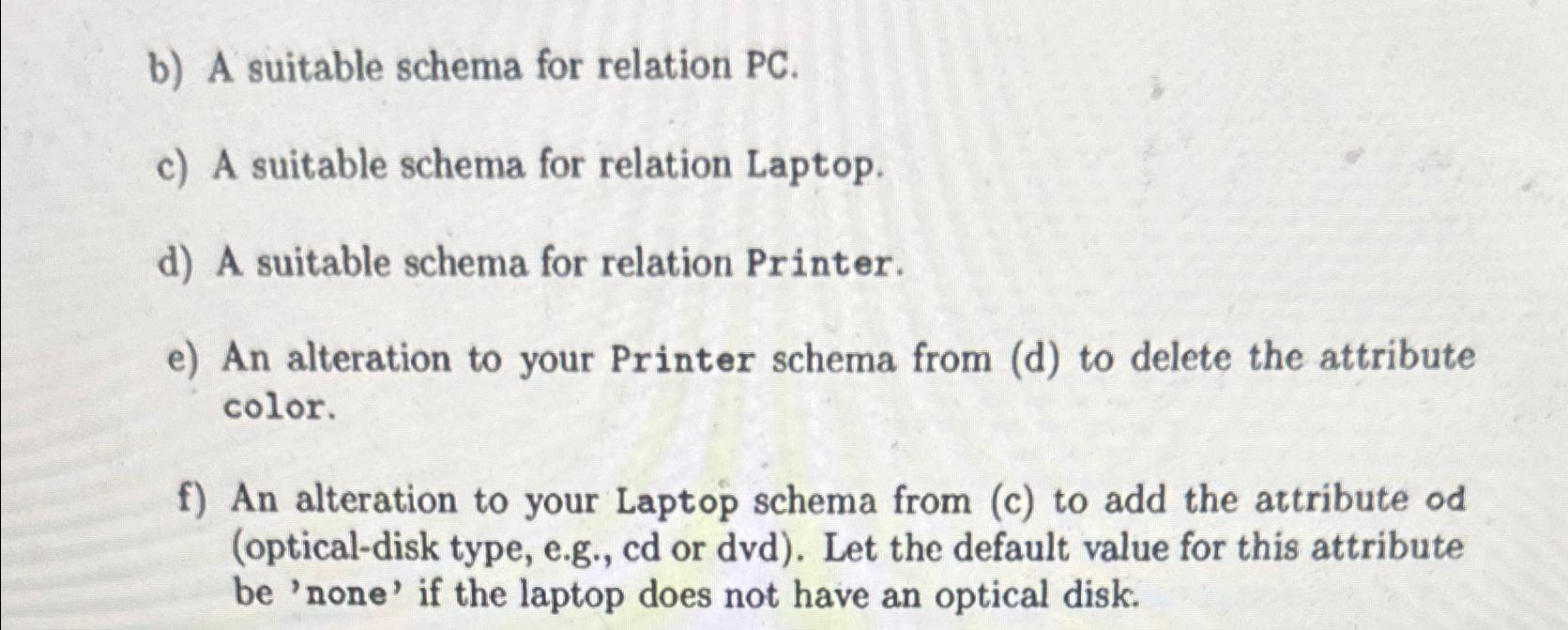
b A suitable schema for relation PC
c A suitable schema for relation Laptop.
d A suitable schema for relation Printer.
e An alteration to your Printer schema from d to delete the attribute color.
f An alteration to your Laptop schema from c to add the attribute od opticaldisk type, eg cd or dvd Let the default value for this attribute be 'none' if the laptop does not have an optical disk.
Step by Step Solution
There are 3 Steps involved in it
1 Expert Approved Answer
Step: 1 Unlock

Question Has Been Solved by an Expert!
Get step-by-step solutions from verified subject matter experts
Step: 2 Unlock
Step: 3 Unlock
 Study Help