







Question: Exercise 2 4 Language of a state ( 6 points ) You already know that the language of a deterministic finite automaton ( DFA )
Exercise Language of a state
points
You already know that the language of a deterministic finite automaton DFA is the set of all words
such that beginning at the start state and reading the word the DFA ends up in a final state.
We now define the language of a state as the set of words such that beginning at a given state
and reading the word the DFA ends up in a final state. Formally:
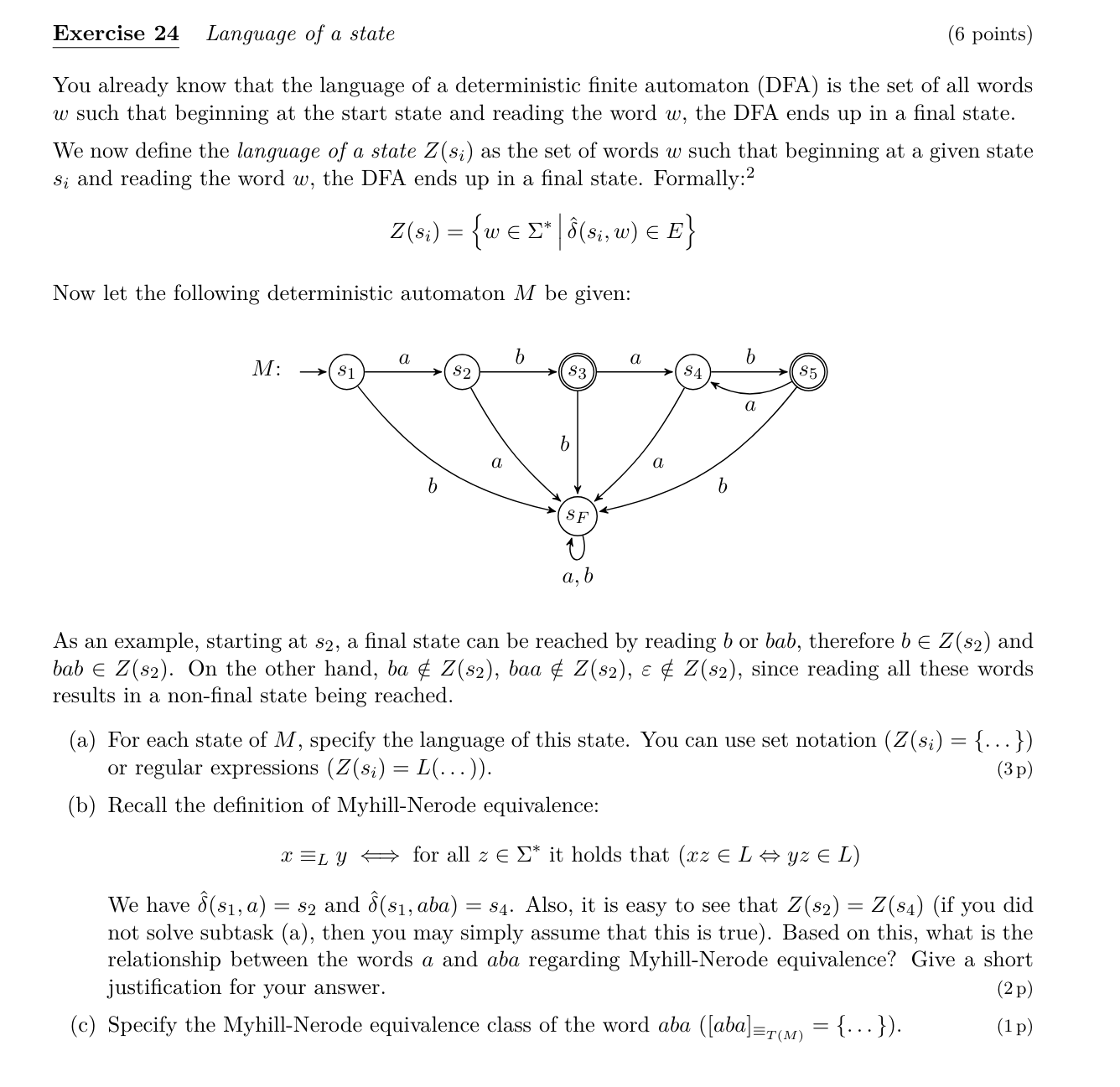
Now let the following deterministic automaton be given:
As an example, starting at a final state can be reached by reading or bab, therefore binZ and
babinZ On the other hand, inZ baa inZ since reading all these words
results in a nonfinal state being reached.
a For each state of specify the language of this state. You can use set notation
or regular expressions
b Recall the definition of MyhillNerode equivalence:
yLongleftrightarrow for all zin holds that yzinL
We have hat and hataba Also, it is easy to see that if you did
not solve subtask a then you may simply assume that this is true Based on this, what is the
relationship between the words a and aba regarding MyhillNerode equivalence? Give a short
justification for your answer.
c Specify the MyhillNerode equivalence class of the word aba
Step by Step Solution
There are 3 Steps involved in it
1 Expert Approved Answer
Step: 1 Unlock

Question Has Been Solved by an Expert!
Get step-by-step solutions from verified subject matter experts
Step: 2 Unlock
Step: 3 Unlock
 Study Help