







Question: Exercise 2 Exercise 2. (16 Points) i) (10 points) Consider a consumer that each month has 200 hours of time they can use to either
Exercise 2
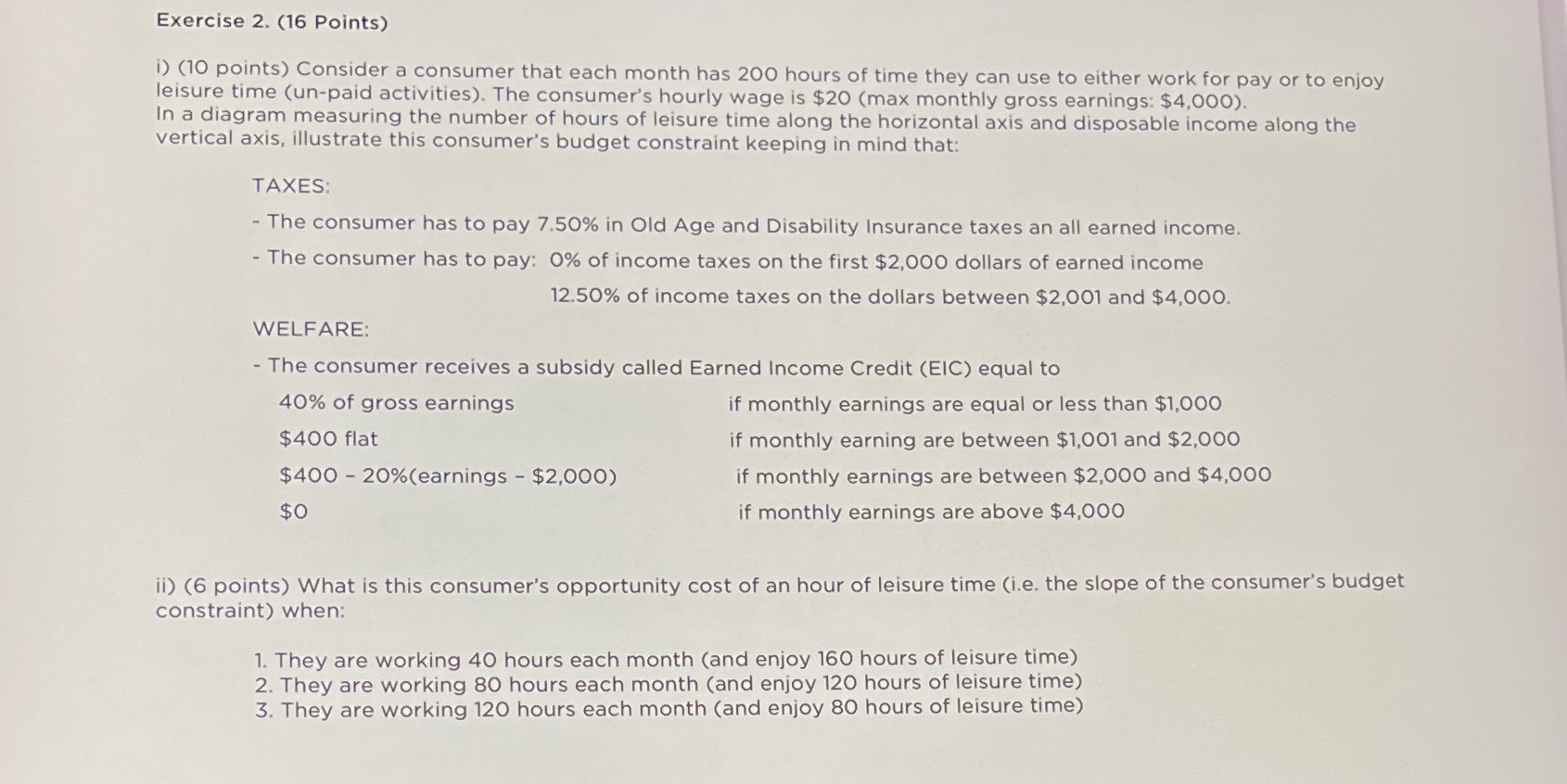
Exercise 2. (16 Points) i) (10 points) Consider a consumer that each month has 200 hours of time they can use to either work for pay or to enjoy leisure time (un-paid activities). The consumer's hourly wage is $20 (max monthly gross earnings: $4,000). In a diagram measuring the number of hours of leisure time along the horizontal axis and disposable income along the vertical axis, illustrate this consumer's budget constraint keeping in mind that: TAXES: - The consumer has to pay 7.50% in Old Age and Disability Insurance taxes an all earned income. - The consumer has to pay: 0% of income taxes on the first $2,000 dollars of earned income 12.50% of income taxes on the dollars between $2,001 and $4,000. WELFARE: - The consumer receives a subsidy called Earned Income Credit (EIC) equal to 40% of gross earnings if monthly earnings are equal or less than $1,000 $400 flat if monthly earning are between $1,001 and $2,000 $400 - 20%(earnings - $2,000) if monthly earnings are between $2,000 and $4,000 $0 if monthly earnings are above $4,000 ii) (6 points) What is this consumer's opportunity cost of an hour of leisure time (i.e. the slope of the consumer's budget constraint) when: 1. They are working 40 hours each month (and enjoy 160 hours of leisure time) 2. They are working 80 hours each month (and enjoy 120 hours of leisure time) 3. They are working 120 hours each month (and enjoy 80 hours of leisure time)
Step by Step Solution
There are 3 Steps involved in it

Get step-by-step solutions from verified subject matter experts
 Study Help