







Question: Exercise 2 (Expected load in the server). Consider a single-server queuing system, which is de- termined by the arrival times (tk and total times spent
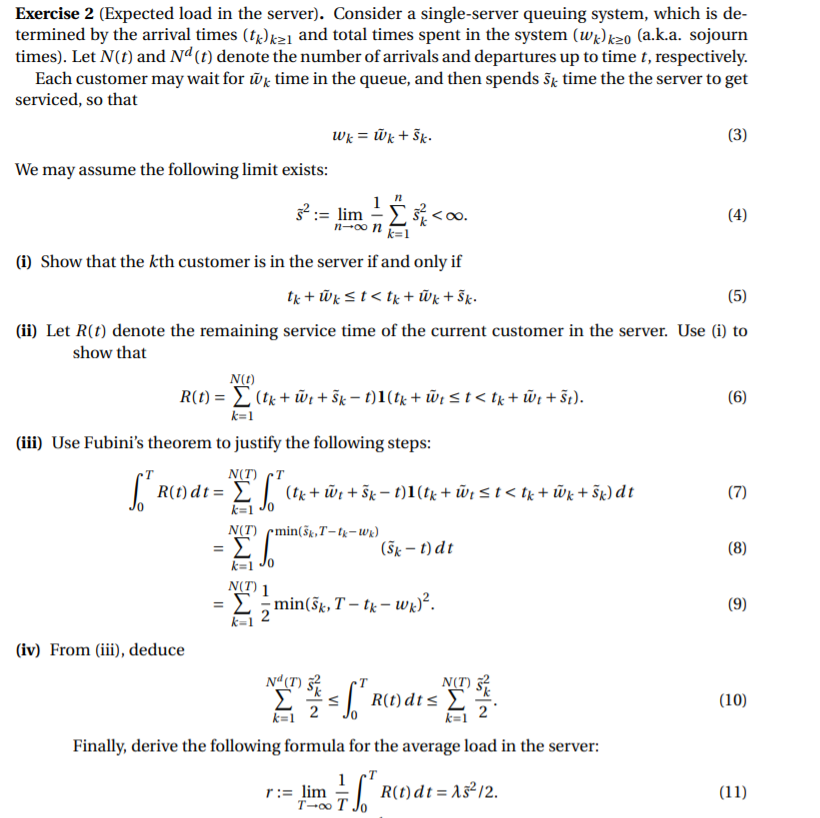
Exercise 2 (Expected load in the server). Consider a single-server queuing system, which is de- termined by the arrival times (tk and total times spent in the system (w)kzo (a.k.a. sojourn times). Let N(t) and Nd (t) denote the number of arrivals and departures up to time t, respectively. Each customer may wait for wk time in the queue, and then spends Sk time the the server to get serviced, so that We may assume the following limit exists: n-+00 1n (i) Show that the kth customer is in the server if and only if (ii) Let R(t) denote the remaining service time of the current customer in the server. Use (i) to show that N(t) (iii) Use Fubini's theorem to justify the following steps: (Sk -t)dt N(T) 1 (iv) From (iii), deduce NUT) (10) 2 Finally, derive the following formula for the average load in the server: Exercise 2 (Expected load in the server). Consider a single-server queuing system, which is de- termined by the arrival times (tk and total times spent in the system (w)kzo (a.k.a. sojourn times). Let N(t) and Nd (t) denote the number of arrivals and departures up to time t, respectively. Each customer may wait for wk time in the queue, and then spends Sk time the the server to get serviced, so that We may assume the following limit exists: n-+00 1n (i) Show that the kth customer is in the server if and only if (ii) Let R(t) denote the remaining service time of the current customer in the server. Use (i) to show that N(t) (iii) Use Fubini's theorem to justify the following steps: (Sk -t)dt N(T) 1 (iv) From (iii), deduce NUT) (10) 2 Finally, derive the following formula for the average load in the server
Step by Step Solution
There are 3 Steps involved in it

Get step-by-step solutions from verified subject matter experts
 Study Help