



Question: Exercise 2 Once again, consider the above contour diagram. a) Estimate the direction of Vf (1,1). b) Estimate the magnitude IIVf (1,1) II. c) What
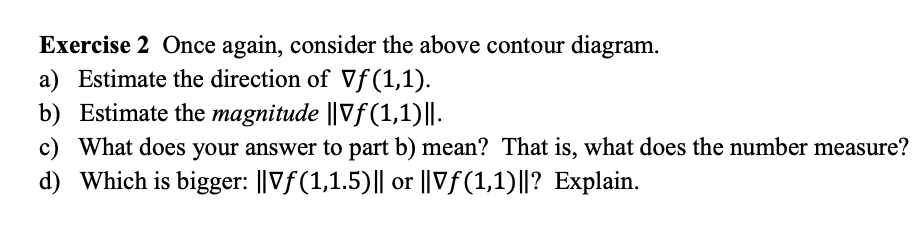


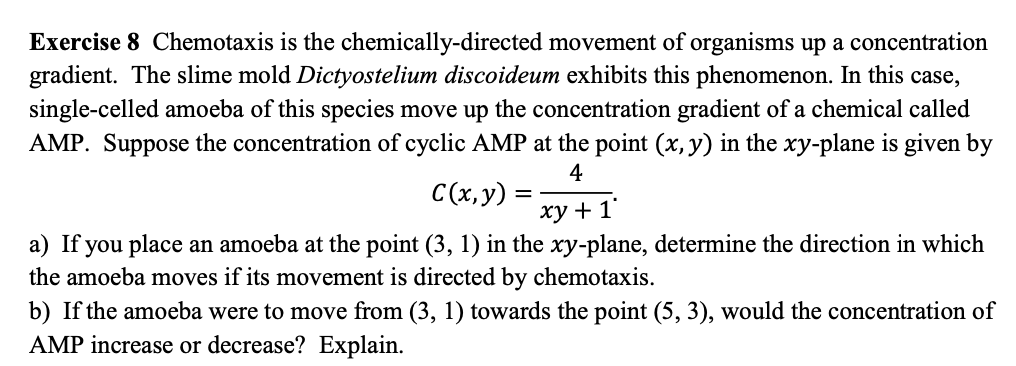
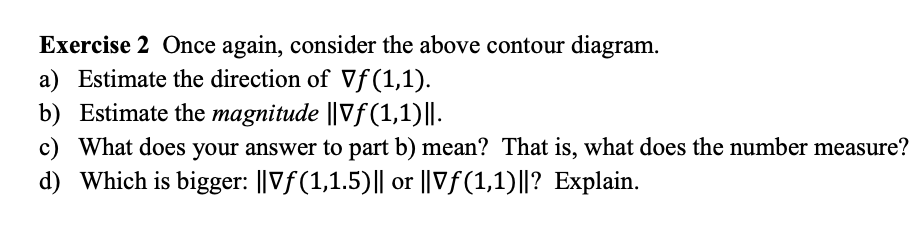


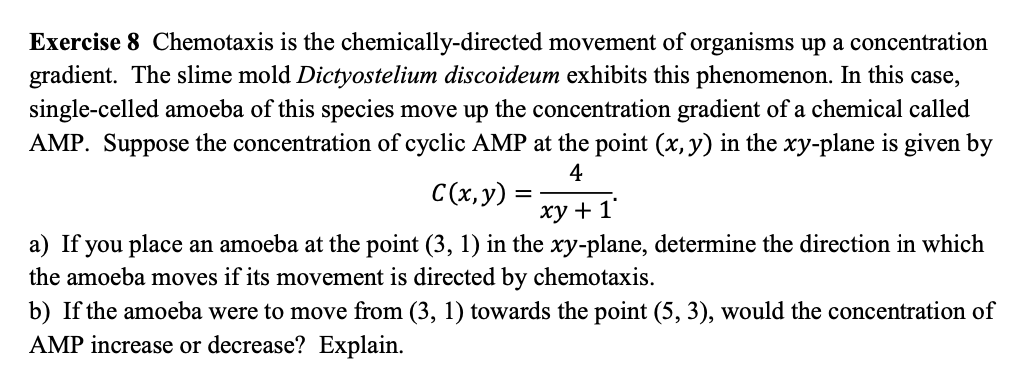
Exercise 2 Once again, consider the above contour diagram. a) Estimate the direction of Vf (1,1). b) Estimate the magnitude IIVf (1,1) II. c) What does your answer to part b) mean? That is, what does the number measure? d) Which is bigger: ||Vf(1,1.5)|| or I|Vf(1,1)||? Explain. Exercise 5 Let f (x, y) = xzy + 3y.c) Is f increasing or decreasing as you leave (2, l) and head towards (1, 3)? Explain. Exercise 8 Chemotaxis is the chemically-directed movement of organisms up a concentration gradient. The slime mold Dz'cryostelium discoideum exhibits this phenomenon. In this case, single-celled amoeba of this species move up the concentration gradient of a chemical called AMP. Suppose the concentration of cyclic AMP at the point (x, y) in the xy-plane is given by 1706.3!) = W + 1- a) If you place an amoeba at the point (3, l) in the xy-plane, determine the direction in which the amoeba moves if its movement is directed by chemotaxis. b) If the amoeba were to move from (3, 1) towards the point (5, 3), would the concentration of AMP increase or decrease? Explain
Step by Step Solution
There are 3 Steps involved in it

Get step-by-step solutions from verified subject matter experts