







Question: Exercise 2: Refuse Collection (30 points) Consider the example of household refuse collection in Minneapolis. Assume that the marginal social cost (MSC) of collecting and
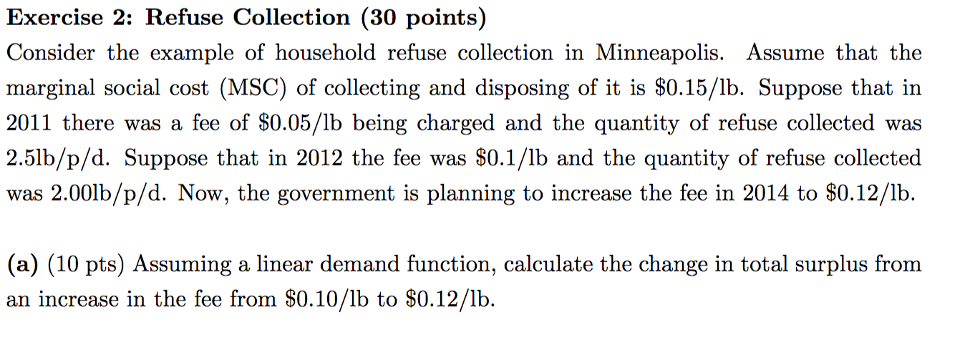
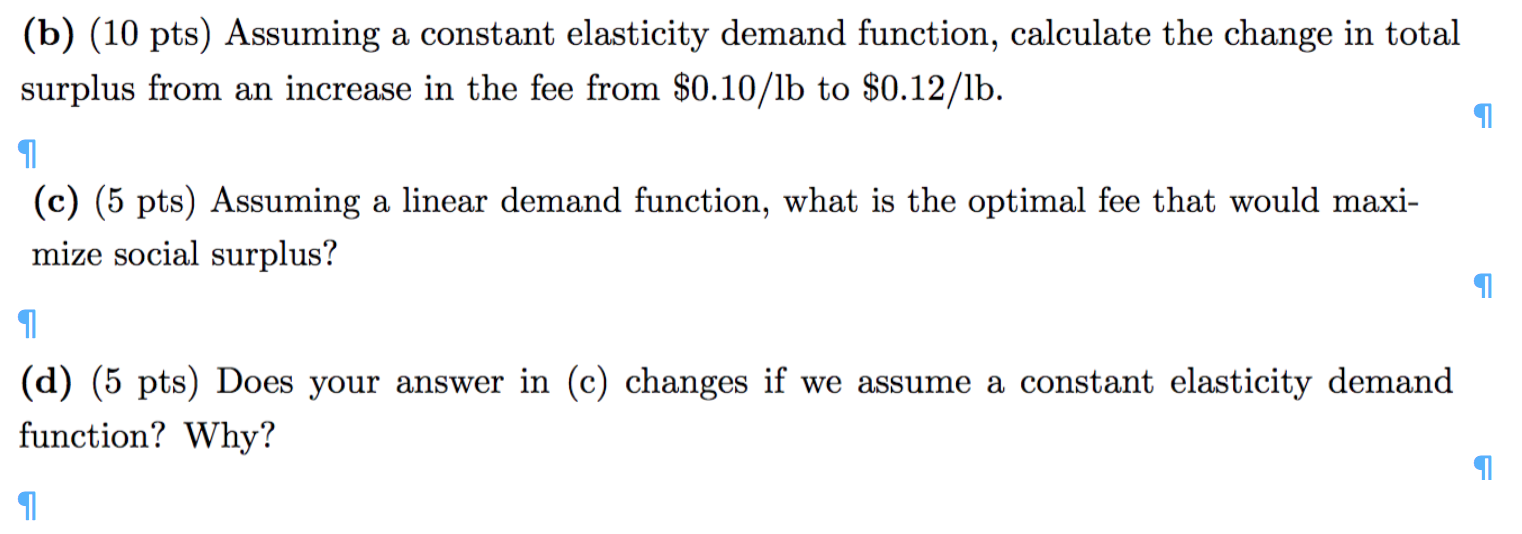
Exercise 2: Refuse Collection (30 points) Consider the example of household refuse collection in Minneapolis. Assume that the marginal social cost (MSC) of collecting and disposing of it is $0.15/ lb. Suppose that in 2011 there was a fee of $0.05 /lb being charged and the quantity of refuse collected was 2.51b/p/d. Suppose that in 2012 the fee was $0.1 / lb and the quantity of refuse collected was 2.001b/p/d. Now, the government is planning to increase the fee in 2014 to $0.12/ lb. (a) (10 pts) Assuming a linear demand function, calculate the change in total surplus from an increase in the fee from $0.10/1b to $0.12/lb. (b) (10 pts) Assuming a constant elasticity demand function, calculate the change in total surplus from an increase in the fee from $0.10/1b to $0.12 / lb. 1] (c) (5 pts) Assuming a linear demand function, what is the optimal fee that would maxi- mize social surplus? 'Il (d) (5 pts) Does your answer in (0) changes if we assume a constant elasticity demand function? Why? 1]
Step by Step Solution
There are 3 Steps involved in it

Get step-by-step solutions from verified subject matter experts
 Study Help