







Question: => Exercise 3. Consider an exponentially distributed random variable f(X;X) = A exp(-Ar). (a) Show that the expected value of X is 1. [5]
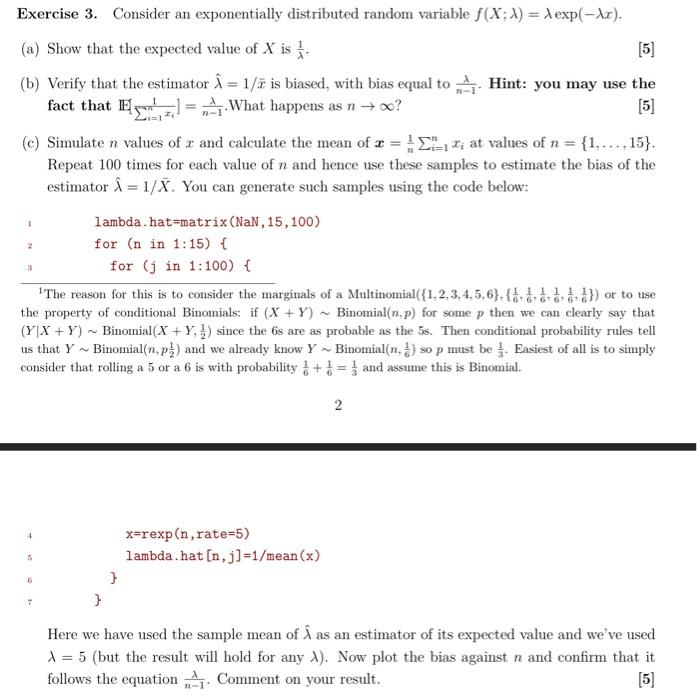
=> Exercise 3. Consider an exponentially distributed random variable f(X;X) = A exp(-Ar). (a) Show that the expected value of X is 1. [5] (b) Verify that the estimator = 1/ is biased, with bias equal to Hint: you may use the fact that E=What happens as n o? (c) Simulate n values of r and calculate the mean of x = [5] at values of n = {1..... 15}. Repeat 100 times for each value of n and hence use these samples to estimate the bias of the estimator =1/X. You can generate such samples using the code below: lambda.hat-matrix (NaN,15,100) 2 for (n in 1:15) { 3 for (j in 1:100) { 66 1 1 6'6 'The reason for this is to consider the marginals of a Multinomial({1,2,3,4,5,6}. {}) or to use the property of conditional Binomials: if (X + Y) ~ Binomial(n,p) for some p then we can clearly say that (YX + Y) Binomial(X + Y) since the 6s are as probable as the 5s. Then conditional probability rules tell us that Y ~Binomial(n,p) and we already know Y ~ Binomial(n,) so p must be . Easiest of all is to simply consider that rolling a 5 or a 6 is with probability += and assume this is Binomial. 5 6 7 } 2 } x-rexp(n, rate=5) lambda. hat [n, j]=1/mean(x) Here we have used the sample mean of as an estimator of its expected value and we've used A = 5 (but the result will hold for any A). Now plot the bias against n and confirm that it follows the equation. Comment on your result. [5]
Step by Step Solution
There are 3 Steps involved in it

Get step-by-step solutions from verified subject matter experts
 Study Help