







Question: Exercise 3. Given a group G and a subset SCG, consider the collection H of all subgroups containing the set S, namely H:= {H
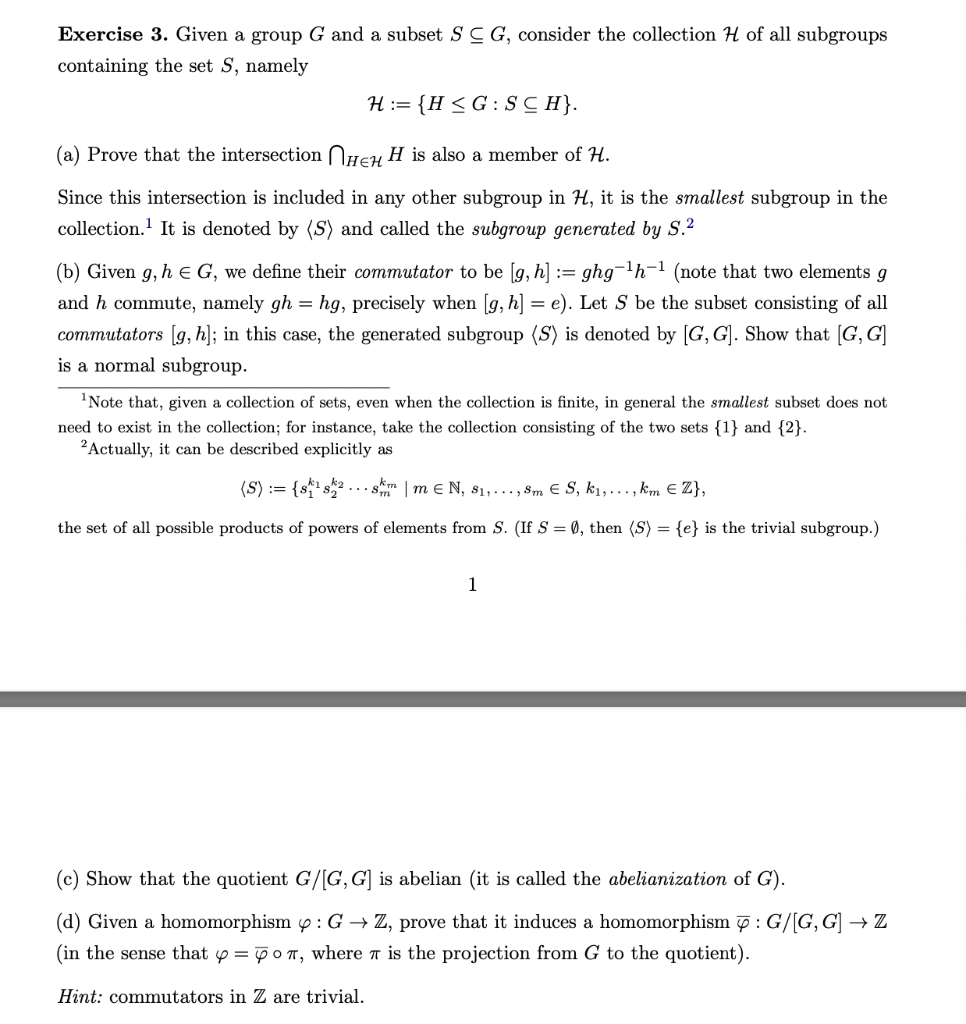
Exercise 3. Given a group G and a subset SCG, consider the collection H of all subgroups containing the set S, namely H:= {H G: SCH}. (a) Prove that the intersection HEH H is also a member of H. Since this intersection is included in any other subgroup in H, it is the smallest subgroup in the collection. It is denoted by (S) and called the subgroup generated by S.2 (b) Given g, h = G, we define their commutator to be [g, h] := ghg-h- (note that two elements g and h commute, namely gh = hg, precisely when [g, h] = e). Let S be the subset consisting of all commutators [g, h]; in this case, the generated subgroup (S) is denoted by [G, G]. Show that [G, G] is a normal subgroup. Note that, given a collection of sets, even when the collection is finite, in general the smallest subset does not need to exist in the collection; for instance, take the collection consisting of the two sets {1} and {2}. 2Actually, it can be described explicitly as (S) := {s s...sm | m N, $,..., Sm S, k,..., km Z}, the set of all possible products of powers of elements from S. (If S = 0, then (S) = {e} is the trivial subgroup.) 1 (c) Show that the quotient G/[G, G] is abelian (it is called the abelianization of G). (d) Given a homomorphism : G Z, prove that it induces a homomorphism : G/[G, G] Z (in the sense that y=pon, where is the projection from G to the quotient). Hint: commutators in Z are trivial.
Step by Step Solution
3.49 Rating (166 Votes )
There are 3 Steps involved in it
3 Given SCH for all Hef S en H Now As e... View full answer

Get step-by-step solutions from verified subject matter experts
 Study Help