



Question: Exercise 3. Portfolio Optimisation. Consider a market that contains n risky assets and one risk-free asset. Denote by i = (F1, ..., in the vector
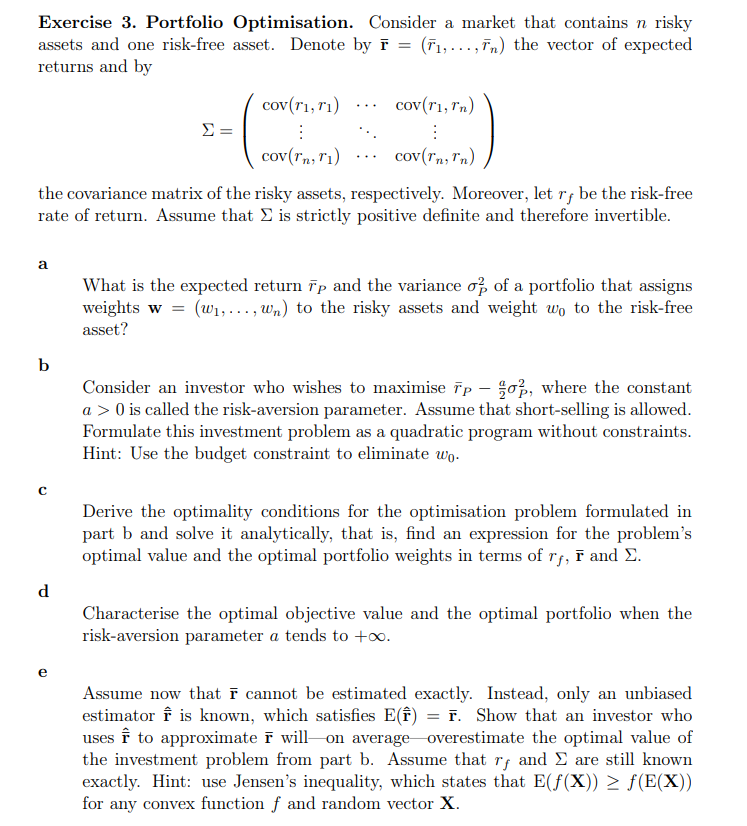
Exercise 3. Portfolio Optimisation. Consider a market that contains n risky assets and one risk-free asset. Denote by i = (F1, ..., in the vector of expected returns and by covri,r) cov(r, rn) = : : covrn.r) cov(r'n, In) the covariance matrix of the risky assets, respectively. Moreover, let rj be the risk-free rate of return. Assume that is strictly positive definite and therefore invertible. a What is the expected return fp and the variance o of a portfolio that assigns weights w = (W1, ... , Wn) to the risky assets and weight wo to the risk-free asset? b Consider an investor who wishes to maximise ip, where the constant a> 0 is called the risk-aversion parameter. Assume that short-selling is allowed. Formulate this investment problem as a quadratic program without constraints. Hint: Use the budget constraint to eliminate wo. Derive the optimality conditions for the optimisation problem formulated in part b and solve it analytically, that is, find an expression for the problem's optimal value and the optimal portfolio weights in terms of rf, F and E. d d Characterise the optimal objective value and the optimal portfolio when the risk-aversion parameter a tends to +. e = Assume now that i cannot be estimated exactly. Instead, only an unbiased estimator is known, which satisfies E(f) = 7. Show that an investor who uses to approximate i will on average overestimate the optimal value of the investment problem from part b. Assume that r; and are still known exactly. Hint: use Jensen's inequality, which states that E(f(x)) = f(E(X)) for any convex function f and random vector X. Exercise 3. Portfolio Optimisation. Consider a market that contains n risky assets and one risk-free asset. Denote by i = (F1, ..., in the vector of expected returns and by covri,r) cov(r, rn) = : : covrn.r) cov(r'n, In) the covariance matrix of the risky assets, respectively. Moreover, let rj be the risk-free rate of return. Assume that is strictly positive definite and therefore invertible. a What is the expected return fp and the variance o of a portfolio that assigns weights w = (W1, ... , Wn) to the risky assets and weight wo to the risk-free asset? b Consider an investor who wishes to maximise ip, where the constant a> 0 is called the risk-aversion parameter. Assume that short-selling is allowed. Formulate this investment problem as a quadratic program without constraints. Hint: Use the budget constraint to eliminate wo. Derive the optimality conditions for the optimisation problem formulated in part b and solve it analytically, that is, find an expression for the problem's optimal value and the optimal portfolio weights in terms of rf, F and E. d d Characterise the optimal objective value and the optimal portfolio when the risk-aversion parameter a tends to +. e = Assume now that i cannot be estimated exactly. Instead, only an unbiased estimator is known, which satisfies E(f) = 7. Show that an investor who uses to approximate i will on average overestimate the optimal value of the investment problem from part b. Assume that r; and are still known exactly. Hint: use Jensen's inequality, which states that E(f(x)) = f(E(X)) for any convex function f and random vector X
Step by Step Solution
There are 3 Steps involved in it

Get step-by-step solutions from verified subject matter experts