Question: Exercise 3. This question is about developing a model for the life-cycle of a type of nanoflagellates, a type of swimming cell that lives in
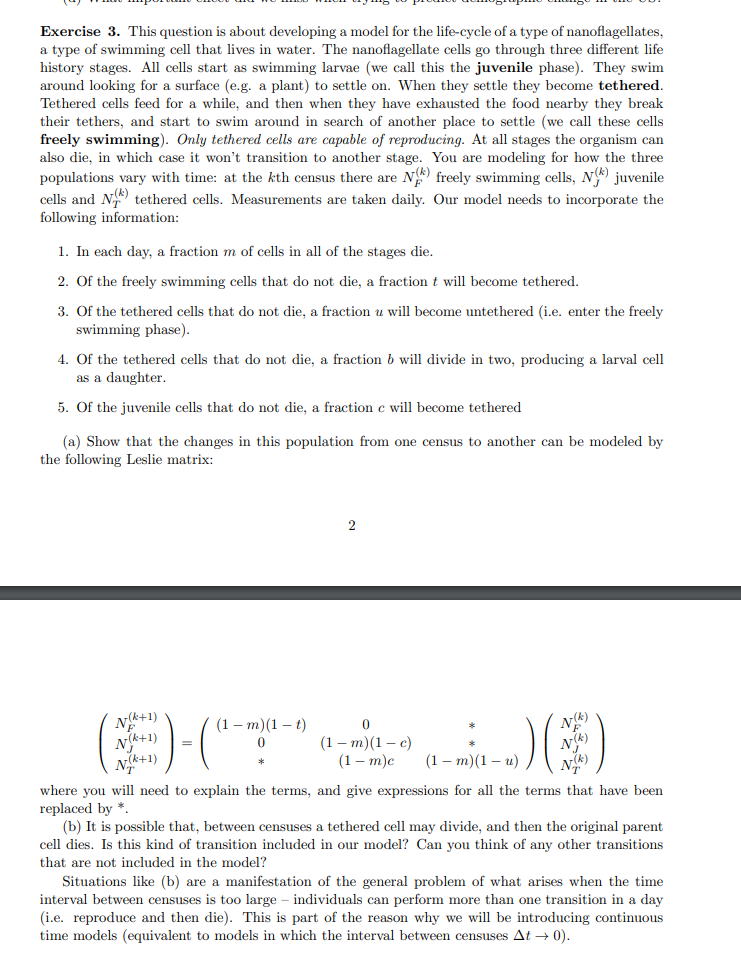
Exercise 3. This question is about developing a model for the life-cycle of a type of nanoflagellates, a type of swimming cell that lives in water. The nanoflagellate cells go through three different life history stages. All cells start as swimming larvae (we call this the juvenile phase). They swim around looking for a surface (e.g. a plant) to settle on. When they settle they become tethered. Tethered cells feed for a while, and then when they have exhausted the food nearby they break their tethers, and start to swim around in search of another place to settle (we call these cells freely swimming). Only tethered cells are capable of reproducing. At all stages the organism can also die, in which case it won't transition to another stage. You are modeling for how the three populations vary with time: at the kth census there are freely swimming cells, nk) juvenile cells and N.** tethered cells. Measurements are taken daily. Our model needs to incorporate the following information: 1. In each day, a fraction m of cells in all of the stages die. 2. Of the freely swimming cells that do not die, a fraction t will become tethered. 3. Of the tethered cells that do not die, a fraction u will become untethered (i.e. enter the freely swimming phase). 4. Of the tethered cells that do not die, a fraction b will divide in two, producing a larval cell as a daughter. 5. Of the juvenile cells that do not die, a fraction c will become tethered (a) Show that the changes in this population from one census to another can be modeled by the following Leslie matrix: 2 F 0 F )-( " JO :{k+1) Nk+1) (1 - m)(1 t) 0 (1 m)(1 - c) (1 - m) (1 - m)(1 tu) where you will need to explain the terms, and give expressions for all the terms that have been replaced by * (b) It is possible that, between censuses a tethered cell may divide, and then the original parent cell dies. Is this kind of transition included in our model? Can you think of any other transitions that are not included in the model? Situations like (b) are a manifestation of the general problem of what arises when the time interval between censuses is too large - individuals can perform more than one transition in a day (i.e. reproduce and then die). This is part of the reason why we will be introducing continuous time models (equivalent to models in which the interval between censuses At + 0). Exercise 3. This question is about developing a model for the life-cycle of a type of nanoflagellates, a type of swimming cell that lives in water. The nanoflagellate cells go through three different life history stages. All cells start as swimming larvae (we call this the juvenile phase). They swim around looking for a surface (e.g. a plant) to settle on. When they settle they become tethered. Tethered cells feed for a while, and then when they have exhausted the food nearby they break their tethers, and start to swim around in search of another place to settle (we call these cells freely swimming). Only tethered cells are capable of reproducing. At all stages the organism can also die, in which case it won't transition to another stage. You are modeling for how the three populations vary with time: at the kth census there are freely swimming cells, nk) juvenile cells and N.** tethered cells. Measurements are taken daily. Our model needs to incorporate the following information: 1. In each day, a fraction m of cells in all of the stages die. 2. Of the freely swimming cells that do not die, a fraction t will become tethered. 3. Of the tethered cells that do not die, a fraction u will become untethered (i.e. enter the freely swimming phase). 4. Of the tethered cells that do not die, a fraction b will divide in two, producing a larval cell as a daughter. 5. Of the juvenile cells that do not die, a fraction c will become tethered (a) Show that the changes in this population from one census to another can be modeled by the following Leslie matrix: 2 F 0 F )-( " JO :{k+1) Nk+1) (1 - m)(1 t) 0 (1 m)(1 - c) (1 - m) (1 - m)(1 tu) where you will need to explain the terms, and give expressions for all the terms that have been replaced by * (b) It is possible that, between censuses a tethered cell may divide, and then the original parent cell dies. Is this kind of transition included in our model? Can you think of any other transitions that are not included in the model? Situations like (b) are a manifestation of the general problem of what arises when the time interval between censuses is too large - individuals can perform more than one transition in a day (i.e. reproduce and then die). This is part of the reason why we will be introducing continuous time models (equivalent to models in which the interval between censuses At + 0)









 Study Help