







Question: Exercise 3: Understanding clustering algorithms 1. Consider density-based clustering algorithm DBSCAN with parameters = V2, MinPts = 3, and Euclidean distance measures. Given the following
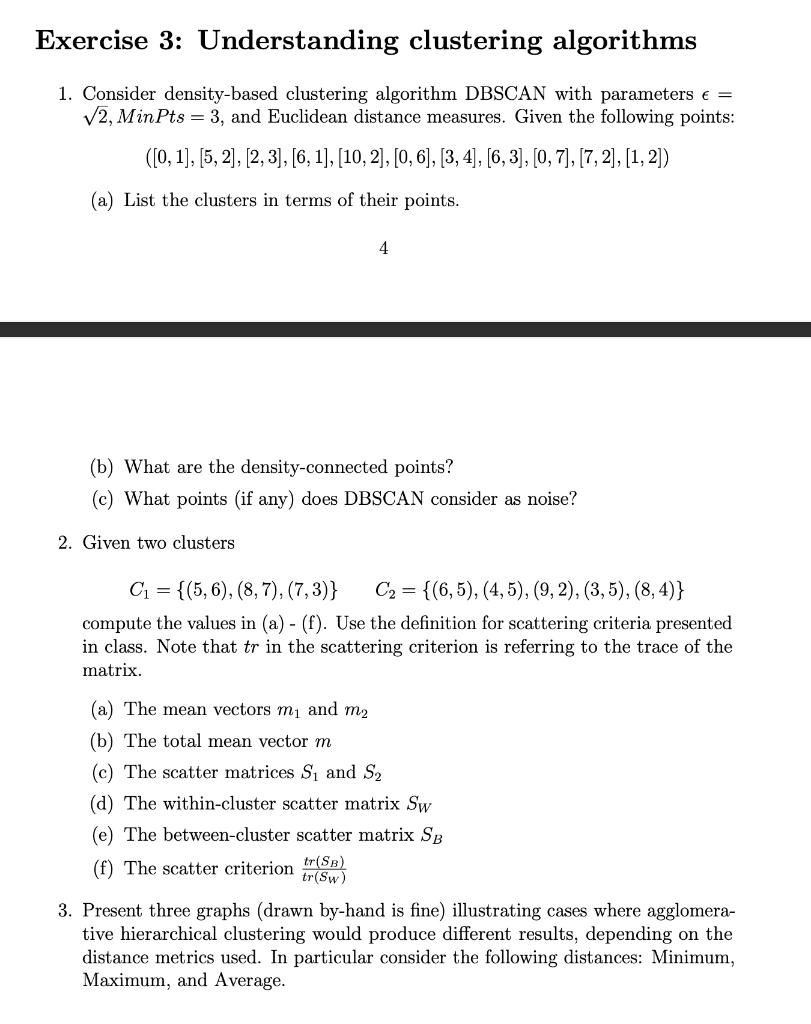
Exercise 3: Understanding clustering algorithms 1. Consider density-based clustering algorithm DBSCAN with parameters = V2, MinPts = 3, and Euclidean distance measures. Given the following points: ([0,1], [5, 2), (2, 3), (6, 1), (10,2), (0,6), (3, 4), (6,3], [0, 7], [7, 2], [1, 2]) (a) List the clusters in terms of their points. 4 (b) What are the density-connected points? (c) What points (if any) does DBSCAN consider as noise? 2. Given two clusters C1 = {(5,6), (8,7), (7,3)} C2 = {(6,5), (4,5), (9,2), (3,5), (8,4)} compute the values in (a) - (f). Use the definition for scattering criteria presented in class. Note that tr in the scattering criterion is referring to the trace of the matrix. (a) The mean vectors m, and m2 (b) The total mean vector m (c) The scatter matrices S, and S2 (d) The within-cluster scatter matrix Sw (e) The between-cluster scatter matrix SB (f) The scatter criterion fr(SB) tr(Sw) 3. Present three graphs (drawn by-hand is fine) illustrating cases where agglomera- tive hierarchical clustering would produce different results, depending on the distance metrics used. In particular consider the following distances: Minimum, Maximum, and Average. Exercise 3: Understanding clustering algorithms 1. Consider density-based clustering algorithm DBSCAN with parameters = V2, MinPts = 3, and Euclidean distance measures. Given the following points: ([0,1], [5, 2), (2, 3), (6, 1), (10,2), (0,6), (3, 4), (6,3], [0, 7], [7, 2], [1, 2]) (a) List the clusters in terms of their points. 4 (b) What are the density-connected points? (c) What points (if any) does DBSCAN consider as noise? 2. Given two clusters C1 = {(5,6), (8,7), (7,3)} C2 = {(6,5), (4,5), (9,2), (3,5), (8,4)} compute the values in (a) - (f). Use the definition for scattering criteria presented in class. Note that tr in the scattering criterion is referring to the trace of the matrix. (a) The mean vectors m, and m2 (b) The total mean vector m (c) The scatter matrices S, and S2 (d) The within-cluster scatter matrix Sw (e) The between-cluster scatter matrix SB (f) The scatter criterion fr(SB) tr(Sw) 3. Present three graphs (drawn by-hand is fine) illustrating cases where agglomera- tive hierarchical clustering would produce different results, depending on the distance metrics used. In particular consider the following distances: Minimum, Maximum, and Average
Step by Step Solution
There are 3 Steps involved in it

Get step-by-step solutions from verified subject matter experts
 Study Help