







Question: Exercise 3.1: Procedure: a) Enter the program in the editor window. b) Execute the Program (See Appendix) c) Enter the coefficiens of characteristic equation in
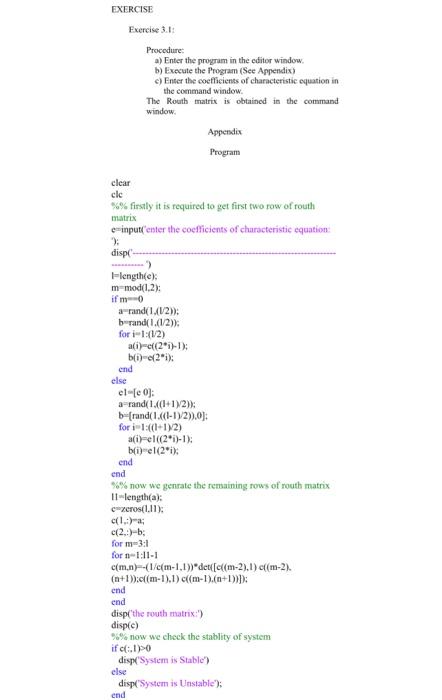
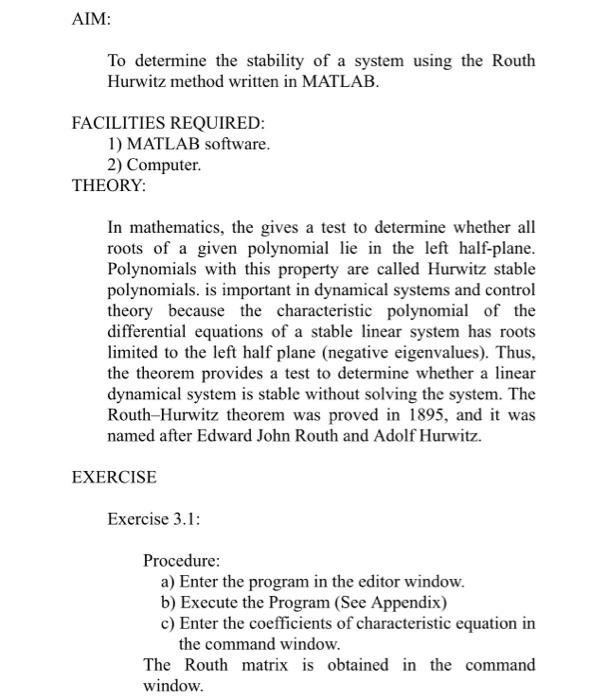
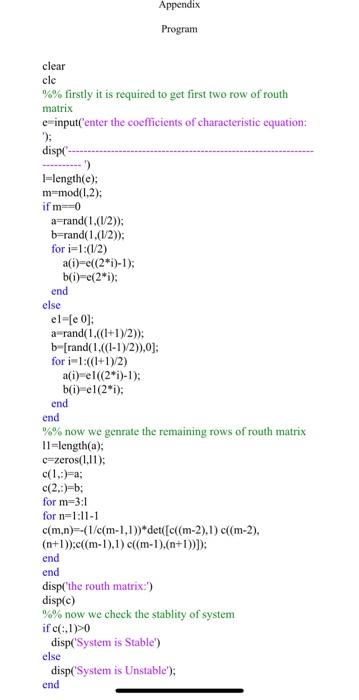
Exercise 3.1: Procedure: a) Enter the program in the editor window. b) Execute the Program (See Appendix) c) Enter the coefficiens of characteristic equation in the command window. The Routh matris is obtained in the command window: Appendix Program clear cle \%\% firstly it is required to get first fwo row of routh matrix e-inputfenter the cocfficients of characteristic equation: 7 ?: dispc"- %% now we genrate the remaining rows of routh matrix If length(a): c-xeros(1.11); c(1,)aa2 c(2,:)b; for m=3:1 for n=1:111 c(m,n)=(1/c(m1,1))det([c((m2),1)c((m2). (a+1));c((m1),1)c((m1),(n+1))]) end cnd disp('the routh matrix:') disp(c) \%\%\% now we check the stablity of system if c(i,1)>0 disp('System is Stable') clse disp('System is Unstable'); end To determine the stability of a system using the Routh Hurwitz method written in MATLAB. FACILITIES REQUIRED: 1) MATLAB software. 2) Computer. THEORY: In mathematics, the gives a test to determine whether all roots of a given polynomial lie in the left half-plane. Polynomials with this property are called Hurwitz stable polynomials. is important in dynamical systems and control theory because the characteristic polynomial of the differential equations of a stable linear system has roots limited to the left half plane (negative eigenvalues). Thus, the theorem provides a test to determine whether a linear dynamical system is stable without solving the system. The Routh-Hurwitz theorem was proved in 1895 , and it was named after Edward John Routh and Adolf Hurwitz. EXERCISE Exercise 3.1: Procedure: a) Enter the program in the editor window. b) Execute the Program (See Appendix) c) Enter the coefficients of characteristic equation in the command window. The Routh matrix is obtained in the command window. Program clear cle %% firstly it is required to get first two row of routh matrix e-input(enter the cocfficients of characteristic equation: '). dispt" (r....') I=length(e); m=mod(1,2); if m=0 a=rand(1,(L/2)); b=rand(1,(1/2)); for i=1:(1/2) a(i)=c((2i)1) b(i)=e(2i) end else el=[e0] a=rand(1,((1+1)/2)); b=[rand(1,((11)/2)),0] for i=1:((1+1)/2) a(i)=el((2i)1); b(i)=e1(2i); end end %% now we genrate the remaining rows of routh matrix llength(a); c= zeros (1,11) c(1,;)=a; c(2,:)=b; for m=3:1 for n=1:111 c(m,n)=(1/c(m1,1))det([c((m2),1)c((m2). (n+1));c((m1),1)c((m1),(n+1))]) end end disp('the routh matrix:') disp(c) %% now we check the stablity of system if c(:1)>0 disp('System is Stable') else disp('System is Unstable'); end
Step by Step Solution
There are 3 Steps involved in it

Get step-by-step solutions from verified subject matter experts
 Study Help