







Question: Exercise 3.13 Find d and u if S(1) can take two values, $87 or $76, and the top possible value of S(2) is $92. Exercise
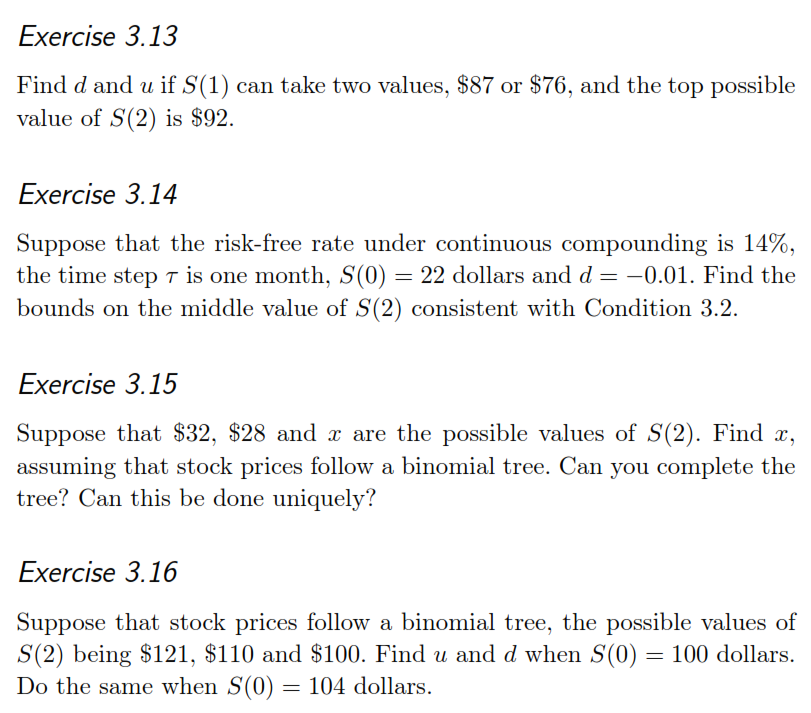
Exercise 3.13 Find d and u if S(1) can take two values, $87 or $76, and the top possible value of S(2) is $92. Exercise 3.14 Suppose that the risk-free rate under continuous compounding is 14%, the time step T is one month, S(0) = 22 dollars and d= -0.01. Find the bounds on the middle value of S(2) consistent with Condition 3.2. = Exercise 3.15 Suppose that $32, $28 and x are the possible values of S(2). Find x, assuming that stock prices follow a binomial tree. Can you complete the a tree? Can this be done uniquely? Exercise 3.16 Suppose that stock prices follow a binomial tree, the possible values of S(2) being $121, $110 and $100. Find u and d when S(0) = 100 dollars. Do the same when S(0) = 104 dollars. = = Exercise 3.13 Find d and u if S(1) can take two values, $87 or $76, and the top possible value of S(2) is $92. Exercise 3.14 Suppose that the risk-free rate under continuous compounding is 14%, the time step T is one month, S(0) = 22 dollars and d= -0.01. Find the bounds on the middle value of S(2) consistent with Condition 3.2. = Exercise 3.15 Suppose that $32, $28 and x are the possible values of S(2). Find x, assuming that stock prices follow a binomial tree. Can you complete the a tree? Can this be done uniquely? Exercise 3.16 Suppose that stock prices follow a binomial tree, the possible values of S(2) being $121, $110 and $100. Find u and d when S(0) = 100 dollars. Do the same when S(0) = 104 dollars. = =
Step by Step Solution
There are 3 Steps involved in it

Get step-by-step solutions from verified subject matter experts
 Study Help